What kind of exercise should you choose for weight loss? Understanding these two types will make your weight loss efforts twice as effective.
Introduction: No one can resist the allure of an enviable figure, and many people say goodbye to their former selves by losing weight. Diet and exercise are two crucial factors in the weight loss process; if you manage both well, successful fat loss becomes much easier. However, some people may still be confused about which exercise to choose and how to do it correctly.
Especially when faced with aerobic and anaerobic exercise, how should one choose between these two fitness methods? Below is a detailed introduction to these two types of exercise.

After reading this article, you will learn the following:
1. Aerobic exercise
2. Anaerobic exercise
3. Muscle strength strengthening training exercises
First: Aerobic exercise
Aerobic exercise can be considered exercise in which the body's oxygen supply and consumption are in balance. This type of exercise requires a relatively long duration, and the intensity is not moderate. During aerobic exercise, a significant proportion of the body's fat is used for calorie consumption.

At the same time, because aerobic exercise increases the body's metabolic rate, fat can continue to be burned for a period of time after exercise. However, it's important to note that aerobic exercise only produces good results when the exercise time is controlled to around 45 minutes. If the exercise time is only 20 to 30 minutes, it will not produce good fat-burning effects.
While aerobic exercise doesn't directly produce significant muscle growth, it can improve muscle endurance. Lactic acid is produced during exercise, and aerobic exercise helps slow down its accumulation. Through this process, muscle endurance gradually increases.

Aerobic exercise has the ability to expand the capillaries surrounding muscles. The more capillaries expand around muscles, the more nutrients they receive, while reducing the amount of metabolic waste produced. This is highly beneficial for muscle cell recovery.
Second: Anaerobic exercise
Anaerobic exercise is high-intensity and high-load, making it difficult to sustain for an extended period. It naturally leads to significant fatigue and the production of large amounts of lactic acid. Therefore, it's essential to allow time for rest after anaerobic exercise.
Anaerobic exercise is highly effective at increasing muscle mass and promoting muscle growth. While the breakdown of glucose is typically an aerobic process, during anaerobic exercise, aerobic metabolism cannot meet the body's needs, thus triggering anaerobic metabolism.

Anaerobic metabolism doesn't effectively burn fat, but that doesn't mean anaerobic exercise is useless for fat loss. Because anaerobic exercise engages muscles throughout the body, it does burn some fat.
Of course, incorporating more anaerobic exercises can engage various muscle groups, which is beneficial for fat burning. The more muscles involved in an exercise, the more calories are required, and the better the fat-burning effect.
Third: Muscle strength strengthening training exercises
Most people work out to achieve a more aesthetically pleasing physique, so simply focusing on fat loss isn't enough. Achieving a better physique also requires building muscle, making strength training essential. The following strength training exercises can serve as a reference.
1. Straight arm pulldown

First, separate your feet about shoulder-width apart, keeping your legs slightly bent, lean your upper body forward, and grab the rope with both hands.
Then, maintain proper body posture throughout the process, being careful not to sway your upper body, and pull the rope down with your arms straight.
Finally, when the rope reaches your abdomen, stop moving and continue to exert force to control the speed at which the rope returns to its original position.
Recommendation: 8 to 12 repetitions for each exercise, 3 to 5 sets each time.
2. Kneeling lat pulldown
First, kneel down with your buttocks in front of the rope device, hold the rope with both hands and stretch it upwards, making sure your entire back is taut.
Then, pull the rope device down with both arms, making sure your body doesn't sway, and pull the rope to the front of your chest.
Finally, after pulling the rope to the front of your chest, slowly move the rope upwards while maintaining the force of your body.
Recommendation: 8 to 12 repetitions for each exercise, 3 to 5 sets each time.
3. Half-squat rope rowing
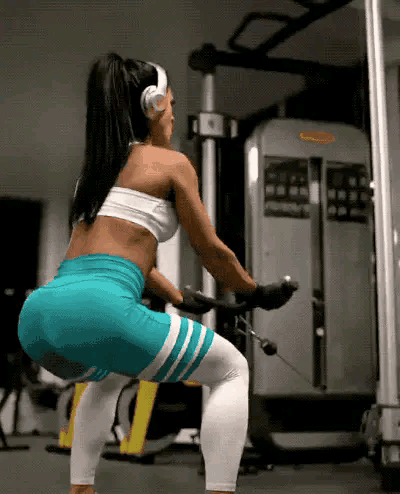
First, squat in front of the rope device, lean your upper body slightly forward, with the angle between your thighs and calves about 90 degrees, and grab the rope with both hands.
Next, while maintaining the stability of your legs and your entire body, pull the rope towards your body until it is about to touch your abdomen.
Finally, pull the rope until it is about to touch your abdomen, then use coordinated effort from your whole body to slowly return the rope to its original position.
Recommendation: 8 to 12 repetitions for each exercise, 3 to 5 sets each time.
In conclusion , both aerobic and anaerobic exercise have their limitations. Therefore, we should determine which type of exercise is best suited to us based on our own abilities. We should strive to maximize the effectiveness of our chosen exercise while minimizing its drawbacks.