Save this! The most comprehensive guide to common cauliflower diseases and pests, their control methods, and pesticide application.
Cauliflower, scientifically known as *Brassica oleracea var. cauliflower*, is an important vegetable crop in my country. Pests and diseases are major factors affecting cauliflower yield and quality. Below, we will discuss common pests and diseases affecting cauliflower and their control measures.
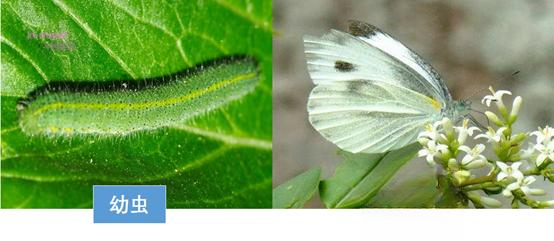
cabbage butterfly
The cabbage white butterfly primarily damages its larvae, also known as cabbage caterpillars. These larvae feed on the host plant's leaves; before the second instar, they only gnaw on the leaf tissue, leaving a transparent outer layer. From the third instar onwards, they devour the leaves, creating holes or notches. In severe cases, the entire leaf is eaten away, leaving only the coarse veins and petioles, leading to complete crop failure and increasing the risk of soft rot in cabbage. The larvae can also burrow into cabbage leaves, feeding voraciously on the heart of the cabbage head and contaminating it with their excrement, thus deteriorating the vegetable's quality, causing rot, and reducing both yield and quality.
Peak occurrence: The most severe damage occurs during the spring and autumn seasons of the year.
Prevention and control methods:
Biological control: In the early stages of young larvae, spraying with Bacillus thuringiensis or cabbage white butterfly granulovirus has a good control effect on cabbage white caterpillars. The best time to spray is in the evening.
Chemical control. Due to severe overlapping generations of cabbage caterpillars, larvae beyond the 3rd instar have increased appetite and resistance to pesticides. Spraying should be applied before the 2nd instar to eliminate them before the 3rd instar. Suitable pesticides include : emamectin benzoate, permethrin, abamectin, and trichlorfon.
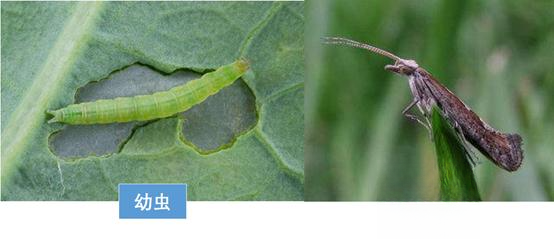
Diamondback moth
Early-instar larvae of the diamondback moth feed on the leaf mesophyll, leaving the epidermis behind and creating transparent spots on the leaves, resulting in holes. Third and fourth-instar larvae can eat holes and notches into the leaves, and in severe cases, the entire leaf can be eaten into a web-like pattern. During the seedling stage, they often concentrate their damage on the central leaves, affecting the formation of the heading stage. The diamondback moth can also damage tender stems, young pods, and seeds.
Peak occurrence periods: The diamondback moth's occurrence and damage clearly show two peaks throughout the year. The first is from mid-May to late June; the second is from late August to late October.
Prevention and control methods:
Physical control: Black light traps to kill adult insects
Sex pheromone trapping: Live female moths that have emerged on the same day or coarse extracts can be used to trap and kill male moths.
Biological control: Bacillus thuringiensis preparations can be diluted with water and sprayed. Protect natural enemies or release them after artificial rearing to control the diamondback moth.
Chemical control: diflubenzuron, abamectin, emamectin benzoate, trichlorfon, etc.
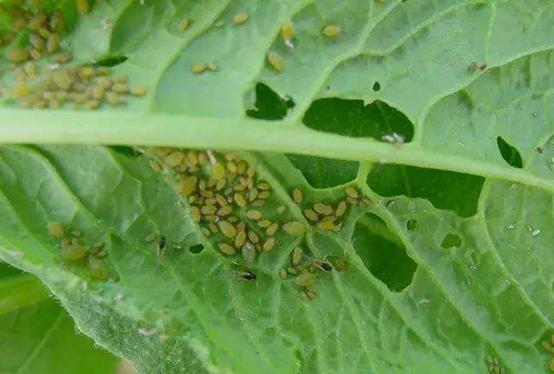
Aphids (cabbage aphid)
They have multiple generations per year, and in warm climates, they can reproduce parthenogenetically year-round. Both adults and larvae can feed on tender parts of crops, severely impacting the growth of cruciferous crops such as cauliflower.
Physical control: Taking advantage of aphids' strong attraction to yellow, yellow sticky traps can be placed in the field. Alternatively, the aphids' negative attraction to silver-gray (avoidance) can be utilized by hanging or covering the field with silver-gray film.
Chemical control: Imidacloprid, Acetamiprid, Matrine (Yake), Lambda-cyhalothrin, Thiamethoxam, Acetaminophen, Pymetrozine, etc.
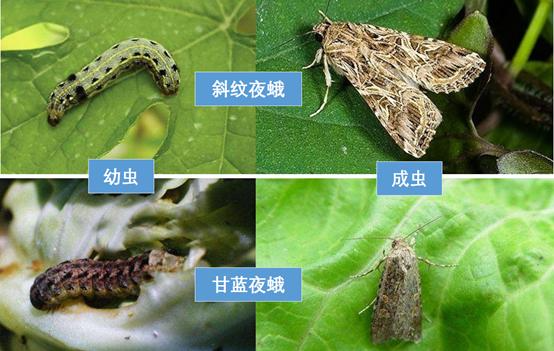
Cabbage looper/Spodoptera litura
They can eat the leaf tissue, leaving only the veins, and even peel off the bark of the stem. The larvae can migrate in groups, and when slightly disturbed, they will spin silk to fall to the ground, exhibiting feigning death. After the 3rd or 4th instar, they hide in the lower part of the plant or in soil crevices during the day, and move out to feed and cause damage in the evening.
It has 6-8 generations per year, with the peak occurrence in July and August, and even more so in years with high temperatures and drought. It often occurs alongside the diamondback moth, posing a significant threat to leafy vegetables. In cabbage and Chinese cabbage, it can bore into the head and heart leaves, excreting feces and causing pollution and rot, rendering the vegetables unmarketable.
Physical control: Adult insects can be attracted and killed using black light lamps or sugar-vinegar basins.
Chemical control: Ethyl spinosad, abamectin (such as chlorantraniliprole), chlorantraniliprole, indoxacarb, etc.
Downy mildew
Older leaves are most susceptible to the disease. When infected, indistinct yellow spots appear, gradually enlarging and becoming polygonal or irregular yellowish-brown to dark brown due to the restriction of leaf veins. Dark brown spots appear on the underside of the leaves, are more prominent and slightly raised, and a scattered white mold layer develops on the underside of the leaves under high humidity. In severe cases, the leaves wither and fall off.
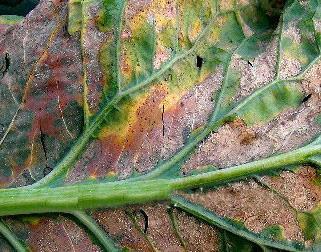
Control methods: In the early stage of the disease, you can use mancozeb (Bangjiawei), cymoxanil, dimethomorph, oxadiazon, etc. for spraying. Spray once every 7 to 10 days, and spray 2 to 3 times in a row.
Soft rot
It usually occurs in the later stages of flower head formation, mainly affecting the flower head, but can also damage the main stem and leaves. The affected area first appears as a waterlogged, translucent substance, then turns brown, soft, and rotten, producing a dirty white bacterial ooze. It feels slimy to the touch and has a foul odor.
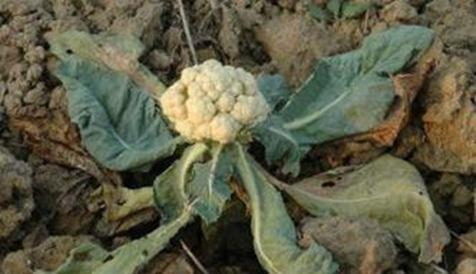
Prevention and control methods: In the early stage of the disease, you can use kasugamycin, streptomycin sulfate, allicin (Jing Shuang), copper hydroxide, etc., once every 7 to 10 days, for 2 to 3 consecutive sprays.
Black rot
When the disease occurs in seedlings, the cotyledons become water-soaked and then quickly wither and die, or the infection spreads to the true leaves. It first appears at the leaf margins, with "V"-shaped yellow (reddish-brown) spots appearing at the tips of the veins along the leaf edges. These spots gradually cover the entire leaf margin, forming a rounded, wavy yellow (reddish-brown) band on the surface.
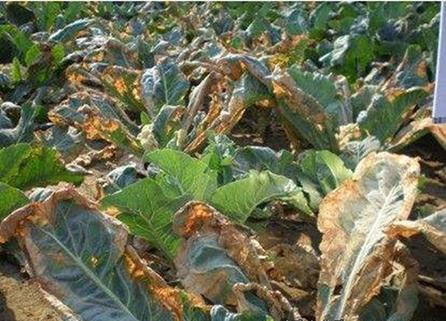
Prevention and control methods: In the early stage of the disease, spray with fungicides such as kasugamycin, copper oxychloride, copper oxychloride, copper hydroxide, or streptomycin sulfate. Apply the fungicide once every 7-10 days, for 2-3 consecutive sprays.
Gray mold
It commonly occurs in greenhouses during winter and early spring. It can occur at both the seedling and mature plant stages. In seedlings, the disease causes water-soaked rot with a gray mold layer. In mature plants, the diseased tissue rapidly dies and rots. "V"-shaped or irregular necrotic spots form on the leaves, and a gray mold layer develops on the diseased areas when the air is humid.
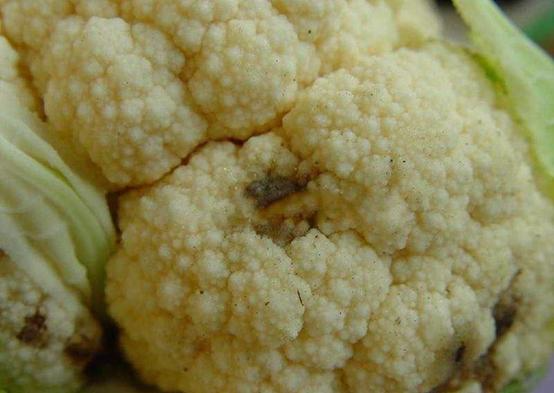
Control methods: In the early stages of the disease, spray with fungicides such as tebuconazole, iprodione, pyraclostrobin, prochloraz (Xiuguang), and pyrimethanil . For greenhouse cultivation, smoke agents or dust agents can be used for control.
Sclerotinia stem cell disease
In the early stages of the disease, water-soaked, light brown lesions appear. The edges are indistinct, the affected tissue is soft and rotten, and white or grayish-white cottony mycelium is present on the lesions, forming black, rat-dung-like sclerotia.
Spray protective agents in the early stages of the disease, focusing on the base of the plant stem, old leaves, and the ground. Suitable agents include thiophanate-methyl and iprodione .
Finally, a reminder to all farmers: when choosing pesticides for pest control, if local pests and diseases have developed resistance to certain pesticides, be sure to rotate the pesticides. It is best to choose pesticides with different mechanisms of action to avoid cross-resistance!