Pests and Diseases | Common Pests and Diseases of Sichuan Pepper Trees and Their Control Methods
Pests and diseases are very common during the growth of Sichuan pepper, and can affect its quality and yield. Therefore, farmers need to take preventive measures. This article introduces common pests and diseases of Sichuan pepper and their control measures for your reference.
1. Sichuan pepper cotton aphid
These insects often cluster on the tender leaves and young shoots of Sichuan pepper trees, sucking sap and causing leaf curling, flower and fruit drop. Their sticky honeydew excretions can also induce sooty mold and impair the photosynthetic efficiency of the leaves. Damage begins from late April to early May, with a symptom drop every 8-10 days. Control methods include spraying every 10 days during the outbreak period with alternating applications of 40% dimethoate (1:500x dilution), 40% methamidophos (1:1000x dilution), and 50% chlorpyrifos emulsion (1:4000x dilution), for 2-3 consecutive applications to control the damage.
2 Kuwahakusuke
It mainly damages branches and trunks, and in severe cases, it can cause branches and trunks to die. Overwintering female adults can be controlled by spraying with 50 times diluted machine oil emulsion or 5 Baume lime sulfur mixture before bud break; newly hatched nymphs can also be controlled by spraying with 100 times diluted machine oil emulsion plus 1,000 times diluted 40% dimethoate in May-June and July-August.
3. Longhorn beetles
The larvae primarily bore into branches and roots, with a generation cycle of approximately two years, making them a devastating pest of Sichuan pepper. Control methods include whitewashing the trunk, manually capturing adults, killing eggs, hooking and killing larvae, or inserting zinc phosphide poison sticks into the borer holes. Alternatively, 80% dichlorvos at a dilution of 500 times can be injected into the borer holes. During the peak adult emergence period, spraying with dimethoate at a dilution of 1000-1500 times or dichlorvos at a dilution of 1000 times will kill the adults before they lay eggs.
4. Flea beetles
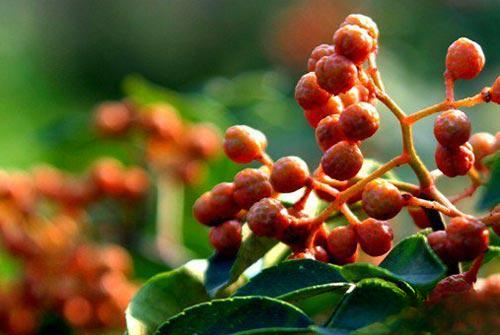
The insect primarily damages leaves, and some larvae also bore into the kernels, inflorescence stalks, and petioles of young pepper fruits (Female II Sichuan pepper red-legged flea beetle). It is a major pest causing fruit drop, leaf wilting, and significant yield reduction. For control, during the leaf expansion stage of Sichuan pepper trees, spray the canopy and ground with 2000 times diluted fenitrothion or deltamethrin to kill overwintering adults emerging from the soil. Alternatively, during the peak larval emergence period in late May, spray the canopy with 1500 times diluted dimethoate or 800-1000 times diluted phosphatidylcholine emulsifiable concentrate to kill larvae.
5. Pepper rust
It damages the leaves. From June to August, spraying with 0.3-0.4 Baume lime sulfur mixture or 15% triadimefon at a dilution of 1000-1500 times 2-3 times can control the occurrence and damage of rust.
6. Sichuan pepper black shank disease
Also known as gummosis, this is a common disease in pepper-producing areas. It primarily affects the base of the trunk or main stem. In severe cases, it also damages branches and is a major cause of tree death. Control methods: ① Before planting susceptible varieties such as Da Hong Pao, soak the root collar in a 10-fold dilution of 40% aluminum phosphide or a 20-fold dilution of 70% mancozeb before planting. For established pepper trees, drench the roots once in late March and once in early June with a 200-300-fold dilution of 40% aluminum phosphide or 70% mancozeb, followed by mounding soil. This can control the disease. ② Using highly resistant varieties such as August pepper and wolf pepper as rootstock, grafting high-position (about 30 cm above the ground) Da Hong Pao and other high-quality varieties using the woody bud grafting method can effectively prevent the occurrence of this disease.