Pest control techniques in organic farming
Pest control techniques in organic farming
The principles of pest control techniques can be broadly summarized as follows:
Timing, location, and dosage of control measures. Timing refers to the need for control measures when the pest population density is still low in the early stages of infestation, usually with the economic injury level as the upper limit. The economic injury level varies depending on the pest species and the control method.
Timing is crucial; a thorough understanding and monitoring of the dynamics and characteristics of pest populations is essential for timely intervention and proactive control. The location of control depends on the pest's stage of development, its habitat, and feeding habits. For example, lepidopteran pests are primarily in their larval stage, while smaller pests such as aphids, whiteflies, thrips, and spider mites can cause damage at any stage except the egg stage. Some are difficult to detect, hiding in leaf veins or other crevices, while others bore into stems or fruits, making them hard to reach. Therefore, it is necessary to understand their biological characteristics and life habits, and to use effective pesticides, natural enemies, or other methods targeting key pest stages. Correct treatment sites are essential to avoid wasting manpower and resources.
Dosage directly impacts control costs, including the amount used per unit area and the application interval. Natural and biological pesticides may require more frequent application intervals than general chemical pesticides due to their higher volatility or susceptibility to environmental factors such as temperature, humidity, and ultraviolet radiation.
Biological control methods depend on the types of natural enemies used. For example, the corn borer wasp (Trichogramma ostriniae Pang & Chen) takes about 10 days from egg to adult at 25°C, so it should be released in the field about once a day. The larval stage of the lacewing (Mallada basalis (Walker)) is about 14 days, so it should be released every 10-14 days. This allows for slight overlap in the instars of natural enemies, preventing gaps in their lifespan.
Properly implementing these three principles can yield twice the results with half the effort. A thorough understanding of pests is paramount in pest control; the simpler the pest population, the easier it is to control. Good netting facilities can isolate some larger pests, such as moths, butterflies, and scarab beetles, thus simplifying the pest population, and can also delay the invasion and population growth of smaller pests such as aphids, whiteflies, thrips, and spider mites.
I. Taking the control of the Asian corn borer in super sweet corn as an example
1. Pest Profile:
The types of pests causing economic losses to corn are relatively simpler than those of other crops. Before germination, birds peck at the seeds; carefully covering the seeds with soil during sowing to prevent exposure can reduce this. In the early whorled stage after germination, seedlings are susceptible to damage from corn borers; extending the soaking time, increasing the number of times the soil is turned over, and extending the sun exposure time during land preparation before sowing, as well as removing nearby weeds, can reduce the risk of pest intrusion from neighboring fields. From about 2-3 weeks after germination until harvest, the Asian corn borer (Ostrinia furnacalis (Guenee)) is the main pest, with occasional occurrences of the beet armyworm (Spodoptera exigua Hubner) or the corn ear borer (Helicoverpa armigera (Hubner)), but these are usually not severe.
2. Population dynamics:
Corn borer egg masses are found in the early whorled stage about 2-3 weeks after corn germination and continue until harvest. Each egg mass contains an average of more than 30 eggs. After hatching, the larvae begin to cause damage and can disperse to damage neighboring plants.
3. Habitat and Feeding Sites
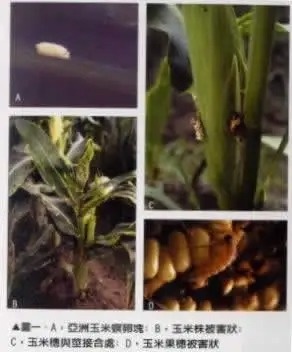
(Figure 1):
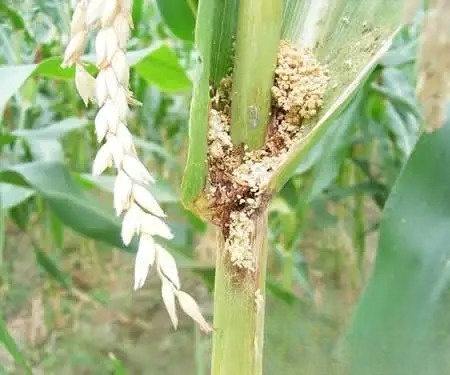
The Asian corn borer lays its egg masses on the underside of leaves. The larval stage is the period of damage, initially feeding on leaf tissue or the leaf axis after hatching. Later, or after the second instar, they bore into the stem from the heart leaf or the junction of the leaf and stem. After the male flower emerges, they damage the stamens and feed on the pollen. When the female ear silks, they feed on the silks, and then bore into the ear from the base of the silks or the junction of the ear and stem, or move from the stem into the ear to bore into the kernels and ear stalks.
4. Prevention and control techniques:
Control measures should be implemented as soon as moth egg masses are found in the field.
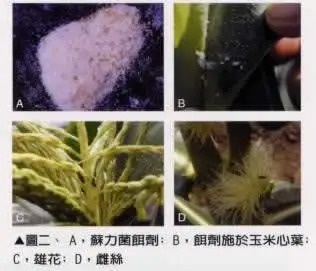
| (1) | Biological agents: Bacillus thuringiensis bait or Bacillus thuringiensis wettable powder plus spreading agent. Apply the agent locally to the heart leaves, male flowers, female filaments, and the junction of the fruit spike and stem (Figure 2). Use 20 kg of bait or about 1 kg of wettable powder per hectare per application. Apply once a week until harvest. |
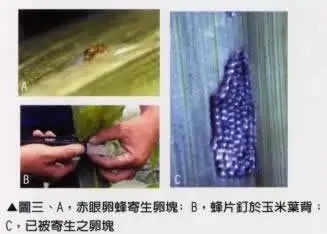
| (2) | Biological enemies: Place a piece of wasp containing approximately 1000 corn borer egg-laying wasp pupae on the underside of leaves (Figure 3), using 150 pieces per hectare per time, evenly distributed throughout the field. Repeat weekly until 7-10 days before tasseling, for at least three consecutive weeks. Ear protection significantly impacts economic value; therefore, control is particularly crucial from silking to harvest. At this time, in addition to larvae that bore into the ears from the stem, newly emerged adults can lay eggs on or near the silk and ear, burrowing into the ear from the silk or the junction of the ear and stem, causing damage. Their population density is also higher at this stage and should not be overlooked. The parasitism rate of corn borer egg masses surveyed 7-10 days before tasseling shows little difference between areas with and without wasps due to the dispersion and natural occurrence of the wasps; therefore, wasp release should be stopped at this point. The combined use of these two control methods yields better results. A few fish may escape the parasite from the egg masses of the pyralid moth and hatch, and the bait can just catch and kill them. At the same time, it can also catch and kill the occasional beet armyworm and tomato armyworm, which has a complementary effect. |
Biological enemies under development by the Agricultural Research Institute
For pests that are currently widespread or serious, the Agricultural Research Institute will conduct experiments and evaluations on effective biological natural enemies collected from domestic fields or introduced from abroad, assessing their biology, rearing methods, and control effects and techniques. Some have already been applied in the field, but the mass breeding and application techniques for many species are still under research and improvement. The following is a brief introduction to the life habits and application techniques of predatory and parasitic natural enemies as examples.
I. Predatory Natural Enemies
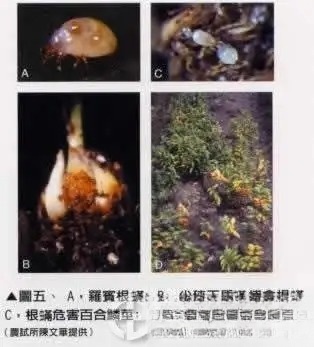
1. Basic Lacewing:
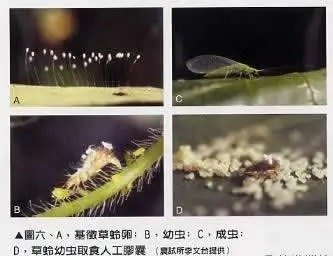
(Figure 6) It can prey on various small pests such as leaf miners, whiteflies, spider mites, scale insects, and aphids. At 25-28°C, it takes about 20-25 days from egg to adult; high temperatures are detrimental to its hatching rate. The egg stage lasts about 4-5 days, the larval stage about 14 days, and the pupal stage about 7 days. Adults can maintain their lifespan for 3-4 months by feeding on honey and brewer's yeast powder, laying more than 1000 eggs in their lifetime. The Agricultural Research Institute has successfully developed artificial microencapsulated feed and mass production technology for lacewings, which can provide for large-scale pest control at any time. Releasing them at the early stage of crop planting or the early stage of the above-mentioned pests can delay the growth of pest populations. It is advisable to release larvae or eggs that are about to hatch to prevent ants from preying on them. The release amount varies depending on the crop type, and it should be released once every 10-14 days.
2. Anchor Ladybug:
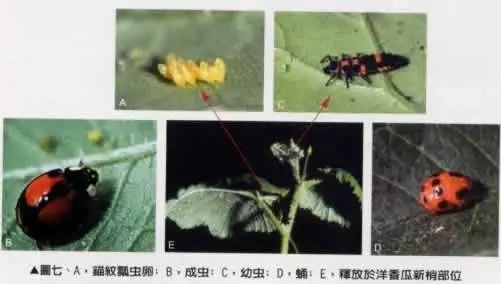
(Lemnia biplagiata (Swartz) (Figure 7)
Both larvae and adults prey on various aphids that damage fruits and vegetables, such as cotton aphids, peach aphids, false cabbage aphids, white-tailed red aphids, and citrus aphids, with a high predation rate. At 25°C, the egg, larval, and pupal stages take approximately 3-4 days, 7-8 days, and 4-6 days respectively. Adults typically live longer than 3 months and can lay over 1000 eggs in their lifetime. Aphids have short development periods; for example, cotton aphids at 25°C take only 5 days from birth to maturity and reproduction. They can also reproduce parthenogenetically, developing into large populations in a short time. Therefore, control measures should be taken at the early stages of infestation. Ladybug larvae or eggs about to hatch can be released, primarily onto newly emerging tender leaves. The release rate varies depending on the crop type, approximately once every 7 days.)
3. Southern Black Flower Elephant:
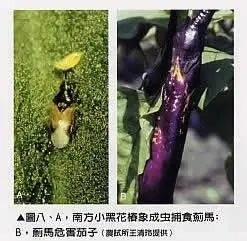
(Orius strigicollis (Poppius) (Figure 8)
Both nymphs and adults prey on small pests such as thrips, whiteflies, spider mites, and aphids. At 25-27°C, the egg stage lasts approximately 3-4 days, with eggs laid inside tender plant tissues, only a white egg cap visible on the surface. Hatching to adulthood takes about 12 days, with female adults living for over 30 days and laying 200-400 eggs. A female can prey on 200-300 thrips or 500-600 spider mites in her lifetime. Taking the common yellow thrips (Thrips palmi Karny) as an example, which commonly damages fruits and vegetables, the eggs are laid inside plant tissues and hatch in about 4-5 days. The larval stage lasts about 3-4 days, the pupal stage about 5-6 days, and the adult lifespan is over 20 days. Larvae and adults mainly feed on the undersides of leaves, but in high densities, they also feed on flowers.)
II. Parasitic natural enemies
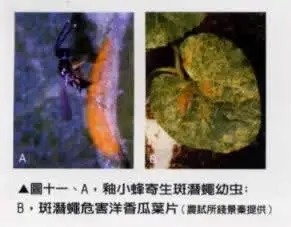
Chrysocharis pentheus (Walker) and Chrysonotomyia okazakii (Kamijo) are effective parasites of the common vegetable leafminer (Liriomyza bryoniae (Kaltenbach)) and tomato leafminer (Liriomyza bryoniae (Kaltenbach)). Hemiptarsenus varicornis
(Girault) and Neochrysocharis formosa (Westwood) are dominant parasites of the African daisy leafminer (Liriomyza trifolii (Burgess)). Leafminers occur from the early stages of crop planting to harvest, have a short development period, high reproductive capacity, and when their density is high, they severely affect the appearance of plant leaves and photosynthesis. For example, the African daisy leafminer at 25°C... The egg, larva, and pupal stages of the female insect take approximately 3, 5, and 9 days, respectively. The lifespan of the female adult varies from 14 to 24 days depending on the number of matings, and she can lay up to 500 eggs or more.
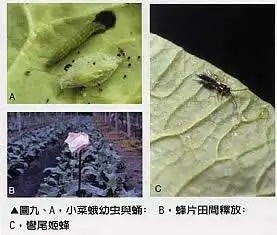
The Oriental whitefly
(Eretmocerus orientalis Silvestir) (Figure 10) is the silver leaf wasp (Bemisia argentifolii Bellows & Perring), the most common species of parasitic wasp in the region. The time from egg to adult emergence varies seasonally, approximately 14-30 days, with an adult lifespan of about 18 days. In addition to parasitizing, female adults also feed on whitefly nymphs, parasitizing 100-200 nymphs and feeding on 50-80 in their lifetime. The silver leaf wasp is an important pest of horticultural crops, widely distributed worldwide, with over 500 host plant species. Population development is rapid with overlapping instars; at 25°C, the time from egg to emergence is approximately 27 days, and the female adult lifespan is about 19 days, laying approximately 113 eggs.
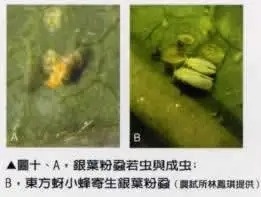
Control of diamondback moth: Three parasitic wasps
(Plutella xylostella L.)
are available: Cotesia plutellae Kurdjumov, Diadegma semiclausum Horstmann, and Diadromus collaris Gravenhorst.
The diamondback moth is an extremely difficult pest to control on cruciferous vegetables. Recorded as early as 1746, it is considered the leading pest of cruciferous vegetables in the Asia-Pacific region, and its importance has been increasing in Europe and America in recent years. This insect has approximately 20 generations per year, with significant generation overlap. The egg, larval, and pupa stages take 3, 9, and 4 days respectively, and the female adult's lifespan is about 6 days. It can lay nearly 100 eggs in its lifetime, and its population grows rapidly. Invasive adults begin to lay eggs after vegetables sprout or are transplanted. Eggs are mostly laid on the underside of leaves in depressions along the veins. Early-instar larvae feed on the epidermis and mesophyll tissue on the underside of the leaves, leaving translucent feeding marks on the upper epidermis; these marks become perforated after the second instar. Although it can inhabit the entire plant, it prefers to feed on tender leaves.
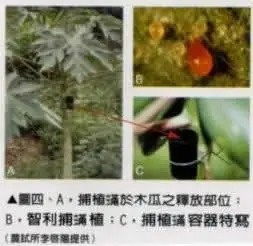
Because the parasitism of Braconid wasps in the field initially increases and then decreases, while the two ichneumon wasps show a steady increase, all three parasitoids can be used in combination in the field. Use Braconid wasps in the early stages and ichneumon wasps in the middle and later stages. Release wasp pupae or adults. Fix wasp fragments containing pupae or containers containing adult wasps to an object about 1 meter off the ground (Figure 9) to prevent ants from preying on them. Release approximately 2000-2500 wasps per hectare each time, releasing Braconid wasps once in the early stages of vegetable planting and ichneumon wasps once in the middle and later stages.
Conclusion
To avoid pesticide residues, biological control is the most acceptable method for pest management. However, the effects of natural enemies are usually slower than those of conventional pesticides, require stricter thresholds for economic damage, and necessitate earlier intervention. A thorough understanding of the various pests to be controlled, including their habits and population dynamics, is essential, along with continuous monitoring and timely, appropriate control measures. Because the relationship between natural enemies and target pests is one of ecological balance, biological control methods rarely eradicate pests completely. A small number of surviving pests may cause minor defects in the appearance of agricultural products, or even leave visible traces; consumers must be accepting of this. Only in this way can the promotion of biological control be facilitated.