Nursery Doctor: Prevention and control of diseases and pests such as grubs, mealybugs, and dampingoff in golden privet.
Golden privet is an indispensable colorful foliage plant in urban landscaping. This paper summarizes the occurrence patterns and control techniques of several of the most common and serious pests and diseases.
Insect damage

grub
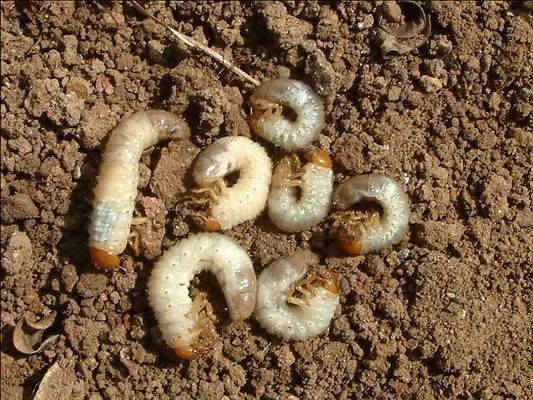
Symptoms of harm:
Grubs are the larvae of scarab beetles that feed on the roots of golden privet. The above-ground parts of the affected plant initially wilt due to water shortage. If sufficient water is provided and the ground is kept moist, the plant will not die, but its growth will be very weak. Otherwise, the plant will gradually dry out and die. Affected plants are easily pulled out, and the root bark below ground is eaten. Plants with sufficient water will only grow a few new roots close to the soil surface. Observations have shown that golden privet is a prime prey for grubs. In areas where red barberry, large-leaved boxwood, Henan juniper, and Chinese juniper are planted, only golden privet shows significant damage. In severely affected areas, large areas of plants often die.
Prevention and control methods:
(1) When planting seedlings, use compost or manure as base fertilizer, and apply it after it has been fully decomposed.
(2) When the affected area is small, the affected seedlings can be pulled out and the larvae near the roots of the seedlings can be dug out. The area to be dug out should be appropriately increased.
(3) Take advantage of the adults’ feigning death behavior to capture or shake them off and kill them from the crops where they land; or take advantage of their phototaxis to lure and kill the adults with black light.
(4) When adult insects are feeding and causing damage, spray with insecticides such as 4.5% high-efficiency cypermethrin at 1000-1500 times dilution, 50% phoxim EC at 1000 times dilution, or 15% chlorpyrifos at 1000 times dilution to kill the adults; during the larval stage, drench the roots of seedlings with 50% phoxim EC at 1000-1500 times dilution or 900-1000 times dilution of 90% trichlorfon. Our practice is to drench the affected areas with phoxim once in early June and again in early July. Through these two drenchings, the pests were completely eliminated.
Pink Scale
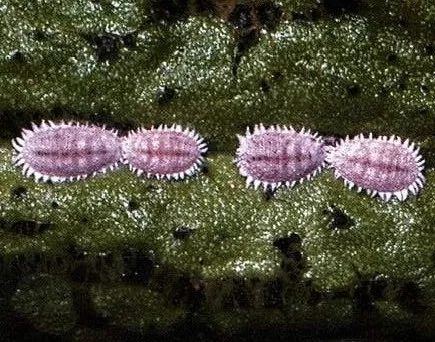
Symptoms of harm:
Adult and weak insects pierce and suck plant sap. In severe cases, the branches and trunks are covered with insects, resulting in weak growth, susceptibility to diseases such as sooty mold, and impaired growth. Sometimes, it can even cause death. It is a pest that is both difficult to control and causes serious damage.
Prevention and control methods:
(1) Thoroughly remove and burn fallen leaves in winter and spring to greatly reduce the number of insects; use a stiff brush to remove egg sacs from rough bark seams and peeling bark.
(2) Focus on the first generation and spray twice consecutively during the first generation for significant control effect; spray again during the hatching and damage period of each generation of nymphs. The pesticides used include insecticides such as toxic scale, chlorpyrifos, scale insecticide, and quick-kill insecticide. Spray evenly and add 0.1% neutral detergent when spraying to increase the efficacy.
Diseases
Privet brown spot disease
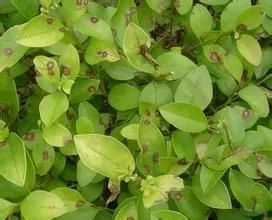
Symptoms:
Privet brown spot disease primarily affects the leaves of privet. In the early stages, small reddish-brown spots appear on the leaves, surrounded by a purple halo, and black mold grows on the spots. As the disease progresses, several spots can merge together, eventually causing the entire leaf to scorch and fall off.
Prevention and control methods:
(1) Avoid continuous cropping. Before planting, disinfect the soil with pentachloronitrobenzene or formalin.
(2) Strengthen water and fertilizer management, avoid excessive application of nitrogen fertilizer, and ensure that the planting area is not waterlogged;
(3) If it occurs, spray with 800 times dilution of 75% chlorothalonil wettable powder or 1000 times dilution of 70% thiophanate-methyl wettable powder for prevention and control. Spray once every 7 days and spray 3-4 times to effectively control the disease.
Coal pollution disease
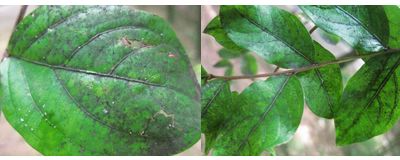
Symptoms:
Sooty mold damages the leaves and branches of privet. In the early stages of the disease, circular black mold spots appear on the leaves, some of which spread along the midrib. These spots gradually increase in number, forming large black patches, thus affecting the photosynthesis of the leaves.
Prevention and control methods:
(1) Strengthen pruning and maintain ventilation and light penetration;
(2) Timely prevention and control of Shanxi mealybug and Comstock mealybug;
(3) If it occurs, it can be controlled by spraying 75% chlorothalonil wettable powder at 800 times dilution, 70% mancozeb at 400 times dilution, or 50% thiophanate-methyl wettable granules at 600 times dilution. Spray once every 7 days for 3-4 consecutive times to effectively control the disease.
Damping-off
Symptoms:
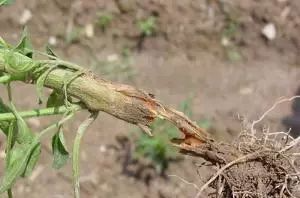
When golden privet is infected with this disease, the first symptoms are wilting and loss of luster of the leaves, which gradually turn yellow and die. The bark of the branches and trunks is very easy to peel off, and the underground fibrous roots die and break easily.
Prevention and control methods:
(1) The soil should be disinfected before planting;
(2) Do not introduce seedlings carrying diseases;
(3) In the early stage of the disease, irrigate with 300 times dilution of 75% chlorothalonil wettable granules or 500 times dilution of 70% thiophanate-methyl, once every 10 days, for 3-4 consecutive times, which can effectively control the disease.
(4) Remove diseased seedlings in time and burn them.