Methods for controlling diseases and pests in roses
Methods for controlling diseases and pests in roses
Roses come in a wide variety of varieties and vibrant colors, making them the queen of flowers. They are characterized by their richly layered blooms, vivid colors, and continuous blooming throughout the year.
1. Powdery mildew
This disease is one of the most common and important diseases in rose cultivation. After infection, a dense white powdery substance appears on young shoots, leaves, and flower buds, causing leaves to curl, shoots and petioles to become deformed, and flower buds to be destroyed and unable to open. It spreads most rapidly under conditions of high humidity, low light, poor ventilation, and a diurnal temperature range exceeding 10 degrees Celsius. In the Beijing area, the disease is most prevalent in May and September. In Jiangsu and Zhejiang provinces, the disease begins in mid-to-late March and ceases until mid-to-late November. In greenhouse cultivation, the disease can occur year-round.
Prevention and control methods: Spray with 65% zineb at 600 times dilution when the buds first sprout, and then spray once every 7-10 days for 3-4 consecutive times; pay attention to ventilation and light, increase the application of phosphorus and potassium fertilizers to enhance disease resistance; spray with 70% thiophanate-methyl at 800-1000 times dilution at the initial stage of disease.
2. Black spots
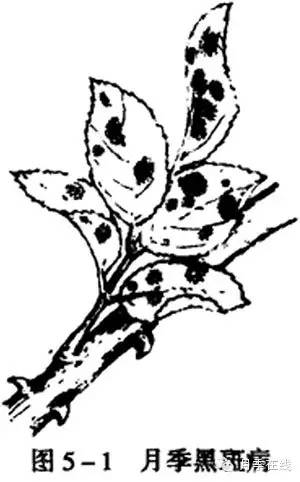
This disease is prevalent throughout China and is highly destructive. When infected, irregular purplish-brown spots appear on the leaf surface, which then rapidly expand into circular or nearly circular dark brown lesions with radiating edges and an uneven perimeter. The lesions are 13-15 mm in diameter. Recently, many small dark brown dots have appeared scattered on the lesions, and the surrounding leaf tissue sometimes turns yellow over a large area. The lesions often merge into one large patch, causing the leaves to wilt (Figure 5-1).
Under humid conditions, the fungal spores spread through rainwater or spraying, therefore, this disease spreads most easily during rainy seasons or when the relative humidity is high. In the Beijing area, the damage is most severe between July and September, while in the Jiangsu and Zhejiang areas, the disease can appear as early as mid-May, with the most severe outbreaks occurring during the plum rain season and the continuous autumn rains.
Control methods: Remove and burn diseased leaves promptly, and keep the ground environment clean. Minimize watering during the disease period to avoid wetting the leaves and creating suitable conditions for spore invasion. During the disease season, spray with 25% carbendazim at a dilution of 500-800 times once a week. This fungicide is systemic, resistant to rain washout, and has a good bactericidal effect. After the onset of the disease, spray with 70% thiophanate-methyl at a dilution of 800-1000 times immediately.

3. Rust
This disease affects leaves, stems, and flower buds. After infection, orange-yellow uredinia and black telia appear on the leaves, causing severe damage and leaf drop. The pathogen spores spread with air currents and rainwater, germinating rapidly on damp leaves and invading the host cells.
Control methods: Spray with 300 times diluted sodium chlorate solution after the onset of the disease; other control methods are the same as for black spot disease.
4. Rot disease
This disease primarily affects two-year-old branches, causing brown spots with purple surrounding areas, and black dots appearing on older lesions. In severe cases, nutrient flow to the plant is obstructed, leading to the withering of upper branches, leaves, and flowers. The pathogen typically enters through pruning cuts or wounds inflicted during grafting.
Prevention and control methods: Take care to avoid damage to branches or frost damage; thoroughly scrape off the affected parts, collect and destroy them, and apply 70% carbendazim at 800 times dilution.
5. Root and neck tumors
After infection, abnormal tumors develop on the root collar or grafting site, hindering seedling growth, weakening the plant, and affecting flowering.
Control methods: Disinfect the rootstock with 2% lime water before grafting, then rinse with clean water. Promptly remove affected plants and disinfect the soil with 1% formalin solution.
6. Aphids, spider mites
The main aphids that damage roses are the rose aphid and the peach aphid. The wingless female rose aphid has
a reddish-brown head and thorax, red eyes, a dark yellow abdomen with black spots on its back. The winged female has a yellowish-green head and thorax, a bright green abdomen, and transparent wings. Rose aphids reproduce ovoviviparously, with 20-30 generations per year. Aphids reproduce rapidly in early spring, with larger aphids congregating on newly sprouted, juicy buds, shoots, and leaves to suck nutrients. Affected areas turn brown, leaves curl, and shoots bend, severely impacting the growth and development of new branches.
Spider mites are more dangerous than mites. They reproduce rapidly during hot, dry seasons. They prefer to congregate on the undersides of older leaves, spinning webs and sucking sap from the cells. Infestations cause small yellowish-brown spots, and in severe cases, large numbers of leaves can wither and fall off within a short period.
Control methods: Spraying with a 1000-1500 times dilution of 40% dimethoate emulsion or a 60-fold dilution of tobacco lime water can control both aphids and spider mites. When controlling spider mites, it is best to spray the undersides of the leaves with water before spraying to wash away dirt and silk-like substances, which will improve the effectiveness of the pesticide. When spraying, be sure to spray the pesticide evenly and thoroughly onto the undersides of the leaves.
7. Rose Leaf Bee
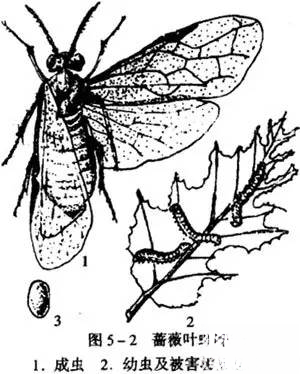
Also known as the yellow-bellied leaf beetle. The adult is about 7.5 mm long, with black wings, a black head, thorax, and legs, and a yellow abdomen. The larvae are yellowish-green, about 20 mm long, with a pale yellow head (Figure 5-2).
In the Beijing area, there are two generations per year. The first generation of larvae peaks in June, and the second generation in August. The larvae often congregate in groups of dozens on leaves to feed and cause damage. In severe cases, they can completely devour the leaves, leaving only the thick veins.
Control methods: In winter and spring, dig out cocoons in the soil near the affected plants to kill overwintering larvae; in the early stages of larval emergence, manually capture them or spray with 1000-1500 times dilution of 50% fenitrothion emulsion.
8. Golden Beetle
There are many species of scarab beetles that damage roses, including the green scarab beetle, the small blue-flowered scarab beetle, the white-spotted scarab beetle, and the blue-flowered scarab beetle. Most species begin feeding on tender leaves and flower buds in spring, with the most damage occurring in summer and autumn. They often eat large quantities of tender leaves, buds, and flowers, and especially like to burrow into light-colored flowers to feed.
Control methods: Utilize their feigning death behavior by manually shaking branches in the early morning, late evening, or during the day to collect and kill the fallen insects; during peak adult emergence
, spray with a 1000-fold dilution of 40% dimethoate emulsion, or spray with a solution of fresh plantain soaked in water diluted 5 times; utilize phototaxis by using lights to trap and kill the green scarab beetle. Utilize phototaxis to trap and kill the white-spotted scarab beetle.
9. Scale insects
Commonly known as rose lice. The main scale insects that damage roses include the rose-like white-scaled scale and the cottony cushion scale. The female adult rose-like white-scaled scale is about 1.3 mm long, purplish-red,
with a very swollen anterior part. The scale is grayish-white and nearly round. Nymphs and adults cluster together and attach themselves to branches, using their stylets to pierce the host tissue and suck sap, which can cause the entire plant to wither and die in severe cases.
Control methods: For small infestations, brush or peel them off with bamboo strips; for large infestations, spray with a 1000-fold dilution of 40% dimethoate emulsion at the early stage of nymph hatching. Spray once every 7-10 days, for 2-3 consecutive times.
10. Other pests
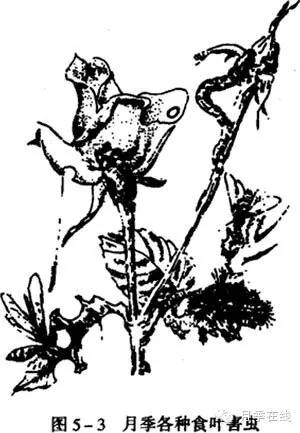
Caterpillars, loopers, leafrollers, tussock moths, bagworms, and longhorn beetles (Figure 5-3) can all damage roses, biting and eating away at the leaves, leaving only the veins. Loopers will also burrow into flower buds and feed on them, destroying the buds and preventing them from opening. Longhorn beetle larvae feed on the xylem, causing the upper branches and leaves to wither or break in strong winds. They can be controlled by manual removal or by spraying pesticides such as dimethoate and dichlorvos.