Learn simple magic tricks
I. Basic card drawing and cutting
Starting from this chapter, we will begin learning basic techniques. Although these techniques may seem simple, they are the foundation of all derivative techniques (I use the word "they" here, yes, they are, just like how your high school Chinese teacher explains why we call our motherland "Motherland." To reiterate, remember to study cultural knowledge while playing!). In later texts, if we mention anything covered in the basic techniques, we will not go into detail again. If you forget, you can refer back to it.
Before we begin, let me emphasize the most important point, like a martial arts manual: all techniques require diligent practice to master and use freely. Alright, enough chit-chat, let's begin. Be patient, and have a pleasant journey!
(a) The normal way to hold the deck
1. Holding (taking) the card with the left hand
With your left palm facing up, your thumb is on the left side of the card and parallel to the side of the card, your index finger is on the top of the card, and the other three fingers are on the right side of the card to hold it firmly. Note that the card is suspended above the palm, not pressed on the palm. Of course, it can also be called the Dealers Grip, but it's a bit long, so from now on, all tutorials here will refer to it as the left-hand card holding method.
2. Holding (taking) the card with the right hand
Hold the card at the bottom with your right thumb, the top with your middle and ring fingers, bend your index finger and place it on the card, and spread your little finger out in the air.
(ii) Standard deck cutting method
1. Cut the cards on the table
Place the dick on the table, pick up the top half with your right hand and place it on the right side, then pick up the remaining part and stack it on top of the dick on the right. That's it, simple, right? But don't be as careless as you were when you learned steps one, two, and three, or it will gradually become complicated. Watch carefully!
2. Pull out the cards
Hold the cards in your left hand, as I just mentioned. Use your right thumb and middle finger to hold the lower half of the Buck on both sides under the Dike, pull it out, and stack it on top of the remaining cards. It's that simple.
3. Side-cut cards
This is a little more complicated, but don't worry, it's just a little bit. Hold the cards in your left hand, making sure the method is correct. If you're unsure, go back and review the previous steps. Bend your index finger and place it on the back of the card, pressing it down. At the same time, use your thumb to apply pressure from the left side of the deck towards your index finger, slightly bending the top left corner of the deck. Then move your thumb downwards (towards your index finger), causing the top left corner of the cards to spring up one by one. Stop when it's about halfway up. Then, pick up the top half of the deck separated by this action with your right hand. Simultaneously, flip the deck in your left hand (flipping around the right side of the deck, using your index finger and the other three fingers for assistance, rotating about 30 degrees). Place the deck in your right hand below the deck in your left hand, stacking them to finish. Although it sounds complicated, it's actually very simple, and this card-cutting action looks really cool!
II. Terminology of Poker Magic
Terms and Conventions
For ease of explanation later, the poker terminology and conventions to be used will be placed at the beginning. This part is short but very important.
Descriptions of hands often include terms like left hand, right hand, thumb, index finger, middle finger, ring finger, little finger, and palm. These are easy to understand.
Regarding the playing cards, I'll continue using the terminology used by Teacher Lu Mei: a full deck of cards is called a "deck" (now I finally know why it's called "deck"—it's a transliteration of the English word "deck," which means a deck of cards. It seems going to school is still the best thing! I'd like to remind those reading this book not to neglect their studies because of playing, otherwise they won't even have the means to play later. Therefore, learning card magic has many benefits, such as improving English proficiency, increasing finger dexterity and brain reaction speed, increasing your charm, and boosting your popularity—so many benefits!).
Some cards are called "Bark". The top card of the deck, whether face up or face down, is called "Top" (a word at a junior high school level). The bottom card is called "Bottom". The longer sides of a deck are called the sides, left and right sides, and the shorter sides are called the ends, top and bottom. Of course, whether the card is face up or face down, the end closer to you is called the bottom end.
In addition, this tutorial from the Card Alliance includes appropriate English annotations to help everyone improve their English proficiency—it's all about learning through play! It can also be helpful for future study of foreign literature. However, my English is limited, so please feel free to point out any mistakes.
I recently noticed some people don't know where the back of the card is, so I'm clarifying: the back is the side without any suits. As shown in the picture, the side you see is the back. :) Okay, now that you've finished the first section, you've got started! Learning card magic is actually quite simple. So, go find a deck of cards and let's begin! (For beginners, a two-dollar deck is fine; no need to spend too much.)
III. Several Simple and Easy-to-Learn Typical Cases
1. How do the four layers of confusion change?
Starting from this chapter, we will begin learning basic techniques. Although these techniques may seem simple, they are the foundation of all derivative techniques (I use the word "they" here, yes, they are, just like how your high school Chinese teacher explains why we call our motherland "Motherland." To reiterate, remember to study cultural knowledge while playing!). In later texts, if we mention anything covered in the basic techniques, we will not go into detail again. If you forget, you can refer back to it.
Before we begin, let me emphasize the most important point, like a martial arts manual: all techniques require diligent practice to master and use freely. Alright, enough chit-chat, let's begin. Be patient, and have a pleasant journey!
(a) The normal way to hold the deck
1. Holding (taking) the card with the left hand
With your left palm facing up, your thumb is on the left side of the card and parallel to the side of the card, your index finger is on the top of the card, and the other three fingers are on the right side of the card to hold it firmly. Note that the card is suspended above the palm, not pressed on the palm. Of course, it can also be called the Dealers Grip, but it's a bit long, so from now on, all tutorials here will refer to it as the left-hand card holding method.
2. Holding (taking) the card with the right hand
Hold the card at the bottom with your right thumb, the top with your middle and ring fingers, bend your index finger and place it on the card, and spread your little finger out in the air.
(ii) Standard deck cutting method
1. Cut the cards on the table
Place the dick on the table, pick up the top half with your right hand and place it on the right side, then pick up the remaining part and stack it on top of the dick on the right. That's it, simple, right? But don't be as careless as you were when you learned steps one, two, and three, or it will gradually become complicated. Watch carefully!
2. Pull out the cards
Hold the cards in your left hand, as I just mentioned. Use your right thumb and middle finger to hold the lower half of the Buck on both sides under the Dike, pull it out, and stack it on top of the remaining cards. It's that simple.
3. Side-cut cards
This is a little more complicated, but don't worry, it's just a little bit. Hold the cards in your left hand, making sure the method is correct. If you're unsure, go back and review the previous steps. Bend your index finger and place it on the back of the card, pressing it down. At the same time, use your thumb to apply pressure from the left side of the deck towards your index finger, slightly bending the top left corner of the deck. Then move your thumb downwards (towards your index finger), causing the top left corner of the cards to spring up one by one. Stop when it's about halfway up. Then, pick up the top half of the deck separated by this action with your right hand. Simultaneously, flip the deck in your left hand (flipping around the right side of the deck, using your index finger and the other three fingers for assistance, rotating about 30 degrees). Place the deck in your right hand below the deck in your left hand, stacking them to finish. Although it sounds complicated, it's actually very simple, and this card-cutting action looks really cool!
Terms and Conventions
For ease of explanation later, the poker terminology and conventions to be used will be placed at the beginning. This part is short but very important.
Descriptions of hands often include terms like left hand, right hand, thumb, index finger, middle finger, ring finger, little finger, and palm. These are easy to understand.
Regarding the playing cards, I'll continue using the terminology used by Teacher Lu Mei: a full deck of cards is called a "deck" (now I finally know why it's called "deck"—it's a transliteration of the English word "deck," which means a deck of cards. It seems going to school is still the best thing! I'd like to remind those reading this book not to neglect their studies because of playing, otherwise they won't even have the means to play later. Therefore, learning card magic has many benefits, such as improving English proficiency, increasing finger dexterity and brain reaction speed, increasing your charm, and boosting your popularity—so many benefits!).
Some cards are called "Bark". The top card of the deck, whether face up or face down, is called "Top" (a word at a junior high school level). The bottom card is called "Bottom". The longer sides of a deck are called the sides, left and right sides, and the shorter sides are called the ends, top and bottom. Of course, whether the card is face up or face down, the end closer to you is called the bottom end.
In addition, this tutorial from the Card Alliance includes appropriate English annotations to help everyone improve their English proficiency—it's all about learning through play! It can also be helpful for future study of foreign literature. However, my English is limited, so please feel free to point out any mistakes.
I recently noticed some people don't know where the back of the card is, so I'm clarifying: the back is the side without any suits. As shown in the picture, the side you see is the back. :) Okay, now that you've finished the first section, you've got started! Learning card magic is actually quite simple. So, go find a deck of cards and let's begin! (For beginners, a two-dollar deck is fine; no need to spend too much.)
III. Several Simple and Easy-to-Learn Typical Cases1. How do the four layers of confusion change?
Effect: The magician takes out a deck of cards and shows it to the audience, proving the cards are correct. Then, face down, the magician asks the audience to pick up a small stack of cards from the top. The magician turns away and asks the audience to count the cards one by one onto the table, counting the total number without the magician knowing, and then set the cards aside. Next, the magician deals 20 cards to the table, arranging them in the shape of a question mark, and then counts them one by one from bottom to top, "1, 2, 3, ... 20." The audience is asked to remember the corresponding card based on the count. At this point, the magician, using a mind-reading technique, picked up a card from the table—the very card the audience had memorized (first layer). The magician said, "You might think I secretly looked at the cards you counted, but actually I predicted this card would be it because its back is a different color." He then turned the card over, and indeed, its back was a different color from the other cards (second layer). The magician continued, "Perhaps you think I just switched it, but actually, I wrote it down on the deck." He picked up the deck, which clearly showed the card's suit and rank (third layer). The audience was already amazed, but the magician added, "You might still think I quickly wrote it down, but look at the deck you just counted." The audience picked up the deck and were astonished to find that the first card on top was the same as the one they had chosen (fourth layer).
Performance: After watching, you should have already figured out the trick. The performance goes like this: The magician first prepares a deck of cards. Then, from another deck (with a different back color), he takes a card that matches the top card of the original deck and places it as the 21st card (you understand the purpose now!). At the same time, he writes the suit and rank of this card on the deck. He then reveals the cards, making sure to show them face up (so the audience can't see the different-colored cards on the back). He tells them that each card is different. At this point, avoid letting the audience see two identical cards, but this is easy to do; just don't reveal all the cards. He closes the deck, face down, and the audience takes a card. You should then remind the audience to only take a small stack, preventing them from getting a card of a different color. The audience counts the cards, dealing them one by one onto the table. This way, the top card that matches the chosen card ends up at the bottom; set it aside. Next, deal 20 cards onto the table, making sure they are face up so the audience can't see the different-colored cards on the back. Count the cards, making sure the order is the reverse of the dealing order. Tell the audience to remember the corresponding card in the order you count, and then find the card using the method above. This will make the audience feel amazed! Now let's modify this magic trick a little: 1. Choose a card that you think best represents your feelings, such as the Ace of Hearts, and write "I love you" or something similar on it. 2. Take a full-screen photo with your phone and set it as your wallpaper. 3. Find the Ace of Hearts from another deck of cards with a different back color, and write something praising your girlfriend on the back, such as: "You look so beautiful today." 4. In addition, the performance order should be different. First, find the Ace of Hearts, but don't turn it over yet. Then let your girlfriend look at the first card in her hand, which is the second step. Third, turn over the selected Ace of Hearts. The back color is different, and there is a sentence you wrote. Your girlfriend should already be exclaiming "Wow!" at this point. Fourth, show her your phone wallpaper and tell her that you knew she would choose the Ace of Hearts that represents your feelings.
Let's make a slight modification to this magic trick:
1. Choose a card that you think best represents your feelings, such as the Ace of Hearts, and write "I love you" or something similar on it. Take a full-screen photo with your phone and set it as your wallpaper.
2. Find the Ace of Hearts from another deck of cards with a different back color, and write a compliment to your girlfriend on the back, such as: You look so beautiful today.
3. Furthermore, the performance order should be slightly different. First, find the Ace of Hearts, but don't turn it over yet. Then let your girlfriend see the first card in her hand – this is the second stage. Third, turn the selected Ace of Hearts over; the back of the card is a different color, and there's a message you wrote on it. Your girlfriend should be exclaiming "Wow!" by this point. Fourth, show her your phone wallpaper and tell her you knew she would choose the Ace of Hearts that represents your feelings.
2. Coin magic tricks without using hand techniques
Place a magnet in your left palm. Place a coin on the back of your right hand, and also hide a coin in your palm!
When you suck the coin from the back of his hand, you should ask him, "Do you know where the coin is?" Then, reach into his pocket and pretend to take out the coin.
Just then, get rid of the magnet in your left hand... OK~~~ Tell him the coin is in your pocket now!
The most crucial element of this magic trick is your ability to mislead!
3. Playing cards
First, reveal the two Jokers, then place the Joker at the bottom of the deck (face down)! Okay, the magic trick begins... You take out the Joker and tell everyone that the two Jokers in a deck (professionally called "wild cards") are connected. Then you deal the cards one by one, and have someone call "stop" immediately. Place the Joker on top of the deck on the table, then place your hand's deck on top of the table's deck! Now pick up all the cards, don't shuffle—just say that you called "stop" immediately, so you don't know where it stopped. But the Joker and the Joker will eventually be together. Then show the cards to the audience and say, "Okay, look at the card above the Joker."
If the performer possesses some professional skills (such as being chosen, or the forced card selection method), the performance will be even more successful.
IV. How to learn magic well?
Magic is a special field because resources about it are not easily obtained from schools or ordinary stores. Even friends with a lot of information may hesitate to teach you due to certain considerations. Therefore, if you want to get started, there are certain steps you must go through.
The first step: You must first understand a little magic. This might seem strange—you want to learn magic, so why is the first step to learning magic learning magic itself? Don't worry, what I mean is that you should first understand what magic is all about before you start learning. Magic has many effects, such as objects appearing, disappearing, transforming, moving, dividing, and combining objects in ways that defy the laws of physics, and using mental manipulation, etc. You should have a basic understanding of these effects first. For example, how does an object appear? In the simplest case, it might be taken out using a covert method; it might have always been there, just hidden from your view; or it might be taken out directly, but so fast that your eyes can't detect it…
For common magic tricks, you should first have some basic understanding. There are three main ways to acquire this understanding: first, learn from a magic dealer (enroll in a class); second, buy some simple props; and third, buy books and study on your own (Note: Several of my friends recommended Guo Andi's books, while I myself started with props).
Generally speaking, these methods are not too expensive. Although you might feel that understanding these techniques still puts you far from becoming a magician, it is an extremely important step. It's like the foundation of this field; without it, you can't stand on it. Regarding quantity, while you can strive for breadth, don't be greedy. Within your financial means, learn/buy only the number you can actually practice.
The second step: You must know what magicians do. This is even stranger. You want to become a magician, so why do you need to know what magicians do first? Simply put, you should practice your routines and props until you're completely familiar with them, learning to perform flawlessly in front of an audience. Even something as simple as threading a pen through a handkerchief or a sponge ball should be practiced thoroughly, becoming as natural and familiar as picking up food with chopsticks. In this process, you'll gain firsthand experience of the mindset of professional magicians. What are they busy with? How do they view a routine or prop? How was it invented? What improvements might have been made? How can it be improved further? How can it be made more suitable for you? What are they thinking in front of an audience? These questions will be answered through continuous practice, performance, and more practice.
After completing the first two steps, you'll have a foundation for communicating with other enthusiasts. Because you know what they're thinking, you can have meaningful conversations. However, one thing is still missing: topics of conversation. In the third step, you should try to explore as many different areas of magic as possible—a little card magic, a little coin magic, a little scarf magic, a little rope magic; a little hand techniques, a little mathematical calculations, a little precision props; a little table magic, a little mid-range magic, and a little stage magic. The goal of this stage is to determine your preferred areas and types of magic, so the scope should be broad, and in-depth study is not necessary at this stage. Practice should only be enough to perform, not as advanced as in the second step. Some might say, "I like more than one area," or even "I like all areas." In that case, you should at least rank your level of enjoyment or plan the order in which you learn them. The field of magic is extremely broad; even with enough money, you may not have enough time, so setting goals is essential. Resources at this stage can come from magic shops or from fellow enthusiasts. While they may not offer you anything particularly advanced, this is exactly what you need right now. Because overly difficult material might give you a false sense of what the field is like.
Incidentally, besides determining what field you like, you also need to consider which fields suit you. Everyone, due to their innate and acquired conditions, may encounter obstacles in certain areas, or unexpectedly possess special strengths in others. For example, someone with a particularly long and thin little finger might struggle with the large gap between their fingers, but might find it exceptionally easy to develop a rap. Discovering your strengths and maximizing their advantages requires experience, but experience is gained through repeated attempts.
Okay, now that you've decided which area you want to delve into the world of magic from, the rest is about how to get there. The fourth step is specialized collection and intensive practice. At this stage, Chinese books and instructional videos are no longer sufficient, and regular magician courses in China are not very helpful. What you need are foreign instructional videos (and related props, if needed), as well as exchanges and discussions with professional/amateur experts in the field. I can't give you advice on how to practice, as that depends on the area you choose. Here are some channels for obtaining books and instructional videos:
Magic shops: Jacqueline's "Magic Master" is highly recommended. For an annual fee of 3600 yuan, you can watch unlimited magic videos. Other magic shops will also display some similar items; just tell the owner what you need, and they'll notify you when they have something good. Places like Robin's "Playful House" also offer ordering services for instructional tapes. Although there's a small handling fee, it's safer, saves you effort, and you can get their opinion—a good option.
Foreign websites: Many foreign magic websites offer videos for viewing, not just for specific products, but also many instructional videos demonstrating the effects. This is a great way to get firsthand product information. Of course, besides your own careful consideration, the opinions of fellow enthusiasts are also very valuable in determining whether an item is worth buying.
If you already have some books or instructional tapes, you can exchange them with fellow enthusiasts. (How to exchange? Uh… don’t ask me that…) Another way to save money is to pool your resources, as long as you can agree on how to “split the spoils.”
To find like-minded people, you can sign up for magic workshops in various locations and meet your friends in person. The internet is also a great channel. The "Related Websites" section lists many professional and amateur magic websites in Taiwan, most of which have message boards or discussion forums. Introduce yourself sincerely, letting people know what you're good at and what you like; people will naturally come to get to know you. If you can offer appropriate ideas on the topics discussed, I believe you will become a popular member of the community.
Finally, I'd like to mention a few common mistakes beginners make. First, they only want to know the secrets and are unwilling to practice diligently. Such people are disliked by all magicians and enthusiasts; the only ones who like them are prop vendors, because they can easily sell new products. If you know someone like this, please give them my advice: they can't truly delve into the world of magic without correcting this habit. Second, they are greedy. While this isn't a huge problem, it easily wastes money and time for learners. And if insufficient practice leads to failed performances and setbacks, it's certainly not a good thing. Being able to predict everything you do is probably worse than not performing at all. Third, they are impatient. Having just learned a little bit of the beginner level, they want to skip the rest of the beginner and intermediate levels and go straight to the advanced level. This is similar to the principle of building a skyscraper; if the foundation is weak, how can the upper structure be stable? Take card tricks as an example. In the amateur magic community "Tim's Magic World," the parent of the "Man-Faced Spider" trick requires his students to practice the double flip over 10,000 times. What is the purpose of this? Magic initially resides in your mind; through continuous practice, it becomes stored in your fingertips. Only when you can perform all the steps smoothly and concisely can you be considered to have mastered it. And only when your initial techniques are refined to perfection will your advanced performances not fail at seemingly insignificant but crucial points.
Finally, here's a small conclusion for beginners: audiences have curiosity, and performers certainly do too. But since you've chosen to be a performer, you should know how to schedule your curiosity. You don't need to rush; as long as the magic trick has already become well-known, you'll eventually get your hands on it.
V. Tutorials and Introduction to Simple Magic Tricks
(a) Poker ear can hear the cards
After shuffling the cards, the performer lays them out for the audience to see. If there are no problems, the audience member is asked to draw a card. The performer then holds the remaining cards in their hand and listens to their ear to know which card the audience member has drawn.
Performance Method:
1. First, remove the two face cards.
2. Arrange all the cards into four rows in the following order (first row: spades, second row: hearts, third row: clubs, fourth row: diamonds), face up. Then, starting from the left, collect the cards in the order of "K" in the first row, "3" in the second row, and so on. 3 beats K, 6 beats 3, 9 beats 6, Q beats 9, and so on.
3. After the audience draws a card, they place the cards that were drawn on top of the remaining cards below.
4. Before declaring a winning hand, take a look at the face-up tiles. If the face-up tile is a "3", then the drawn tile must be a "6". If the face-up tile is a "heart", the drawn tile must be a "black suit".
5. Remember the rule: "Hearts, Hearts, Flowers, Diamonds plus three". For example, if you see a "6 of Hearts", the card the audience draws must be a "9 of Clubs". Hearts are followed by Flowers, and 6 plus 3 equals 9, so the card drawn must be a "9 of Clubs".
6. When taking back the drawn card for the next performance, be sure to place it on the back of the deck or on the face of the deck; do not insert it in the middle.
7. If you do not use the flower cards, you can arrange your own performance. It is also acceptable to remember the names of the first and second flower cards.
(II) Quick Card Guessing Game
The performer takes out a deck of cards, shuffles them, and then lays out twenty-five cards (the remaining cards are put back in the box). He arranges them in four horizontal rows, face up, on the table. He then invites a spectator to identify the cards, asking them to randomly choose one card from the twenty-five, remember its rank, and keep it a secret. However, the spectator must specify which rows the cards with the same rank are in. The performer can quickly identify the ranks of the cards he has identified. This greatly surprises the spectator, who asks for a second chance. The performer then rearranges the cards. He repeats the process, again guessing correctly. He does this many times, always guessing correctly without fail.
Performance method:
1. The twenty-five cards the performer initially presents were pre-arranged and placed together. Specifically, one each of Ace, 2, 4, and 8; three each of 7, Jack, and King; and two each of 3, 5, 6, 9, 10, and Queen. The card values must be in this order; the suit is irrelevant.
2. Arrange the cards in the following order: first row of seven cards: 1, 3, 5, 7, 9, J, K; second row of six cards: 2, 3, 6, 7, 10, J; third row of six cards: 4, 5, 6, 7, Q, K; fourth row: 8, 9, 10, J, Q, K. The first card of each row from left to right, namely A, 2, 4, 8, is key. The card point guessed by the performer is actually calculated by adding the numbers of the first cards in each row. For example, if the audience says that the card they recognize is in the first and fourth rows, and the first card on the left in the first row is A, and the first card on the left in the fourth row is 8, you add A(1) and 8 to get 9, and you immediately guess that it is a 9-point card. If they say that it is in the first, second, and fourth rows, you add 1 + 2 + 8 to get 11(J), and so on.
3. If the audience requests another round, you can move the cards to increase the mystery and avoid any omissions. However, the principle is that different points can only be exchanged within the same row, while the same points can be exchanged between different rows.
4. As for the initial shuffling of the entire deck, that only refers to the portion of the deck that was not properly arranged.
(III) Poker Mind Reading
This is a card-guessing magic trick, which is to guess the card someone is thinking of.
First, randomly draw nine cards from a deck and let the audience member randomly choose one (she just needs to know in her mind). Then, divide the nine cards into three piles (like you would when playing cards with several people). Next, take each pile one by one and ask her if it contains the card she randomly chose. Take the pile that doesn't contain her randomly chosen card, place the pile that does contain it in the middle, and then place the other pile on top. Next, divide the cards into three piles again and ask her again if each pile contains her randomly chosen card. The second card in the pile that does contain her randomly chosen card is the card she randomly chose. Reveal it; she will be incredibly impressed...
Some people have actually tried this (the principle is very simple: elimination, which most people wouldn't think of).
(iv) A brand new type of magic – “Video Magic”
Video magic is a new genre that has emerged in recent years. Many close-up magicians have used it to push street magic to its limits, even reaching godlike levels. Examples include the super-popular Japanese magician Cyril and the renowned American magician Criss Angel. It can be said that video magic has elevated the effects of traditional magic to an extremely high level, giving countless television viewers an unprecedented and powerful shock. Most viewers feel their traditional concepts have been overturned, and some even can't help but wonder—is this really a "human" performing?
There might not be a precise definition for video magic, but broadly speaking, any magic trick that utilizes blind spots in the camera or the differences between the video performance and the actual performance to achieve a magical effect can be called "video magic." Consider the following trick, a typical example: a magician claims to bend a plastic spoon using telekinesis, but this is actually achieved by an assistant using a high-temperature blowtorch off-camera. Viewers watching the performance are completely unaware of this because the camera's field of vision is limited, and the assistant's actions off-camera go unnoticed.
Precautions for learning magic
First, you must take notes every time you learn a new magic trick. Human memory is limited. Even if you remember it now, you will forget it after a few days or months. So you must take notes.
2. Prepare a mirror for practice.
Third, when practicing magic tricks alone, don't just focus on the techniques. After thinking about the script, practice it in conjunction with the techniques.
Fourth, once you've mastered a move, show it to others as soon as possible. The longer you delay, the more afraid you'll become of not being able to change it well, and the less you'll dare to change it.
5. Before going out each day, choose one magic trick and practice it once or twice. This way, when you have the opportunity to perform magic tricks during the day, you won't be flustered.
6. Once you have mastered more magic tricks, condense the names of the tricks you know onto a piece of paper. You can take it out and look at it when needed to quickly recall the trick, which is helpful for practice or performance.
7. Before going to bed, think about the magic tricks you performed today, write down the parts that need improvement, or write down the parts that the audience reacted well to.
8. A magic trick requires a set period of time to practice, but sleight of hand doesn't have to be practiced like a magic trick. Before or after meals, while watching TV, on the bus, or before bed are all good times to practice sleight of hand.
9. When someone asks you to teach them magic, first determine whether they just want to know how the trick is done or genuinely want to learn magic. In this case, you can first tell them, "I don't know how to teach magic yet," and then try to steer the conversation away from the topic.
10. If you want to master a technique, it's normal to practice it thousands of times. If you want to become proficient in a difficult technique, it's not surprising to practice it tens of thousands of times. So when you feel that it's too difficult to learn, don't be discouraged. As long as you practice more, there is no magic trick that you can't learn.
VI. Magic Tutorial: Finger Dexterity Practice
Method 1: Increase the independence of each finger. I remember when I first started learning guitar, my left middle and ring fingers weren't very separate. When one finger pressed a chord, the other would move along with it. Their independence was very poor. But because the left hand needs to press chords, and some fast solos require each finger to be able to play independently, I came up with a solution: I tied my index and middle fingers together with rubber bands, and my ring and little fingers together. I basically didn't untie them except when practicing, even sleeping with them tied together. After only five days, I could untie the rubber bands and my fingers could move independently. So, inspired by this, if you tie your middle and ring fingers together, you can increase the independence of your index and little fingers.
Method Two: Increase the width and resilience of your fingers. Use the index, middle, and ring fingers of your left hand to simultaneously press against the index and middle fingers of your right hand. With your left middle finger pressing against the base, squeeze the other two fingers outwards as much as possible to increase the width of the pressed fingers. You can use the same method to press the middle, ring, and little fingers. Alternatively, you can reverse the process, using the three fingers of your right hand to press against the fingers of your left hand.
Method 3: Increase finger strength and power. This method can also train arm strength. You may often see muscular men using five or even three fingers, and some extreme individuals even use only two fingers of one hand (commonly known as "two-finger Zen") to support their body while doing push-ups. Of course, I'm not suggesting you imitate them, but you can use five, three, or even two fingers to press against a wall, desk, or some hard object, and then concentrate your upper body strength to move the force to your fingertips, performing a squeezing exercise.
Method Four: Increase Finger Dexterity. The most obvious method is practicing coin rolling. This is a basic move that most magic enthusiasts do. I myself only got into coin magic after accidentally seeing this move in a movie. This method looks very cool. However, when you first start practicing, you may roll the coin away repeatedly, but don't be discouraged. First, you need to master the method, which you can learn by searching for video tutorials on relevant websites. You can practice on your bed at the beginning, making it easier to pick up the coin and practice again. I practiced while walking at the beginning, and at least 20 coins rolled into the gutter and sewer, tragically perishing. (My deepest condolences!) I suggest using one-yuan coins at the beginning, and some old coins are also a good choice, but remember not to use coins that are too big or too small. Once you have mastered it, you can switch to 50-cent coins. Now I can roll 10-cent coins smoothly. After mastering your right hand, you can practice with your left hand, then practice rolling with both hands alternately, then rolling back, then rolling forward and backward with your palms facing up... These exercises are very useful for improving finger dexterity, and they are also the foundation of coin magic. Once you have mastered these skills, learning coin magic will be much easier.
VII. A Complete Guide to Basic Card Playing Techniques
Basic techniques of poker magic (1): 'Showing the cards'
When performing card magic tricks, it is often necessary to spread out a deck of cards on the performance table so that the audience can see all the cards face up or face down at the same time. This method is called tabletop card display.
1. Place a deck of cards face up on the playing table, tilting the deck slightly to the right when placing it.
2. Gently press your right hand on the deck of cards, pinch the outer edge of the cards on the left with your four fingers, and then wipe to the right.
3. Under the force of the four fingers of the right hand, the entire deck of cards unfolds rhythmically from the bottom cards outwards to the right, forming a ribbon-like shape. The audience can see at a glance...
The deck of cards is completely disorganized; the performer has not arranged them in any particular order. However, when wiping the cards, the right hand should maintain even pressure and movement. If the performance table is too hard or slippery, [the following applies].
If you have difficulty spreading the cards, you should place a tablecloth on the playing table to increase friction. At the same time, the speed of spreading the cards should be appropriately fast, without pausing midway, so that each card is spread out smoothly.
The distance between the cards is roughly equal.
--------------------------------------------------------------------
Basic poker magic tricks (2): 'Showing cards with both hands'
The performer skillfully spreads a deck of cards in both hands, displaying the number of cards, the condition of each card, and allowing the audience to inspect them or choose one. Therefore, the performance...
Some card tricks rely on the act of displaying cards with both hands. The skill level of this act directly reflects the performer's skill level (displaying cards with both hands is also known as "card running").
1. Hold the entire deck of cards in your left hand, and prepare to receive cards with your right hand.
2. Use your left thumb to push the top cards one by one to the right, while your right hand receives them one by one. At the same time, use your four fingers to help align the cards you receive.
3. Continue the Uyghur card-playing motions until the cards in both hands are roughly equal. Then, pinch the bottom right corner with your thumb and push slightly to the right. The entire deck will then be neatly spread out, and you can ask the audience to draw a card. After the audience has seen the suit and rank of the drawn card and returned it, you can then perform the card magic trick you want to do, depending on their request.
4. When you need to find a specific card from a deck of cards, you can also use the method of spreading the cards with both hands. Simply hold all the cards face up and perform the above actions to find the card.
You can push the cards out with your fingers.
----------------------------------------------------------------------
Basic techniques of card magic (3): 'Opening the fan'
Revealing the cards (opening the game)
Flipping the cards involves turning the playing cards face down one by one. The method is as follows:
1. Hold the cards in your left hand, face down, with your thumb on the back of the cards and the other four fingers underneath. Place the left side of the stack of cards against the web between your index finger and thumb, and press down with your thumb.
Press the inner side of the joint firmly against the lower end of the plate to form a circle.
2. Place your right thumb on the left corner of the deck. Apply slight pressure and push the deck to the right in an arc.
3. Drag the cards face-down over the four fingers of your left hand until the first card face-down is against the palm of your left hand.
Collect cards
1. After showing the card to the audience, place your right hand on the left side of the back of the card.
2. Press the left corner of the card with your right hand and push it to the right.
3. Push the cards together completely. Use your fingers to help align the cards.
-----------------------------------------------------------------------
Basic poker magic tricks (4): 'Fake cut'
When performing card magic tricks, it's often necessary to shuffle the deck to bring the known cards needed by the performer to the top or bottom. However, some astute audience members may suspect there's something wrong with the top or bottom cards and request that the deck be cut once or twice after shuffling. In this situation, the performer can use an interesting cutting method—a fake cut. This makes the audience completely convinced of the cut, without actually messing up the deck. The cutting method is as follows:
1. Hold a deck of cards with your left thumb and other four fingers, and pull out the bottom half of the deck by pinching it between your right thumb, middle finger, and ring finger.
2. As soon as you draw the cards out with your right hand, move them slightly towards your chest, then draw an arc around the cards in your left hand. The circling motion should be neither too fast nor too slow, but natural and fluid.
3. After drawing the arc, place the card on the performance table with your right hand, and then take the upper part of the card from your left hand and place it directly on top of the lower part of the card.
4. After cutting the cards this way, the entire deck retains its original order without any change. As long as the entire action is performed at a suitable speed, just like cutting cards normally, it is very easy to deceive the audience and will not arouse suspicion. The effect is excellent.
If you've seen the TV show "The Starry Night," you'll know that Liu Qian often uses this card-cutting method during his performance!
------------------------------------------------------------------------
Basic Techniques of Poker Magic (5): The Legendary Double Flip
The double card trick involves quickly and accurately taking two cards into your hand and clearly displaying them to the audience, convincing them that there is only one card, thus achieving the goal of turning one card into the other. This is the most widely used skill in card magic.
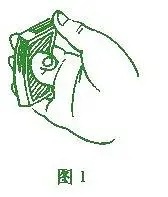
1. Hold a deck of cards with your left palm facing up. Place your index finger at one end of the deck and the other three fingers on the right side of the deck (as shown in Figure 1).
2. Reach your right hand onto the deck in your left hand, press your index finger against the back of the top card, and gently hold the ends of the card with your thumb and the other three fingers. Use your right thumb to lift the top card slightly from the inside of the deck.
3. Use your right thumb to lift the second card slightly at the same time, and gently press down the right back corner of the card stack with your left little finger so that the two lifted cards will not fall.
4. Release your right hand. The two top cards come together. However, due to the action of your left little finger, there is a gap between the two top cards and the deck below. As long as the gap is not facing the audience or the deck is slightly moved, the audience will not be able to see it.
5. Extend your right hand onto the deck of cards in your left hand, and lift the top two cards that are joined together, just like when you reveal a card. So that the audience can see that there is only one card. But when you reveal the card, your right index finger should gently press against the back of the card to prevent the audience from discovering that there is a gap between the two cards.
6. The performer shows the audience the suit and rank of the second card, then places both cards face down back on the deck. Next, the performer picks up the first card and places it face down on the table, asking the audience to turn it over. The original card is gone, replaced by a new card. The audience member, unaware of the double-card trick, assumes it's the card they saw before.
When using the double-touch card technique, the performer must not look at the cards. Because wherever your eyes look, the audience will follow. You can look at the audience, talk to them, and then rely on the feel of your fingers to perform the card-lifting action.
------------------------------------------------------------------------
Basic poker magic tricks (5): 'Gap' (also known as 'false pairing')
1. The magician borrows a deck of cards from the audience and shuffles them in front of everyone. Then he asks an audience member to randomly draw a card and display it to the audience. Let's say it's the Ace of Diamonds.
2. The magician divides the cards in his hand into two piles, face down, one in each hand. He asks the audience to place the Ace of Diamonds on the pile in his left hand. Then, he quickly presses his little finger tip against the bottom corner of the pile.
3. Place the cards in your right hand onto the deck in your left hand, and hold the entire deck in your left hand, using your little finger to divide the deck into two parts.
4. Hold the cards sideways with your left hand, and use your right thumb to lift the top of the deck to show the audience that the entire deck is properly assembled. The audience will see that the card he drew is not only sandwiched within the deck, but the entire deck is also very neat. Because the little finger of his left hand is facing the magician, the audience cannot see it.
5. Use your right hand to remove the top half of the deck from your little finger. At this point, the Ace of Diamonds is still on top of the deck in your left hand.
6. The special card in the left hand is placed on top of the card stack in the right hand, and the audience draws cards from the top of the deck, allowing the magician to perform his tricks at will.
------------------------------------------------------------------------
Basic poker magic tricks (7): One-handed card cutting (for showing off...)
1. With your left palm facing up, press your thumb against one long edge of the playing card, your middle and ring fingers against the other long edge, and your index and little fingers against the two short edges respectively.
2. Relax your thumb slightly, allowing the lower part of the cards to fall diagonally into your palm.
3. Bend your index finger downwards and press it against the edge of the card opposite your thumb as it falls, so that the card and your thumb are tightly locked together.
4. Relax your thumb outwards, allowing the upper half of the card to fall. Gradually bend your index finger, with the tip touching the upper half of the card. At the same time, gradually move your index finger downwards, causing the lower half of the card to overlap the upper half, eventually forming a complete overlap. At this point, the positions of the upper and lower halves of the card are completely reversed.
------------------------------------------------------------------------
Basic Techniques of Poker Magic (8): Short Deck Positioning
If you've seen the TV show "The Starry Night," you'll know that Liu Qian often uses this card-cutting method during his performance!
Short cards are cards that are slightly shorter than regular cards. They are made by cutting approximately 1 millimeter off both ends of a regular card and then trimming the four corners. In magic performances, short cards can be used for marking positions, forcing cards out of the player, and producing cards chosen by the audience. After inserting a short card into a deck, you can quickly locate it and control it to the top or bottom position. The method is as follows:
1. Hold the deck in your left hand, and extend your right hand onto the deck. Press your index finger against the back of the cards, and use your thumb and other fingers to hold the deck at both ends. Press firmly against the back of the cards with your index finger, and hook the inside of the deck upwards with your thumb. Then, release the hook with your thumb, allowing the cards to fall one by one. When your right thumb feels a clear separation between the falling cards or hears a louder "snap" than a series of falling cards, this means the short deck has fallen.
2. At this point, immediately stop releasing the cards with your right hand, remove the remaining cards, and place them under the stack of cards in your left hand. This short card then becomes the top card of the entire deck. Of course, if you don't find the short card the first time, you can rearrange the entire deck and search for the short card again; you will definitely find it.
3. If you want to control the short cards from the top to the bottom of the deck, you can use the pass-through control method.
VIII. Magic Teaching
(I) Teaching the text of floating roses
Prepare one rose-patterned napkin and one sheet of paper.
1. Place the rose in your sleeve (I imagine you wouldn't be wearing short sleeves in this cold weather). When placing it, make sure the rose stem is inside your sleeve, and the blossoms are just outside, within easy reach of your fingers, but not visible to the other person. Also, secure the rose with a hidden thread before placing it, with one end of the thread hanging down to your ear.
2. At this point, take out a napkin and casually toss it in the air a few times (remember to use your left hand, or you'll give yourself away). Then place the napkin in your right hand and use the space between two fingers of your right hand to hold the bottom of the napkin. Then, use your left hand to take out a lighter and light it. At this point, the rose, your hand, and your girlfriend's eyes should be in a straight line. The purpose is to block the rose; your girlfriend will only focus on the torch. (Remember, be careful not to burn the hidden thread; otherwise, it will be too embarrassing!)
3. While she's not looking, discreetly remove the rose with your left hand, pressing the stem downwards, but don't remove it completely; leave a small portion inside. The angle at this point is crucial; success or failure hinges on this. Use your left hand to feign fiddling with a napkin, while simultaneously pressing the flower down. The stem is resilient, giving it a spring-like potential energy. When the torch has burned sufficiently, release your left hand, allowing the rose to spring out. Then release...
With your right hand, release the torch. At that moment, the rose pops out, scattering the burning torch and sending sparks flying. The rose appears! Speed is key in magic; the rose pops out, and the effect is fantastic! This is the first step. At this point, the girl might be very surprised, but you can't laugh when you see her surprised expression. You have to maintain a serious demeanor (of course, this is a bit difficult because...).
I laughed at this part, but thankfully I didn't find anything. (Sigh...)
4. Then bend over and squat down, telling a story or speaking your true feelings as you do so, making sure to be sincere. While squatting, hold the roses in both hands and slowly lower them to the ground. By "lower to the ground," I mean the roses should be held upright, with your hands touching the ground (the roses should be held upright, giving the impression of holding a rose). Then...
Then continue the story. While telling the story, slowly release your hand. Because of the hidden thread, the rose won't fall over; it will appear upright. Don't completely remove your hand at this point. Then slowly stand up, keeping your hand close to the rose, otherwise it will sway and you'll be seen through. Once you're standing upright, completely release your hand. Now, the most crucial part!! Don't look at the rose anymore. Be silent for about 10 seconds, then keep your eyes on the girl's eyes and say whatever you need to say, but don't say more than 10 sentences! You must capture the girl's mindset at this moment. Once you say something touching, haha, I don't need to tell you the consequences, right? Finally, remember to carefully put away the rose and the hidden thread.
These are two simple magic tricks, but the effects they produce are absolutely amazing. Make the most of them! Sigh...!
(II) Teaching Candle Magic
Chemical magic tricks, I hope you enjoy them! They seem a bit difficult to perform though.
Performance effect:
A regular candle can be blown out in one breath when it's burning.
However, there is a special kind of candle that you can light simply by blowing on it.
It's all done in one breath. Now, watch the magician's performance!
The magician then took out a candle and deliberately showed it to the audience, letting them see it.
He believed it was an ordinary candle, then placed it on the candlestick, blew on the wick, and the candle lit up. After you finished watching the magic...
After the sorcerer's performance, can you answer the mystery of how a candle can ignite with a single breath?
teaching:
It turns out that before the performance, the magician loosened the candle wick and dripped in some carbon disulfide solution containing dissolved white phosphorus. This is because liquid carbon disulfide is highly volatile.
The magician blew a long breath to accelerate the evaporation of the carbon disulfide, leaving extremely fine white phosphorus particles on the wick after the carbon disulfide had completely evaporated.
Granular white phosphorus reacts with oxygen in the air to produce heat. When the temperature rises to 35°C, the white phosphorus spontaneously combusts, thus burning away the original...
The extinguished candle wick reignited. This phenomenon of combustion, caused by the oxidation of white phosphorus in the air, is common in nature; it is a natural occurrence.
What they call "heavenly fire" or "ghost fire".
(III) 20 Classic Magic Tricks Tutorial
Just a simple text description
1. Catching smoke in mid-air
The performer walks onto the stage, grabs a cigarette from the air, puts it back in a hat, grabs another cigarette, and repeats this several times. Where do those cigarettes come from?
Explanation: The performer had a semi-circular metal ring, resembling a gold ring, on the middle finger of his right hand, with a small pointed tip. The cigarette was inserted into it. When the hand was bent, the cigarette appeared; when the hand was straightened, the cigarette disappeared. In reality, there was only one cigarette. The performer was mindful of the audience's perspective during the performance.
2. Turn blank paper into money
The performer takes out ten blank sheets of paper from his pocket, unfolds them one by one to show that both sides are blank, then puts them together in his palm. With a snap of his hands, the ten blank sheets of paper turn into ten ten-yuan bills, immediately eliciting a burst of laughter from the audience.
Explanation: The special feature of this program is the sleight of hand magic. First, ten RMB banknotes are pasted on the back of one of the blank sheets of paper. Then, by closing your hands, the other side is flipped, and ten ten-yuan banknotes appear.
3. Prick balloons with needles
Needle-punctured balloon: The performer presents a large balloon to the audience, then takes out a steel needle and pierces the middle of the balloon, but strangely, the balloon does not burst.
Instructions: Before the performance, attach rubber to both ends of the balloon. The steel needle will pierce through the rubber without breaking it. You might as well try it.
4. Straight-line infusion bottle
The performer gives a small vase, then inserts a rope, and immediately the vase is lifted up.
Instructions: There is a small, round rubber ball inside the bottle. During the performance, a small string is placed into the bottle opening, and when the bottle is turned upside down, the rubber ball presses down on the string. You can also use a household wine bottle to perform this, but it cannot be transparent.
5. The flying cup disappeared.
The performer brings out a round plate containing an open-mouthed pot and a glass. He then covers the mouth of the glass with a handkerchief. The performer picks up the glass and handkerchief and walks toward the audience. With a flick of his wrist, the glass disappears.
Explanation: The secret mechanism was actually hidden in the handkerchief. Inside the handkerchief was a round iron ring, about the size of the rim of a cup. However, by the time the handkerchief was brought towards the audience, the cup was already gone. Because the iron ring was the same size as the rim of the cup, the audience wouldn't notice it.
6. Two cards become five
The actor takes out two cards from a deck of cards, shows them to the audience with their backs to explain that there were no cards smuggled in. Then, with a flick of his wrist, he shows the audience five playing cards: 1, 2, 3, 4, and 5. How did it suddenly become five cards? The actor flicks his wrist again, and it becomes two playing cards again.
Explanation: Originally, only two cards were used. The other three cards with different numbers were cut out and pasted into one corner. When the performer shakes the card, it changes direction and turns the head. This simple magic trick relies on practice; the turning should be natural to achieve a good effect.
7. Eggs from an empty bag
The performer lifted a black velvet bag from the stage. To prove that it was empty, the performer turned it over and squeezed it repeatedly outside the bag. Then, he made a magic trick, and an egg was squeezed out from the corner, followed by more than a dozen eggs.
Note: On the back of this velvet bag, at the top edge, there is actually a long strip of interlayer. This interlayer is sealed on the left and opened on the right inside the velvet bag. More than ten eggs are all inside. In order to reduce the weight, only one of the more than ten eggs is real, and the rest are all fake or eggshells.
8. Pull the towel from the bottom of the cup
The actor presents a glass teacup to the audience and pours water into it without spilling a drop. The actor then pours out the water, wipes it dry, places it in a silk cloth cup, seals the cup, holds it in his left hand, and immediately pulls out the silk cloth from the cup with his right hand.
Explanation: The secret lies in the cup. When making the prop, a small hole, about the size of a one-cent coin, was drilled on the bottom side of the cup. When pouring water, the left hand is pressed down, and the water does not leak. The silk scarf is pulled out through the small hole.
9. Flying Match
After showing the audience an empty box of matches, the performer uses a magic trick to open the box, revealing it to be full of matches.
Explanation: Originally, these matches were made by filling a bag with two wicks and half a drawer. When you pushed the bag upwards, it was full.
10. Restore torn paper
After the performer handed over a long strip of paper, he tore it into tiny pieces, but then blew on it and it returned to being a single strip of paper, which puzzled the audience.
Instructions: Before the performance, complete the preparations. Roll another strip around the top corner of the paper, tear off the strip that was given as instructions, hold it in your hand, and release the other strip.
11. Aerial Cup
After the performer showed the audience two empty glasses, he placed them on a piece of glass and a handkerchief, then placed the two glasses on top of each other, turning the glass upside down so they wouldn't fall. The audience found it incredibly thrilling.
Explanation: The key to the props was that there was a concave metal piece placed inside the handkerchief, on either side, so the cup could be lifted with fingers and wouldn't fall over.
12. Vanished without a trace
The performer lit a cigarette, took a puff, and suddenly put it in his hand, whereupon it disappeared in an instant.
Instructions: Insert a rubber band through the inside of the sleeve, tie a pen cap to the end, put a cigarette inside the cap, and when you release your grip, the cigarette will retract inside.
13. Burning paper money turns it into money
After the performer handed over a blank sheet of paper, he lit it with a match, and it instantly turned into a one-yuan banknote.
Instructions: Fold a one-yuan coin beforehand and place it behind a match. Light the match and push the coin into your hand; it will immediately appear as a one-yuan coin.
14. Poker Telephone
The performer explains using a deck of cards, then asks the audience to draw one or two cards, listen to them, and they'll know the answer—it's really strange.
Note: This hand consists of consecutive straight flushes, but the cards drawn are still shuffled. The exact cards drawn can be determined by looking at the bottom of the deck.
15. Change the letter A into a "3"
The performer showed the audience a red Ace of Spades, then blew on it and it turned into a red 3 of Spades! Wow! What's the logic behind that?
Instructions: Originally, a "3" was pasted on the corner of the letter A. Simply flip it up and use your thumb to peel off a corner.
16. Cut the rope but don't break it.
After the performer handed over a rope, he asked the audience to cut it on the spot. When he counted "one, two, three," the rope was immediately put back together, and everyone clapped and cheered.
Note: When the ribbon passes through the doorway, the other end is cut off by the audience, and one head is dropped by the hand passing through the doorway.
17. Wu Song escapes the gang
The performer asked an audience member to use a handkerchief to hold their hands together and put them into a strap. 1, 2, 3, the strap came off, but the hands remained still. Strange!
Explanation: The performer uses two fingers to pop the inner strap of their wrist out and slide it down without moving it.
18. Matches become colorful scarves
The performer shows a box full of matches, lights two, and asks the audience to count to 1, 2, 3. Then the matches disappear, and three red and green silk scarves are taken out.
Note: Actually, that row of matches was fake. Half of each match was stuck to the corner of the silk cloth, so when two real matches were burned, the whole bag disappeared.
19. Cut the handkerchief and restore it.
The performer takes a white handkerchief from his pocket, then takes a small pair of scissors and cuts a piece in the middle of the handkerchief. He then puts the shredded cloth back into the middle of the handkerchief, shakes it, and in a moment it becomes a whole handkerchief again. The audience finds this very strange!
Explanation: The original white handkerchief looks ordinary, but the trick is that the performer carries a small white handkerchief on their hand; what's actually cut out is just a small handkerchief. This requires skill and mastery of the angle so that no one can tell the performer is carrying a small handkerchief on their finger.
20. Rice turns into rice puffs
The performer takes out a grain of rice, asks two audience members to come on stage and stretch out a piece of cloth, and then puts the rice on the cloth and shakes it continuously for a few minutes. The rice turns into rice puffs, which can then be eaten.
Note: The rice cakes were actually prepared in advance and placed in a small dustpan. The performance required props, and the rice cakes were lightly released by shaking the hands.
(IV) Fun Magic Trick of Getting a Coin into a Ball
I haven't found any good videos lately, so I'll find some great text-based tutorials for you first!
Magic is all about fun!
1. The performer takes a small ball out of his pocket, asks the audience member to open it and check; it's empty. The ball is then placed in the audience member's hand.
2. The performer then takes a coin out of his pocket, lets the audience check it, and places it in the performer's left hand.
3. At this point, take a handkerchief from your pocket and place it over the audience member's head.
4. The performer slowly opens their hand above the audience member's hand; the coin doesn't fall. Then, when the palm is opened, the coin is gone.
5. The audience member opened the ball in their hand and found that the coin was actually inside.
Teaching: It's actually very simple; it just involves adding some techniques with balls and coins.
Props: Two identical balls, two identical coins, a handkerchief. Beforehand, place coin A inside your hand and hold it in your left hand, using a ball-clamping method. Place ball B, coin B, and the handkerchief in your right pocket.
1. First, state that both hands are empty. (For specific techniques, see Mark Wilson's "Cross-Handed Ball Clamping Technique")
2. Take another ball from your pocket with your right hand, let the audience inspect it, then take it back and use a "palm-to-ball" technique to replace ball B with ball A, placing it in the audience's hand. It's best to "kindly" remind the audience to hold it tightly to prevent you from cheating.
3. At this moment, with ball B in his right hand, he puts it in his pocket, takes out a coin B, reveals it, and then uses the coin-escape technique to leave it in his right hand.
4. At this moment, reach into your right pocket with your right hand, take out a handkerchief, and take the opportunity to drop a coin.
5. Place a handkerchief over the audience member's hand, slowly open their hand; the coin hasn't fallen. Open your palm, and the coin is gone.
(V) Teaching the magic trick of two coincidences of numbers
The coincidence of two numbers
This is a great tutorial on word magic! Word magic allows you to fully express your own style during performances because you can make associations!
Effect:
There is a piece of paper and a pencil on the table. The performer walks to the table, turns his pockets inside out to show the audience that they are empty, and then turns them back inside out.
The performer picked up a pencil and wrote a number on a piece of paper (without letting the audience see it). After writing it, the performer put the paper in his pocket. The performer said to the audience, "Now, just say any number. I already predicted the number you said and wrote it on that piece of paper."
"Okay, now think of any number and say it." After the audience member called out a number, the performer took out the slip of paper from his pocket and showed it to the audience member. Sure enough, it was the number the audience member had called out.
What's going on? Can the performers really predict the future?
Specific operations:
The performer places a pencil lead about 1 cm long on one corner of the table beforehand (because it is small, the audience will not notice it). Of course, you can also hide the pencil lead in other places according to your own preference.
When the performer picks up a pencil and writes numbers on a piece of paper, they pretend to write but actually don't. After "writing," they put the paper in their pocket.
As the audience member finished calling out their number, the performer secretly picked up a pencil lead from the table. Then, reaching into his pocket, he quickly wrote down the number called out by the audience member on a slip of paper using the pencil lead.
(For ease of writing, when asking the audience to call out numbers, you can limit the number of digits to between 0 and 9).
At this point, the performer takes out a piece of paper and shows it to the audience (the performer can throw away the pencil lead while the audience is looking at the paper), which will surely amaze the audience.
Well done! That was a really great little magic trick!
(vi) Teaching the trick of alternating shuffling cards
A great magic tutorial! Card tricks are very practical!
The fake shuffling technique is a closely guarded secret in magic performances, yet it is one of the most widely used shuffling methods. When used properly, it can make the audience believe that the entire deck has been shuffled multiple times, while in reality it is exactly the same as the original arrangement, without any change whatsoever.
1. Press the back of the card with your right index finger, and use your thumb and the other three fingers to firmly grip both ends of the card stack.
Extend your left palm flat at the front of the deck, and gently release your right thumb so that about half a deck of cards falls onto your left palm.
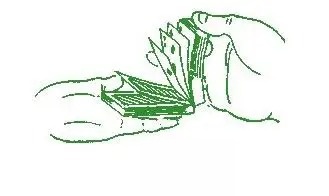
2. Use the three fingers at the back of the right-hand deck to help lift the left hand into the same position as the right hand, ensuring the front ends of the two hands can overlap. Place both fingers on the table, then simultaneously relax both thumbs, causing the front-end cards to fall one by one in an alternating pattern.
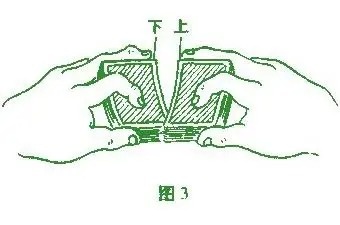
3. After all the cards have been alternately dropped, do not push the two stacks of cards that have not been alternated together with both hands. Instead, keep the cards that were originally on top on top and the cards that were originally on the bottom on the bottom. The cards that have been alternately shuffled into the back will automatically exit under the cover of both hands, so that the cards are placed in the correct order.
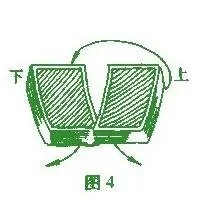
By using a natural approach, the cards appear shuffled to the audience, but in reality, not a single card has been shuffled.
(VII) Teaching the Flipped Card Magic
This is a very simple magic trick tutorial! If you carefully read the written instructions, you'll be able to learn and perform it right away!
That was a really great magic trick!
A card chosen by a spectator can be automatically flipped over after being inserted into the deck—this is perhaps the most surprising type of card game. This is the most basic yet most interesting one.
Secrets and Preparation
The trick to this act is quite simple: before starting the performance, simply flip over the bottom cards of a deck and then neatly stack them. There are two ways to do this preparation: the first is to pre-place the bottom cards in a deck box, so you can start the performance as soon as you take them out. The second is impromptu preparation. Before the performance, take advantage of the opportunity to introduce the act to the audience, put your hands behind your back, and flip over one of the bottom cards. The audience will never suspect that while you have cards face down in your hand, there is another bottom card face up.
method
(1) After running the cards with both hands, ask a spectator to draw one card at random. Be careful not to spread the last part of the cards in your left hand too wide, so that the spectator can see the face-up card.
(2) After the audience draws a card, immediately arrange the remaining cards neatly in your hand. Ask the audience to clearly see the card that was drawn. At this moment, completely flip the cards in your left hand and place them on the table. You know, at this point, all the cards in the deck, except for the top card which is face down, are face up.
(3) After all the spectators have seen the card that was drawn, you pick up the whole deck of cards from the table, hold it tightly in your left hand, and then ask the spectator to insert the drawn card face down. He will not realize that only the card you originally prepared and the card he just inserted are face down in the whole deck.
(4) Put your hands behind your back and explain, "Because you touched that card, it has your body heat on it, and I can feel it immediately." Then turn the card you originally turned over back over. In this way, you can fully demonstrate your amazing "skill".
(5) The entire deck of cards was quickly spread out on the table. Sure enough, all the cards were face down, except for the one that the spectator had drawn, which was strangely flipped over!
Comments and suggestions
It seems this show requires no preparation; you can even let the audience shuffle the cards themselves at the beginning. The only thing to be careful about is that when you put your hands behind your back to arrange the cards, you need to make it seem natural to the audience that you're just looking for a hotter card, something they know is impossible. Don't say how you automatically flip a card over, otherwise the audience will suspect you're doing it behind your back. Flipping the entire deck can also be done behind your back, making it foolproof.
(8) A tutorial on telepathic magic for picking up girls
This is a very simple and easy magic trick tutorial. I used to perform it a lot when I first learned it.
Effect
The magician and the girl each took a deck of cards and shuffled them several times. To prove there was no secret to shuffling, they switched their decks. Each of them then chose a card from their deck, placed it on top, and cut the deck. Next, they switched their decks back and each took the card they had just chosen, placing it face down on the performance table. Simultaneously, they turned their chosen cards face up to reveal them to the audience, who saw that their cards were identical.
method:
After shuffling, remember your hole card. Then exchange cards. Your cards are now the spectator's, and their cards are yours. Choose any card and place it on top of the deck (because the card you chose is just a distraction and has no real effect). Have your sister do the same (at this point, the card she chooses should be the one after the hole card you remembered). Cut the deck randomly (note: cut, making sure the hole card you remembered and your sister's card don't separate...). When you exchange cards again, your sister's card will be behind your hole card. Take it out and place it on the table. Wait for your sister's surprised expression.
The Magic Space is a free place for magic enthusiasts to learn, research, and exchange magic tricks. I've performed magic tricks there myself and with many girls, and the results were fantastic!
(ix) Coin Magic Text Teaching
(1) The disappearance of coins (detailed text instruction)
Only after mastering this important performance skill will you be able to perform other coin magic tricks more effectively.
The magician had a coin resting on his left fingertip, and then gently took the coin from his left hand with his right.
Then the magician blew on his right hand... gently rubbed it... opened his right hand... and the coin had vanished without a trace!
Performance method:
1. Hold a coin horizontally with your left fingertips pointing upwards, making sure your fingers are tightly clenched so that the audience cannot see the gaps between them!
2. With your right thumb down and the other fingers up, reach your left hand from behind, ready to grasp the coins simultaneously. After this, the coins should be out of the viewer's sight.
3. Cover the entire coin with the fingers of your right hand, wrapping it tightly.
4. While keeping your right hand still, release the coin with your left thumb, allowing it to fall quietly into the base of your left fingers.
5. Immediately afterwards, make a fist with your right hand and pretend that you have taken the coin from your left hand.
6. Next, as you turn your body to the right, flip both hands over. By turning your left hand inwards (towards your body), the audience will not be able to see the coin. At the same time, turn your right hand so that your clasped fingers face the audience. While turning both hands, you can also point your left index finger at your right hand. Throughout this process, keep your eyes on your right hand, as if you are tightly holding a coin.
7. As you move your right hand to the side, casually place your left hand at your side, holding the coin with your bent fingers. Your eyes should remain fixed on your right hand throughout; this is called distracting the audience.
8. Begin by making a slow rubbing motion with your right fingers, as if you are trying to completely rub the coin away. Then, open your right hand to show that the coin has completely disappeared.
(2) The effect of turning a five-cent coin into a one-yuan coin using only manual techniques is amazing.
This is a coin trick I did a long time ago. The principle is simple, and the effect is excellent. Don't think that just because it's simple, you shouldn't practice it!
Effect: Open your hands to show a regular 50-cent coin, then rub it between your hands; it will turn into a 1-yuan coin. Break it open again, and it becomes two 1-yuan coins. Place the coins in your palms; you will only see two 1-yuan coins, and the 50-cent coin will disappear.
teaching:
Preparation: Prepare two one-yuan coins (stacked together), hold them horizontally with the first joint of your right thumb and forefinger. Place a five-jiao coin vertically in front of the one-yuan coin to block it. From the side, it looks like a horizontal T. From the front, the five-jiao coin in front will block the viewer's view and hide the two one-yuan coins behind.
Procedure: Show the five-cent coin to the audience from the front (make sure the audience's line of sight is level with the five-cent coin so that the audience can only see a small five-cent coin), keep your hands open (I don't think you would spread out the two fingers holding the coin), and indicate that you have nothing else in your hands.
Using your left thumb, push the 50-cent coin backward behind the 1-yuan coin, while simultaneously standing the 1-yuan coin upright to show its flat surface to the audience (the audience will see a 1-yuan coin with the 50-cent coin on the back). Then, use your left hand to separate the two stacked 1-yuan coins, holding each with your thumb and forefinger (keeping the other four fingers spread). The 1-yuan coin with the 50-cent coin on the back should be in your left hand, while your right hand holds the undamaged 1-yuan coin. At this point, you can toss the coin in your right hand a few times (to demonstrate). Then, casually place the 1-yuan coin from your left hand onto the palm of your right hand (remember to cover the 50-cent coin with the 1-yuan coin; the palm is concave, so the 1-yuan coin won't appear to be sticking up). Now the audience can see that you have both intact 1-yuan coins in your left hand. Pick up the undamaged 1-yuan coin with your right hand and hand it to the audience for inspection, then casually put both coins back into your pocket with your left hand. Haha, let the audience study it at their leisure!
My experience:
1. The display must be at eye level with the audience.
2. After separating the coins, keep your remaining four fingers spread out. The five-cent coin should be completely hidden behind the one-dollar coin.
3. Finally, place the one-yuan and five-jiao coins flat in your palm and cover them up.
There are many ways to handle the five-cent coin in this magic trick. Hiding the coin is much better; give both the two one-dollar coins to the audience for a better effect and to avoid suspicion. This is just to provide an example for beginners; once you're more familiar with it, you'll understand the variations.
(3) Translation teaching of Salt shaker and Quarter
Effect:
The magician asks a spectator for a coin and places it on a table. The magician says, "Now I'm going to use a salt glass (or a regular clear glass) to make your coin disappear through a table made of solid material." (Simply put, the coin will vanish and then reappear under the table.)
Then the magician said, "To prevent the bottle from being broken by the coin, I'm going to wrap it with a napkin." And then the magician took a napkin and wrapped the entire bottle.
"Alright, the show begins!" The magician muttered incantations after shining the bottle on the coin. Suddenly! When he opened the bottle... wait... the coin was still there! The magician was a little embarrassed, but he said, "Oh right, I forgot to press down on the bottle, so the coin didn't go through! Come on, let's try again." OK... Then the magician repeated the steps, suddenly pressing down hard with both hands!
The entire bottle disappeared from the table, leaving only a leftover coin and a napkin—the audience fainted!
secret:
It's very simple. When you first try to make the coin disappear, that's actually a trick. The trick is to make the audience think that you're going to make the coin disappear again, not the bottle/cup.
When you 'fail' for the first time, you should draw the audience's attention to the coin, not the bottle/cup wrapped in your napkin.
While their attention is on the coin, you can subtly move the bottle/cup towards your body, then loosen your grip on the napkin, letting the bottle fall onto your lap. Because the napkin has some stiffness, it won't immediately soften, and from the audience's perspective, you still appear to be holding the bottle.
Then raise your thigh so the bottle doesn't fall.
Note: The above series of movements must be performed quickly! Don't perform if you haven't practiced them thoroughly!
Okay, now put the 'bottle' on the coins (make sure the audience can see there's no bottle inside), and then it's all about your acting skills.
(10) Tutorial on Tomorrow's Ring Magic
Mini magic trick tutorial
It's a classic little magic trick. The first time I saw it, I probably thought there was some kind of mechanism involved and spent a long time checking it!
It's amazing that it's a simple magic trick involving a "ring and chain," but I've never been able to figure out its secret.
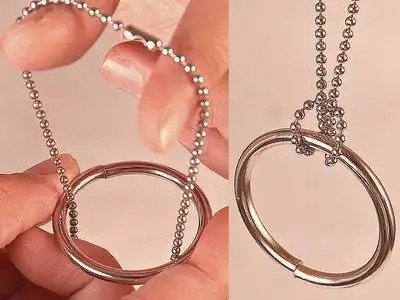
Holding the chain with your left hand, you use your right hand to pull the ring up from below the chain, then release your right hand to let the ring fall down, and it's hooked into the chain. I looked closely before but still didn't understand. This year, I suddenly became interested in magic, and when I went to a magic shop last time, I studied it carefully and suddenly it all became clear. So that's how it works! (Curious friends can think about it themselves first; see the pictures below to find out the answer ^_^)
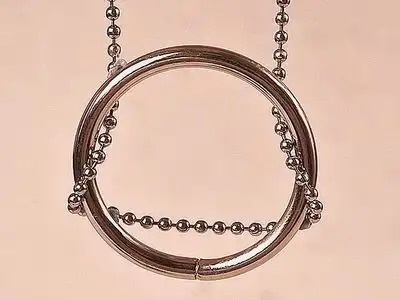
A quick online search revealed it also has a beautiful name – "Tomorrow's Ring," which was used in the 2005 movie "Say I Love You Again" to express a beautiful love story. PS: Apparently, the male lead, Andy Lau, spent 30,000 yuan to learn this magic trick! However, out of curiosity, I also spent 15 yuan to buy this magic prop.
Strictly speaking, this magic trick shouldn't be called magic; it simply utilizes principles of physics or natural science. However, it's quite classic, giving a strong sense of the impossible, and requires very simple props, making it suitable for performance.
(XI) Teaching of Long-Distance Telepathy Magic
Magician: Do you believe in using mental power to transmit information over long distances? Audience: I've heard of that. You're not going to perform that for me, are you? Magician: Well, I'm going to perform a mental magic trick. Because it's mental magic, if you cooperate with me, we might succeed; if you don't, we might fail. Actually, I don't always succeed. Are you interested in trying? Audience: Really? How can I cooperate? Magician: It's actually very simple. Just keep quiet. Audience: --! Magician: Hehe, okay, now, please look into my eyes… Audience: ◎◎ Magician: Think of a two-digit number in your mind and tell me. Audience: I have to tell you! Magician: Yes, but don't worry, I won't let you down. Audience: 43 Magician: Good! I like this number. (The magician takes out his phone and shows it to the audience) Magician: Please choose any name from your phone book. Audience: (Flips through dozens of names) This one—Zhou Lunjie. Magician: (Takes back the phone) Okay, now, I'm going to use my mental power to send the number "43" that you mentioned to Zhou Lunjie. Please keep quiet. (The magician closes his eyes for ten seconds) Magician: Now I'm calling him. (The audience sees the magician press the call button for "Zhou Lunjie" on his phone) Magician: (A moment of silence) Hello, Zhou Lunjie? Did you receive the signal I sent? Yes, I'm performing a magic trick. Okay, please tell this lady the number you received. (The audience takes the phone suspiciously) Audience: Hello? Zhou Lunjie: Hehe, is it 43? Audience: ... Preparation before the performance: One mobile phone for the magician, one assistant with a mobile phone. Principles and methods: (1) Back up all the phone numbers in your mobile phone's address book in a safe place. (2) Only keep the male or only female names (depending on the assistant's gender). (3) Replace all the phone numbers with the assistant's mobile phone number. (4) When calling the assistant, face the audience sideways. If the audience is on your left, use your right hand to hold the phone, and vice versa. (5) After the call connects, do not speak. Gently tap the phone casing with your index fingernail. Make the following agreement with your assistant: the first set of sounds represents the tens digit, and the second set represents the units digit. For example, 43: Tap tap tap tap—tap tap tap. Assistant: (After understanding the code) Is it 43? Magician: Hello, is this XXX? Did you receive my signal? Yes, I'm performing a magic trick. Okay, please tell this lady the number you received. (The audience suspiciously takes the phone) Audience: Hello? Assistant: Is it 43? Audience: … Note: If the assistant misunderstands and says a different number, the magician should tap again, making the tapping softly so the audience doesn't notice (it's best to perform in a noisy place). Thank you!
(12) Illustrated Instruction of Magic Techniques
1. Lay the entire deck of cards face down, allowing the audience to randomly draw a card. The performer gathers the cards, holding them in their left hand with their thumb on the left and the other four fingers on the right. As the audience looks at the suit and rank of the drawn card, the performer picks up a portion of the cards from their left hand with their right. As the audience places the drawn card back on the back of their left hand, the performer presses their left little finger on the audience's drawn card while simultaneously placing the cards from their right hand onto the audience's drawn card.
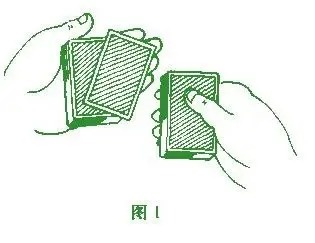
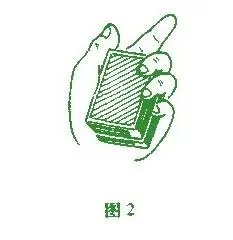
2. The performer randomly draws cards from the deck and places them on top or bottom. If the cards are from the lower half of the deck below the little finger, the performer can place the drawn card on top of the entire deck.
3. If you want to keep the audience's drawn cards at the bottom of the deck, you can use your little finger to press down on the audience's drawn cards, and put the other cards on the back of the deck.
4. The little finger pressing method can shuffle the cards drawn by the audience to the top or bottom of the entire deck, which is very flexible.
(13) Teaching the Text of Small Magic Tricks
Watching magic trick tutorials like this requires wisdom!
There was a piece of paper and a pencil on the table. The performer walked to the table, turned his pocket inside out to show the audience that it was empty, and then turned it back inside out. The performer picked up the pencil and wrote a number on the paper (without letting the audience see it), then put the paper in his pocket. The performer said to the audience, "Now say any number. I've already predicted the number you'll say, and I've written it on this piece of paper. Okay, now think of any number and say it." After the audience member said a number, the performer took the paper out of his pocket and showed the audience the number written on it—it was indeed the number the audience member had said. How could this be? Could the performer really predict the future?
Specific operations:
The performer places a pencil lead, about 1 cm long, on the corner of the table beforehand (it's small enough that the audience won't notice). Of course, you can hide the lead anywhere else you like. When the performer picks up the pencil and writes a number on a piece of paper, they should pretend to write but not actually write anything. After "writing," they put the paper in their pocket. When the audience member calls out a number, the performer secretly picks up the pencil lead from the table. Then, they reach into their pocket and quickly write the number called out by the audience member on the paper with the lead (to make it easier, the audience member can limit the numbers to between 0 and 9). The performer then pulls the paper out for the audience to see (the performer can discard the pencil lead while the audience member is looking at the paper). The audience will definitely find it incredible. That's a very clever little magic trick!
2. Banknotes become blank paper
Preparation: 10 banknotes and about 10 sheets of white paper.
Performance Method: The performer secretly places strips of white paper between the 9th and 10th banknotes. At the start of the performance, the performer unfolds the 10 banknotes into a fan shape and holds them in their hand. Then, they pretend to show off a few banknotes, front and back, while simultaneously moving the 10 banknotes to the bottom, revealing a stack of white paper underneath. Next, they straighten the stack of banknotes, strike it with their right fist, and then unfold the fan again. Strangely! The original stack of banknotes has completely turned into white paper. They then pretend to show off a few more pieces of paper, using these to cover the banknotes, making it appear as if the banknotes have all turned into white paper.
Important: The banknotes and white paper used for the performance must be new and crisp.
3. Use newspaper to hold water
The performer pours water into a funnel made of rolled-up newspaper, which is surprising enough—how can newspaper hold water? But he carefully folds the bottom of the newspaper funnel to prevent water from spilling out; the audience waits to see if the water will leak from under the newspaper. Unexpectedly, the performer suddenly throws the newspaper into the air, holds it down, and unfolds it—not a drop of water remains; the newspaper is completely dry. Then, he rolls the newspaper up again and pours water from inside into a glass. The props required are two ordinary everyday items: a large glass with a handle and a newspaper. An additional prop is needed—a transparent plastic container, 3-4 cm in diameter and 15 cm high, with a handle. During the performance, the glass is placed on a table, with the plastic container hanging behind it (from the audience's perspective). Now, the newspaper is rolled into a funnel shape. The performer picks up the glass with his right hand, and with his left hand holding the funnel-shaped newspaper, he lifts the glass from bottom to top from behind, thus hooking the plastic container inside the newspaper. The water in the glass can be poured into the plastic container inside the funnel-shaped newspaper (be careful not to wet the newspaper). Once most of the water has been poured out, the hand holding the newspaper is lifted from the bottom up, allowing the glass to hang the transparent plastic container, then the glass is set down. To enhance the performance, the performer pretends to be very careful holding the newspaper, as if trying to prevent the water from spilling, but suddenly throws the newspaper into the air, or even throws it into the audience. Then, the newspaper is rolled back into a funnel shape, and the water is poured back into the glass—first, the plastic container hanging on the glass is placed into the funnel-shaped newspaper, then the water in the plastic container is poured out, and the empty plastic container is hung up again in the same way. The glass is then placed back down, and the newspaper is unfolded for the audience.
4. The flickering match
If you happen to meet a group of friends, you can tell them you've just discovered a brilliant method for detecting your pulse. Take two ordinary wooden matches from your pocket, place one on your left palm, and explain that it can be used as a pulse counter. Then, place the second match underneath the first, making it the pulse generator for the entire demonstration. As your friends carefully observe the counter, they will naturally notice it beating up and down rhythmically, as if recording your heartbeats. Suddenly, your heartbeat loses its normal rhythm, and finally, with an almost melodious movement, it stops beating. Next, you hand the matches to your friends, asking them to examine them carefully, and then ask them to try it out. Obviously, despite their best efforts, determined to "show off" like you, they can only watch helplessly as the two matches lie quietly "sleeping" in their palms. Secret Technique and Preparation: When performing this trick, it's best to use large wooden matches. Because the requirements for props are not high, you can borrow such matches anytime, anywhere. In fact, the real secret to performing this show lies in the hidden mechanism of that match—a pulse generator.
Performance Methods
1. As shown in the picture, place the first matchstick on your left hand as a pulse counter. Adjust the position of the matchstick so that it is close to the base of your fingers, with the head facing you.
2. Hold the second match, which is the pulse generator, with your right thumb and forefinger, while simultaneously pressing your middle fingernail firmly against the back of the match, as shown in Figure 2.
3. If you apply slight pressure to the match with your middle fingernail, or slide the match very slowly across your fingernail, the match will inevitably produce a series of imperceptible pulses.
4. Place the generator match under the counter match, as shown in the picture. Following the method specified in step 3, gently rub the match with the nail of your right middle finger. This will cause the match in your right hand to continuously produce a series of vibrations in the match in your left hand.
5. Two numbers coincidence
There's a piece of paper and a pencil on the table. The performer walks to the table, turns his pocket inside out to show the audience that it's empty, then turns it back inside. The performer picks up the pencil and writes a number on the paper (without letting the audience see), then puts the paper in his pocket. The performer says to the audience, "Now say any number. I've already predicted it, and I've written it on this piece of paper. Okay, now think of any number and say it." After the audience member says a number, the performer takes the paper out of his pocket and shows the audience the number written on it—it's indeed the number the audience member said. How is this possible? Can the performer really predict the future?
Specific operations:
The performer places a pencil lead, about 1 cm long, on the corner of the table beforehand (it's small enough that the audience won't notice). Of course, you can hide the lead anywhere else you like. When the performer picks up the pencil and writes a number on a piece of paper, they should pretend to write but not actually write anything. After "writing," they put the paper in their pocket. When the audience member calls out a number, the performer secretly picks up the pencil lead from the table. Then, they reach into their pocket and quickly write the number called out by the audience member on the paper with the lead (to make it easier, the audience member can limit the numbers to between 0 and 9). The performer then pulls the paper out for the audience to see (the performer can discard the pencil lead while the audience member is looking at the paper). The audience will definitely find it incredible. That's a very clever little magic trick!
6. Banknotes become blank paper
Preparation: 10 banknotes and about 10 sheets of white paper.
Performance Method: The performer secretly places strips of white paper between the 9th and 10th banknotes. At the start of the performance, the performer unfolds the 10 banknotes into a fan shape and holds them in their hand. Then, they pretend to show off a few banknotes, front and back, while simultaneously moving the 10 banknotes to the bottom, revealing a stack of white paper underneath. Next, they straighten the stack of banknotes, strike it with their right fist, and then unfold the fan again. Strangely! The original stack of banknotes has completely turned into white paper. They then pretend to show off a few more pieces of paper, using these to cover the banknotes, making it appear as if the banknotes have all turned into white paper.
Important: The banknotes and white paper used for the performance must be new and crisp.
7. Newspapers used to hold water
The performer pours water into a funnel made of rolled-up newspaper, which is surprising enough—how can newspaper hold water? But he carefully folds the bottom of the newspaper funnel to prevent water from spilling out; the audience waits to see if the water will leak from under the newspaper. Unexpectedly, the performer suddenly throws the newspaper into the air, holds it down, and unfolds it—not a drop of water remains; the newspaper is completely dry. Then, he rolls the newspaper up again and pours water from inside into a glass. The props required are two ordinary everyday items: a large glass with a handle and a newspaper. An additional prop is needed—a transparent plastic container, 3-4 cm in diameter and 15 cm high, with a handle. During the performance, the glass is placed on a table, with the plastic container hanging behind it (from the audience's perspective). Now, the newspaper is rolled into a funnel shape. The performer picks up the glass with his right hand, and with his left hand holding the funnel-shaped newspaper, he lifts the glass from bottom to top from behind, thus hooking the plastic container inside the newspaper. The water in the glass can be poured into the plastic container inside the funnel-shaped newspaper (be careful not to wet the newspaper). Once most of the water has been poured out, the hand holding the newspaper is lifted from the bottom up, allowing the glass to hang the transparent plastic container, then the glass is set down. To enhance the performance, the performer pretends to be very careful holding the newspaper, as if trying to prevent the water from spilling, but suddenly throws the newspaper into the air, or even throws it into the audience. Then, the newspaper is rolled back into a funnel shape, and the water is poured back into the glass—first, the plastic container hanging on the glass is placed into the funnel-shaped newspaper, then the water in the plastic container is poured out, and the empty plastic container is hung up again in the same way. The glass is then placed back down, and the newspaper is unfolded for the audience.
8. The flickering match
If you happen to meet a group of friends, you can tell them you've just discovered a brilliant method for detecting your pulse. Take two ordinary wooden matches from your pocket, place one on your left palm, and explain that it can be used as a pulse counter. Then, place the second match underneath the first, making it the pulse generator for the entire demonstration. As your friends carefully observe the counter, they will naturally notice it beating up and down rhythmically, as if recording your heartbeats. Suddenly, your heartbeat loses its normal rhythm, and finally, with an almost melodious movement, it stops beating. Next, you hand the matches to your friends, asking them to examine them carefully, and then ask them to try it out. Obviously, despite their best efforts, determined to "show off" like you, they can only watch helplessly as the two matches lie quietly "sleeping" in their palms. Secret Technique and Preparation: When performing this trick, it's best to use large wooden matches. Because the requirements for props are not high, you can borrow such matches anytime, anywhere. In fact, the real secret to performing this show lies in the hidden mechanism of that match—a pulse generator.
Performance Methods
1. As shown in the picture, place the first matchstick on your left hand as a pulse counter. Adjust the position of the matchstick so that it is close to the base of your fingers, with the head facing you.
2. Hold the second match, which is the pulse generator, with your right thumb and forefinger, while simultaneously pressing your middle fingernail firmly against the back of the match, as shown in Figure 2.
3. If you apply slight pressure to the match with your middle fingernail, or slide the match very slowly across your fingernail, the match will inevitably produce a series of imperceptible pulses.
4. Place the generator match under the counter match, as shown in the picture. Following the method specified in step 3, gently rub the match with the nail of your right middle finger. This will cause the match in your right hand to continuously produce a series of vibrations in the match in your left hand.
Comments and suggestions
Although this is just a small, impromptu magic trick, if performed correctly, it can still be very captivating. When performing this act, it's best to use large wooden matches. Their advantage lies in their better visual appeal and ease of handling. Please remember this: unless you rub the match with your middle fingernail, the match used as a counter will not move at all. Another topic you can discuss during the performance is that you can tell the audience you've learned how to use magic to make the matches magnetic. Rub the first match (the pulse generator) a few times on your sleeve or tablecloth. You can be sure that when you bring the first match close to the second match (the counter), the latter will begin to vibrate slightly, as if some mysterious force is constantly propelling it!
(XIV) Cyril Four-in-Six Prop Making Magic Tutorial
I don't know if you guys have seen this magic trick before~ It's amazing! Actually, turning 4 into 6 relies on magic props~
Below, I'll show you the production process with pictures! Following along might be a bit difficult; it's best to use a high-quality prop. This prop is excellent and has a powerful effect on performances!
Watch more of Cyril's magic videos, and I believe you'll be able to replicate his magic tricks more successfully.
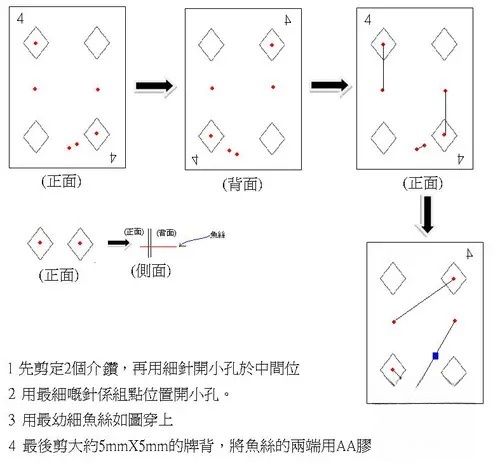
A tutorial on a magic trick that turns money into magic.
The general effect is that you can turn a five-yuan bill into a one-hundred-yuan bill.
I've always fantasized about having this ability, and now I finally do! Of course, this is a very simple and easy-to-learn magic trick tutorial.
This is a very practical magic tutorial; follow along if you're interested!
Money-turning magic tutorial
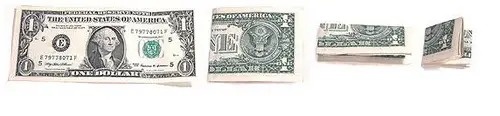
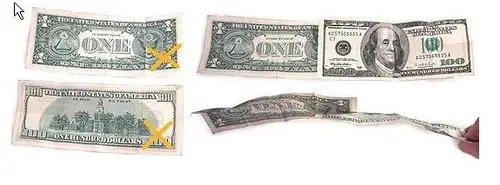
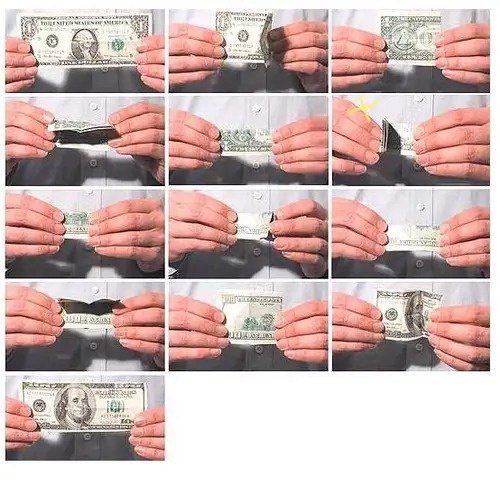
1. The magician first holds a specially made, connected "prop rubber band ring" in his right palm (his palm should always face down so that the audience cannot see it).
2. Have a female audience member fold a "real rubber band" into a circle in the magician's left palm.
3. The magician transfers a loop made of a real rubber band from his left hand to his right, placing it on top of the prop rubber band. The audience sees nothing unusual.
4. Next, use your thumb to hold the audience member's stacked "real rubber band" ring (located at the top of the stack of rubber bands. This step requires practice) and pour the prop rubber band (bottom) into the female audience member's hand.
5. Grasp the audience member's "real rubber band" with your right hand and quickly and naturally drop it (put it in your pocket or drop it under the table).
6. Then have the female audience member close her hands and then open them again, just like the rubber bands she had folded earlier are now connected together.
For details, please refer to Cyril's performance.
This concludes the complete tutorial for Cyril's rubber band magic performance!
(17) Magic Tutorial: Hiding Coins with One Hand
Basic magic trick tutorials are very useful, but you need to practice a lot.
Magic Tutorial: Hiding Coins with One Hand
Magic tutorial image 1

Magic tutorial image 2
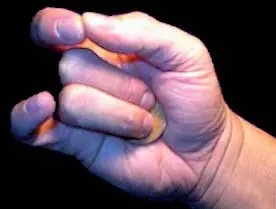
Magic tutorial pictures 3
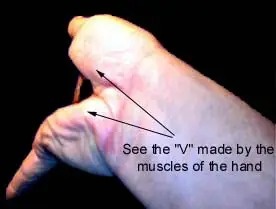
Magic tutorial pictures 4
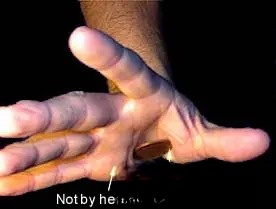
Magic tutorial image 5
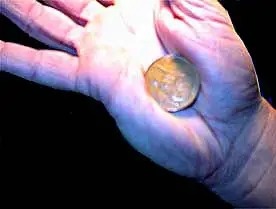
Magic tutorial pictures 6
Magic tutorial images 7
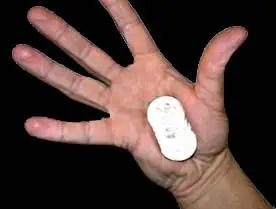
Magic tutorial pictures 8
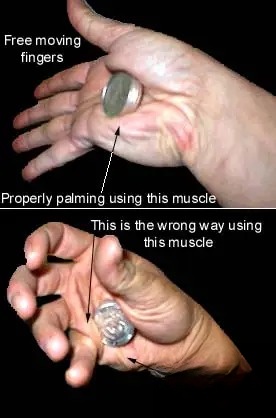
Magic tutorial images 9
Many people have seen the coin-through-the-back-of-the-hand magic trick, and there are many ways to achieve this. Props can be used, but below is a tutorial on a pure coin-through-the-back-hand magic trick. If you are interested, you can practice by following the picture. In fact, this is an application of the coin-hiding technique.
The magician first shows his hands are empty. Then, he takes out a coin with his right hand, holding it between his index and middle fingers, while making a fist with his left hand. He then places the coin on the back of his left hand and gently rubs it; the coin has vanished. He opens his left hand, revealing that the coin has passed through his palm and is now in his left hand…
Performance Method: This is actually an application of the coin-hiding magic trick. Hold the coin between your right index and middle fingers. As you place the coin from your right hand onto the back of your left hand, bend your right index and middle fingers, subtly trapping the coin between your thumb and forefinger. Meanwhile, slightly loosen your left thumb when making a fist, leaving a small hole. Gently rotate your left hand, and your right hand will release, allowing the coin to fall into the eye of your left fist. Then, boldly rub the back of your hand to indicate the coin has disappeared.
Finally, open your left hand; the coin will appear in your left palm. This process needs to be quick.