How to schedule a gym workout for weight loss? The most practical personal training sessions!
Everyone knows that losing fat requires exercise and a controlled diet, but putting it into practice isn't always easy. For those new to the gym, fat loss can often feel aimless, as if running and cycling are the only options. Today, we're bringing you a comprehensive gym-based fat loss guide to help you navigate this challenging journey!

To lose fat, you first need to understand the principles of fat loss:
To burn fat, you need to create a calorie deficit in your body. When your daily calorie expenditure exceeds your daily calorie intake, you can create the conditions for fat loss. The main reasons why many people fail to lose fat are the following two points:
First, eating too much and consuming too many calories every day.
Second, the exercise intensity is too low, and the calorie deficit generated by the exercise is too small.
Studies have shown that 1 kilogram of adipose tissue can store approximately 7,740 kilocalories. In other words, consuming 1 kilogram of fat requires creating a calorie deficit of approximately 7,740 kilocalories.
Below are specific suggestions and methods for losing fat at the gym:
The best way to lose fat is to combine strength training with cardio (at a steady pace or intervals).
Aerobic exercise can improve cardiopulmonary function and physical fitness, and it also burns a lot of calories. Jogging, elliptical trainers, stationary bikes, rope skipping, and aerobics classes are all excellent forms of aerobic exercise.
Strength training (anaerobic exercise) can increase basal metabolic rate and athletic performance, as a high basal metabolic rate leads to increased calorie expenditure. Weight training, including dumbbell and barbell exercises, all fall under the category of strength training.
My advice for beginners trying to lose fat is to combine strength training and cardio in every workout. Strength training doesn't need to be too segmented; you can divide your body into upper and lower body exercises and alternate between them. Each workout can follow these steps:
Warm-up (5 minutes) → Strength training (upper or lower body 30-40 minutes) → Aerobic training (20 minutes) → Cool-down (5 minutes). Specific times can be adjusted according to individual circumstances, but each workout session is recommended to last approximately 1 hour, and no more than 1.5 hours.
| on Monday | Tuesday | Wednesday | Thursday | Friday | Saturday | Sunday |
| upper limbs | rest | lower limbs | upper limbs | rest | lower limbs | rest |
Below are the specific steps for each training session:
Step 1: Warm-up
Warming up is an essential part of fitness, and it shouldn't be neglected when trying to lose fat. Warming up gets the body into a workout state, greatly reducing the risk of injury. Injuries during exercise not only affect progress but can also cause irreversible damage to the body.
The workout routine is simple; you can jog or use an elliptical machine for about 3-5 minutes, followed by appropriate stretching to reduce muscle adhesions. (Further reading: How to stretch?)

Step Two: Strength Training
For beginners, the most important things when starting out at the gym are getting a fitness test and familiarizing themselves with the equipment. They need to know which machines and exercises target which muscle groups, and how much weight to use.
To find out which equipment and exercises target which muscle groups, reply with "muscle workout diagrams" in the comments section.
The weight used is generally the weight that will bring you to exhaustion after 8-12 repetitions (women can set it at 12-15 repetitions). For fitness enthusiasts who are not yet familiar with the movement, a lower weight can be used to get the hang of the movement, such as an empty barbell or the lightest weight.
Strength training is divided into upper and lower limb exercises, and the movements should be compound movements involving multiple joints to provide the body with more and more effective stimulation. Below is the detailed training content:
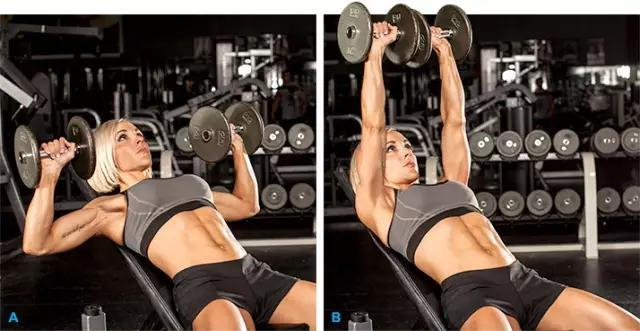
Upper limb training:
Upper body training should target all major muscle groups in the upper body, including the chest, shoulders, back, and core. For fat loss in the arms, separate training is unnecessary, as these are already engaged in chest, shoulder, and back exercises. Initial upper body training can be conducted as follows:
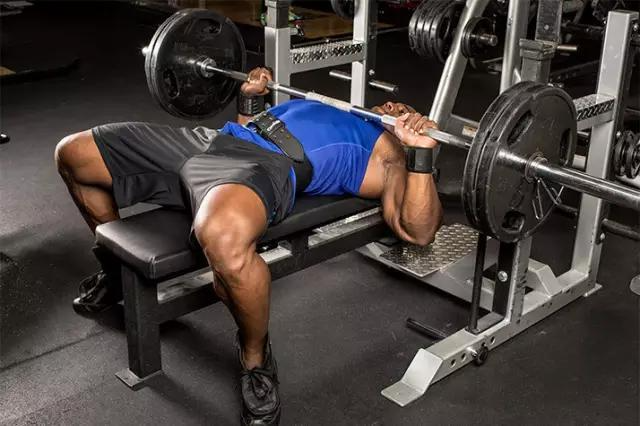
Step 1, Chest muscles: 3 sets of barbell bench press, 2 sets of dumbbell flyes.
Step 2, Shoulders: 3 sets of machine or dumbbell shoulder presses, 2 sets of dumbbell lateral raises.
Step 3, Back: 3 sets of lat pulldowns with machine, 2 sets of single-arm dumbbell rows.
Step 4, Abdomen: 2 sets of crunches, 2 sets of Roman chair back extensions.
Chest, shoulders, and back: 8-12 reps per set; abs: 12-15 reps per set; rest 30-60 seconds between sets.
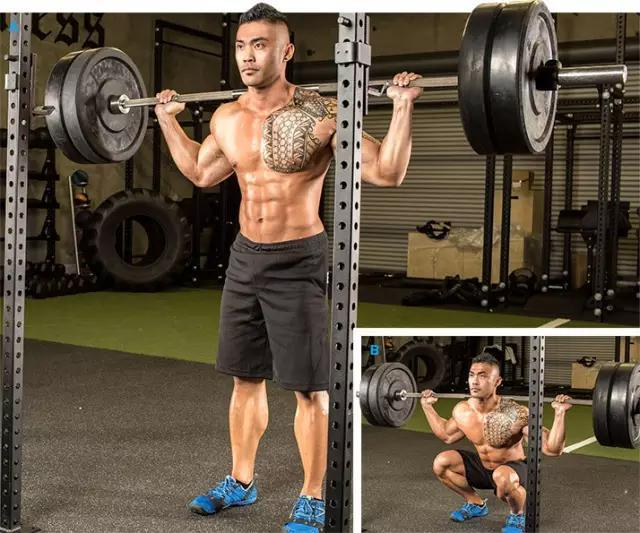
Lower limb training:
Lower body training mainly focuses on the thighs, glutes, and calves. Initial lower body training can be conducted using the following steps:
4-5 sets of barbell squats, 2 sets of straight-leg deadlifts, 2 sets of seated leg extensions, 2 sets of seated leg curls, 2 sets of dumbbell lunges, and 3 sets of weighted calf raises.
8-12 repetitions per set, with 30-60 seconds of rest between sets.
The intensity of strength training is not a benchmark because everyone's physical condition is different, but it is a good reference for many fitness enthusiasts. The specific operation can be adjusted appropriately, such as the choice of exercises and the order of training.
Step 3: Aerobic Training
After strength training, the body's blood sugar has already been partially depleted, so doing aerobic exercise afterwards can have a good fat-loss effect. However, the duration should not be too long, because too high an intensity will cause the body to secrete cortisol, which will affect health and fat loss results.
After strength training, you can jog for 20 minutes at a pace that's comfortable and as fast as possible. An elliptical trainer is also a good option, as it puts less stress on your knees and feet. Other forms of aerobic exercise, such as spinning or group classes, can be chosen based on your interests.
If you don't have enough time, you can also try HIIT interval training. (Further reading: HIIT training exercises)

Step 4: Relax
Relaxation promotes physical recovery and reduces fatigue and soreness after exercise. Relaxation can be achieved through the following methods:
Step 1: Stretch the muscles you are working out using the same stretching techniques you used during warm-up.
Step 2: Hit and knead the congested muscle areas.
Did this article make things clearer? Actually, losing fat isn't difficult. If you stick to it for 21 days, you'll find that losing fat isn't as hard as you thought!