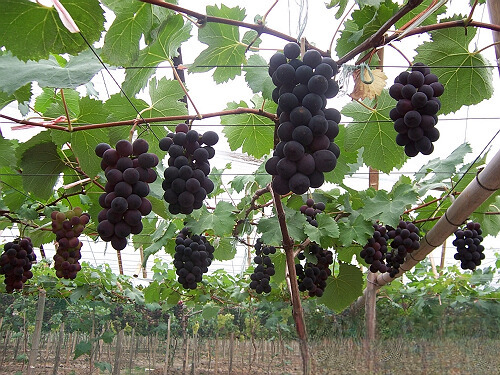
Horticulture Techniques | HighEfficiency and HighQuality Greenhouse Grape Cultivation Techniques
※Suitable varieties
Coastal areas are frequently affected by typhoons, so the varieties that should be selected are early-maturing, high-quality, stable-yielding, and less prone to fruit cracking, such as Kyoho, Fujiminori, Summer Black, Victoria, Kyoho, and Beauty Finger.
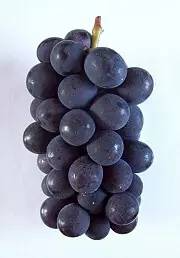 【Kyoho】 A hybrid of European and American varieties, originally from Japan, introduced to China in 1959. It has vigorous growth. The fruit clusters are relatively large, averaging 600.2 grams, conical or oblong-conical in shape, with no secondary clusters or only small secondary clusters, and short pedicels. The berries are moderately compact, averaging 7.9-11.2 grams, oval or nearly round, dark purple or reddish-purple, with a moderately thick bloom, relatively thick skin, medium-quality flesh, juicy, sweet, with a strawberry aroma, soluble solids content of 16.0 % -20.0 %, and acid content of 0.44 % -0.57 %, making it a high-quality variety. Harvesting begins in mid-to-late June under greenhouse cultivation , and the berries are fully ripe by mid -July .
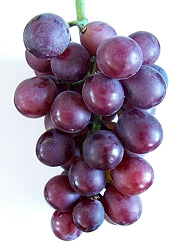 【Fujiminori】 A hybrid of European and American varieties, originally from Japan, introduced to China in 1986. The tree is vigorous and stable, producing high and consistent yields. The fruit clusters are large, averaging 788.4 grams, and conical in shape. The berries are moderately or relatively tightly packed; after gibberellin treatment, the average berry weight is 13.0-19.5 grams. The berries are purplish-red or purplish-black, with thick skin, medium-sized flesh, and are juicy with a sweet and sour taste. Soluble solids content is 14.2 % -17.1 %, and acid content is 0.38 % -0.45 %, making it a medium-to-high quality variety. Under greenhouse cultivation, it fully ripens in early July .
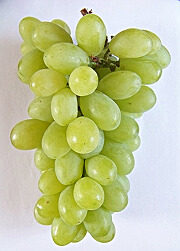 【Victoria】 A Eurasian variety, originating from Romania. The tree is vigorous. The fruit bunches are large, conical or cylindrical, with an average bunch weight of 630 grams. The berries are moderately densely packed; the berries are large, averaging 10.5 grams, oblong in shape, and attractively shaped. The skin is greenish-yellow, of medium thickness, with firm, crisp flesh, a sweet and refreshing taste, a soluble solids content of up to 14.0% , and an acid content of 0.37% , making it a medium-to-high quality fruit. It matures in mid-to-late June when grown in greenhouses . This variety is early-maturing, has large berries, is high-yielding, of excellent quality, and has an attractive shape, giving it strong market competitiveness.
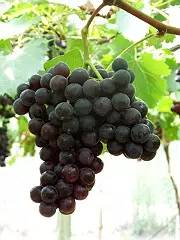 【Xiahei】 A hybrid of European and American grapes, originally from Japan, introduced to Jiangsu, China in 1998. The vine is vigorous. The bunches are large, conical or with shoulders, averaging around 420 grams. The bunches are uniform in size, and the berries are tightly packed. The berries are nearly round, with a natural weight of 3-3.5 grams, which can reach 7-10 grams after gibberellin treatment . The skin is purplish-black, the fruit colors easily and evenly, with a thick bloom, and the skin is thick and crisp. The flesh is firm and crisp, the juice is purplish-red, and the soluble solids content is 18%-20% , reaching up to 24.9% (the sweetest grape record in Zhejiang Province's Agricultural Guinness World Records). It has a strong strawberry aroma, is seedless, and of excellent quality. In greenhouse cultivation, it matures in mid -to-late June. It is highly disease-resistant, high-yielding, and the fruit does not crack or drop after ripening.
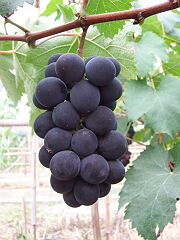 【Jingya】 A European-American hybrid, tetraploid. A new variety selected from Black Olympic grape seedlings by the Beijing Botanical Garden,1992.The fruit bunches are conical, sometimes with secondary bunches, averaging400grams, with larger bunches reaching1000grams. The berries are short-oval, averaging11.5grams, with larger ones reaching18grams. The skin is purplish-black, the flesh is relatively soft, juicy, and has a slightly grassy aroma. Soluble solids content is15%~17%Juneunder greenhouse cultivation. It exhibits strong disease resistance, high yield, does not shatter, and is resistant to transportation.
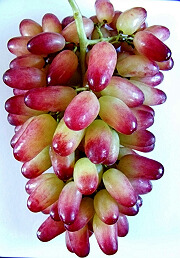 【Beauty Finger】 A Eurasian variety, specifically a Japanese variety. This variety has an average bunch weight of around 1000 grams, with a maximum bunch weight of 1850 grams; the berries are large, averaging 11-12 grams, with a maximum of 20 grams; the berries are slender and elongated, with a glossy purplish-red tip and a slightly lighter base, resembling a beautiful woman's finger with red nail polish, giving them a beautiful appearance. The flesh is crisp, odorless, sweet and refreshing, with soluble solids of 16%-19% . It matures in mid-to-late July when grown in greenhouses . It is relatively resistant to storage and transportation, has vibrant color, good marketability, and commands a high price.
※ Orchard establishment and sapling management
[Vineyard Establishment] Choose a contiguous flat area with flat terrain, deep soil, convenient irrigation and drainage, and a low water table in a coastal region for vineyard establishment, preferably reclaimed tidal flats. Apply 2000 kg of well-rotted organic fertilizer and 25 kg of calcium magnesium phosphate fertilizer per acre, either by broadcasting or by furrowing. Deeply till the entire vineyard and make beds 2.4 meters wide , with a deep furrow every two beds. Select high-quality seedlings from the current year for planting. For varieties with weak self-rooted growth, choose grape-specific rootstocks suitable for the southern climate, such as SO4 , 5BB , or Huajia 8. Before planting, prune the roots of the seedlings, leaving 3 buds at the graft union , and sterilize them by soaking them in a 0.3-0.5 Baume solution of lime sulfur for 1 minute. Plant 185 seedlings per acre , with a spacing of 1.5 meters × 2.4 meters. When planting, dig planting pits 30 cm wide and 15 cm deep, ensuring the roots are evenly distributed at the bottom of the pit. Tamp the soil down with your feet, then fill the pit completely with more soil. Planting should generally be completed before February .
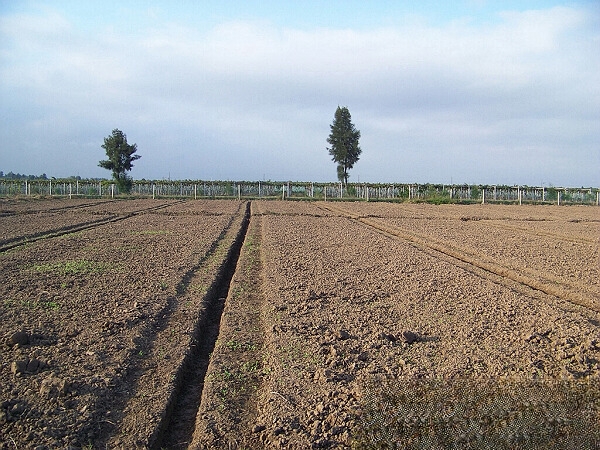
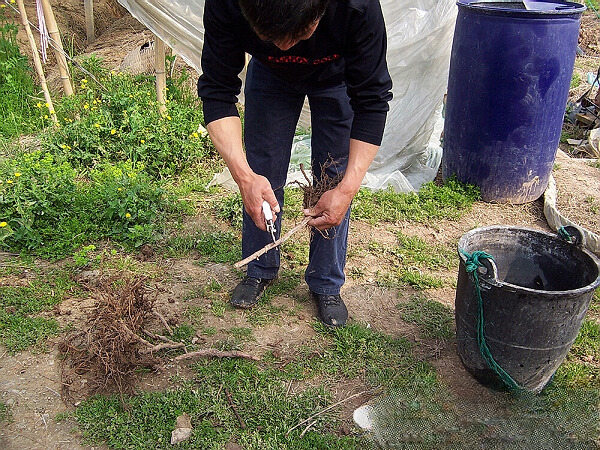
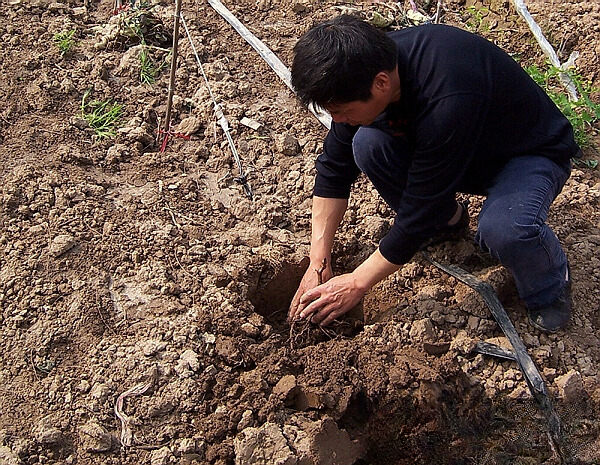
[Management during the sapling stage] Young trees do not require mulching in their first year. After the seedlings sprout, select one of the most vigorous new shoots to cultivate as the main vine, and remove the rest. When the main vine grows to 6 leaves, apply the first top dressing, using 3 kg of nitrogen - rich compound fertilizer per acre , and use bamboo poles for support. Afterward, apply 5 kg of compound fertilizer per acre every 10-15 days, combined with irrigation . When the plant reaches a height close to the trellis, prune or pinch the main vine about 15 cm below the trellis to promote lateral shoot growth. Select 2-4 strong lateral shoots and distribute them evenly on the trellis. When the lateral shoots grow to about 80 cm, perform the second pinching. Repeatedly pinch the first lateral shoot that emerges after pinching, leaving 3-4 leaves; repeatedly pinch the other lateral shoots, leaving 1-2 leaves. Through this repeated pinching treatment, 3-4 strong, mature fruiting branches will form in the first year, and the plant will enter its peak production period in the second year.
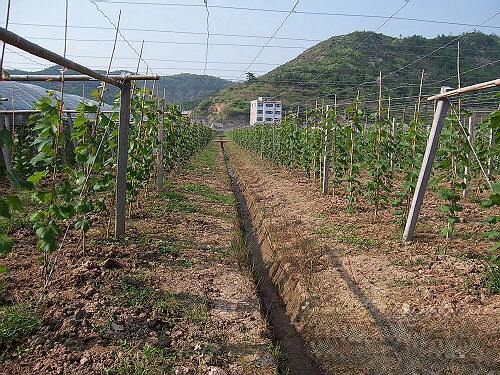
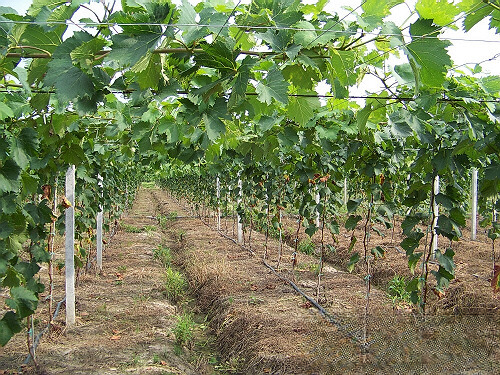
Disease prevention for seedlings mainly focuses on preventing black rot and downy mildew. On sunny days, apply protective agents every 15 days or so, and use fungicides for control after heavy rain.
Greenhouse Management
Begin covering the greenhouse with plastic film for insulation in January. During the budding stage, insulation is the primary focus to promote budding and shoot development. When the temperature inside the greenhouse exceeds 30 ℃ , promptly lift the skirt film for ventilation and cooling. After 3 PM, when the greenhouse temperature drops below 25℃ , lower the skirt film for insulation. Before and after flowering, maintain a daytime temperature of 15℃~28℃ , and ensure adequate insulation at night to facilitate pollination and fertilization, and improve fruit set. During the fruit development period, the outside temperature begins to rise, and the temperature difference between inside and outside the greenhouse decreases. Temperature management focuses on cooling during the day, maintaining a daytime temperature of 28℃~32℃ and a nighttime temperature of 15℃~17℃ . Once the outside temperature stabilizes in early May, all skirt films can be removed. When the daytime greenhouse temperature exceeds 32℃ , for greenhouses with excessively long structures, it is necessary to periodically open part of the top film (open skylights) to help dissipate heat, and close them at night. Remove the top film after fruit harvest.
Greenhouse humidity should be managed according to the principle of high initially, then low, and then level off in the middle. Humidity should be highest during the bud-promoting period, above 90% ; lowest during harvest, below 60% ; and controlled between 50% and 70% during flowering and fruit enlargement . When fog forms inside the greenhouse, ventilation should be carried out promptly to remove excess moisture. Especially during flowering, a relative humidity of 65% is ideal; excessively high humidity will affect pollination and fertilization, resulting in parthenocarpic fruit and uneven fruit size.
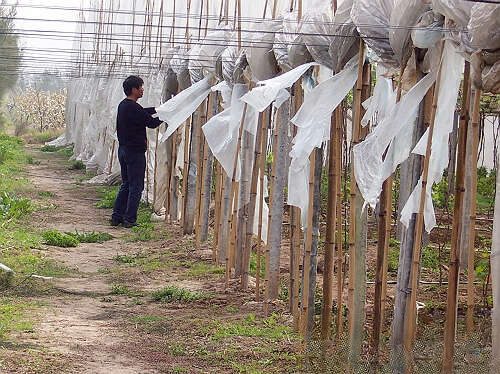
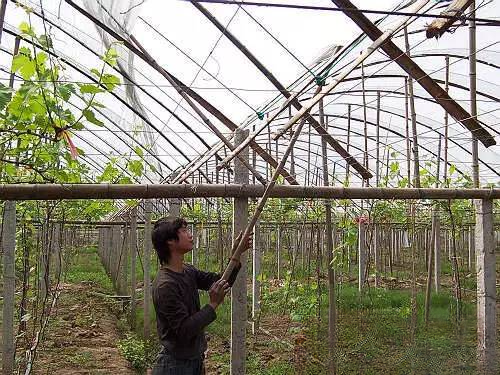
Orchard Management
[Soil Management] Deep tilling should be carried out every October in conjunction with the application of organic fertilizer. Apply 2500 kg of well-rotted organic fertilizer per acre, either by applying it in trenches or spreading it on both sides of the tree. At the same time, deep tilling should be carried out throughout the orchard or gradually increased in depth each year, generally to a depth of about 30 cm. This can improve soil fertility, improve soil structure, promote new root growth, and enhance tree vigor. During the forcing cultivation period, mulch should be used to reduce air humidity and decrease the occurrence of gray mold. During rain-sheltered cultivation, a straw system should be implemented. During open-field cultivation, legumes or vegetables can be intercropped to improve land utilization and economic benefits.
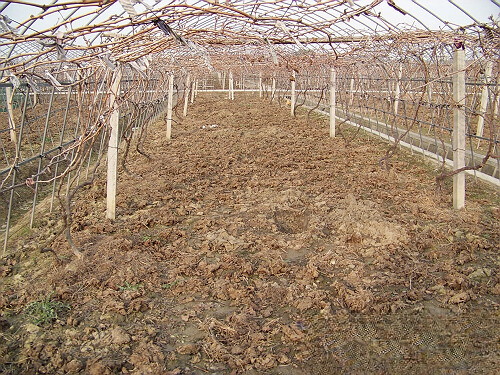
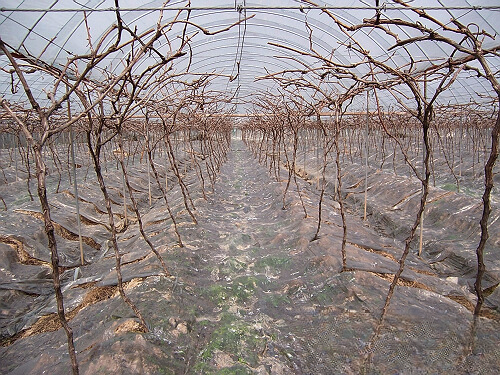
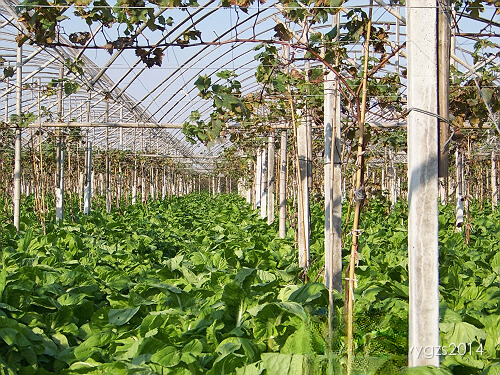
[Fertilizer and Water Management] A combined fertilizer and water irrigation system is generally established in the greenhouse, and fertilizer and water management is carried out through this system during the growing season. 15 days after mulching, apply 10 kg of compound fertilizer per mu (0.067 hectares). For trees with weak growth, apply an additional 10 kg of compound fertilizer when the new shoots have grown to 5-7 leaves . After fruit set, apply 20 kg of compound fertilizer per mu, divided into two applications. Before coloring, apply 7.5-10 kg of potassium magnesium sulfate fertilizer per mu. After harvesting, apply 15-20 kg of compound fertilizer per mu to restore tree vigor. In the early stage of new shoot development, spray the leaves with 0.1%-0.2% organic liquid fertilizer 1-2 times in conjunction with disease prevention . Before flowering, spray the leaves with a 2000- fold dilution of Cuikang Jinbo liquid . During the fruit growth period and after harvesting, spray the leaves with trace elements such as potassium, zinc, and calcium 2-3 times every 10-15 days .
Five days before mulching , irrigate thoroughly . After bud break, irrigate moderately in conjunction with fertilization. Seven days before flowering, irrigate lightly . After fruit set, irrigate thoroughly to promote young fruit growth. During fruit enlargement, irrigate lightly or moderately every 7-10 days in conjunction with fertilization, keeping the soil layer below 10 cm moist. Irrigate thoroughly again during the second growth peak before the fruit softens to ensure fruit enlargement. After the fruit begins to color, control irrigation, keeping the soil appropriately dry to prevent fruit cracking and increase sugar content.
※Flower and Fruit Management
[Inflorescence Thinning] Inflorescence thinning can be done using the method of ' 2 for strong , 1 for medium , and none for weak ' . First, remove weak, deformed, overly dense, and improperly positioned inflorescences from the fruiting branches. Strong fruiting branches can retain 2 inflorescences, medium-sized fruiting branches can retain 1 inflorescence, and weak branches should not retain any inflorescences. The number of inflorescences selected should match the yield target. Generally, for a vineyard with a yield target of 1500 kg per mu , 2000-2500 inflorescences can be selected based on the size of the fruit bunches .
[Harvest Shaping] Harvest shaping includes removing secondary ears, pinching the ear tips, straightening the ears, and shaking the ears. To ensure aesthetically pleasing ears, uniform fruit size, and consistent ripening, for varieties with high fruit set rates, the first secondary ear (removing secondary ears) and the tip of the first 1/4 to 1/5 of the inflorescence should be pinched off before flowering (pinching the ear tips). Straightening the ears refers to, before and after fruit set, tying the vines together and gradually straightening the ears resting on the wire or branches down to the canopy surface. While straightening, gently shake the ears a few times to shake off shriveled and poorly fertilized small grains (shaking the ears). Straightening and shaking the ears are best done in the afternoon when the ear stalks are soft and less likely to break.
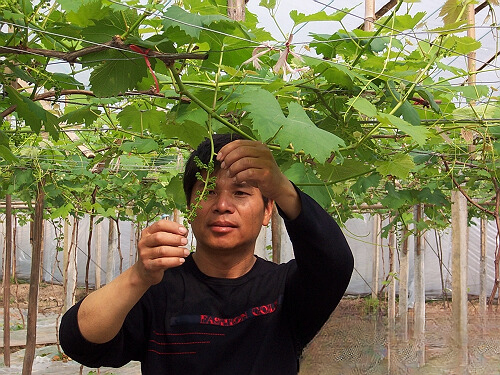
[Fruit Thinning] To improve the marketability of the fruit, fruit thinning should be carried out after the fruit bunches are shaped. Thinning is best done when the fruit is about the size of a soybean after setting, removing small and overly dense fruit to ensure uniform fruit size. The number of fruit retained depends on the variety, but is generally around 35-50 .
※ Shaping and trimming
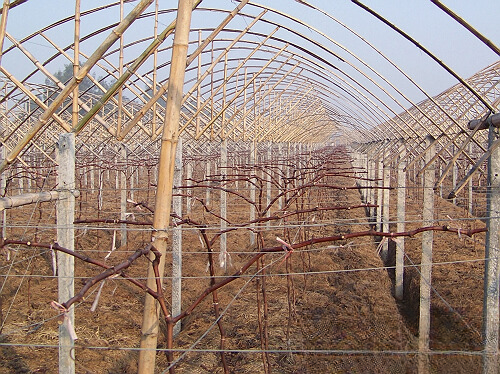
[Winter Pruning] Generally, a small "X" shape is adopted on a flat trellis . December is the ideal time for pruning. The purpose of winter pruning is to control the number of flowers retained, maintain the tree shape, stabilize the tree vigor, reduce the sprouting of ineffective buds, regulate the balance between fruiting and growth, and ensure a neat tree shape, uniform flower buds, and vigorous fruiting capacity. Therefore, winter pruning of grapevines generally follows the principle of evenly distributing branches within the trellis space while paying attention to branch renewal. Different pruning methods should be used depending on the vigor of the tree; weak trees require heavier pruning, while strong trees require lighter pruning. The number of branches retained is generally controlled between 1500 and 1800 , with 8-10 excellent fruiting branches retained per vine , and each fruiting branch pruned to retain 3-6 buds.
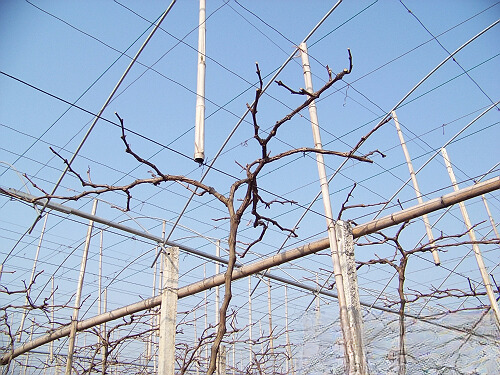
[Growing Season Pruning] Bud removal should be carried out promptly after bud break. Bud removal should be done in batches before the new shoots begin to grow rapidly. First, remove buds sprouting from the base of the rootstock and main vine, as well as compound buds among ternary and twin buds. Then remove overly dense, poorly developed, improperly positioned, downward-growing, and excessively early-growing terminal buds. After the inflorescence appears, determine the number of shoots to retain based on yield targets, bunch size, and variety, and remove new shoots without inflorescences and overly dense new shoots in batches. Generally, retain two fruiting branches per fruiting mother branch. Based on a yield of 1500 kg per acre , the number of branches retained per acre should be controlled to within 3600 for Kyoho grapes, with no more than 20 branches per vine; for Fujiminori grapes, the number should generally be controlled to within 2500 branches, with no more than 15 branches per vine. Retain moderately viable branches at the base as renewal branches to prevent the fruiting position from shifting outwards.
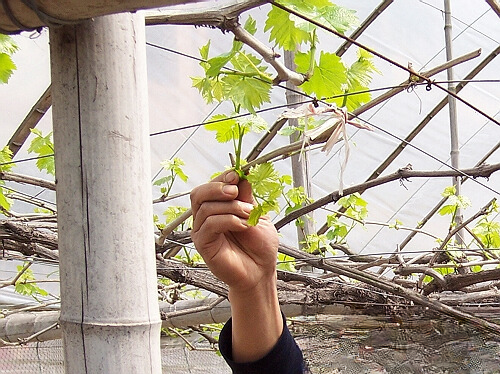
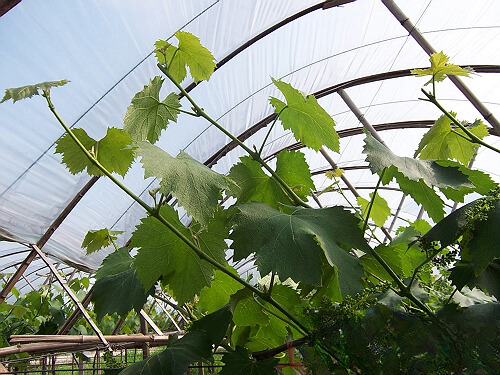
When the first flower appears in the entire garden, pinch off the tips uniformly. Generally , pinch off the tip of the flower spike, leaving 4-6 leaves. Remove all lateral shoots below the flower. Pinch off the lateral shoots above the flower, leaving 1-2 leaves. For subsequent new lateral shoots, pinch off the top leaves 2-3 leaves and the rest leaves 1 leaf. When the new shoots grow to the 6th leaf, tendrils will appear and should be removed promptly. During the hardening stage, allow the entire garden to grow shoots. During the coloring stage, pinch off the tips of all new vines . Stop pinching at the end of July .
※Pest and disease control
During greenhouse grape cultivation, the mulching stage protects the vines, leaves, and fruit from rain, leading to changes in disease control. Black rot is largely prevented, and downy mildew and anthracnose are significantly reduced. However, gray mold, rachis rot , and white rot become more severe. Therefore, improving the ecological environment of the vineyard is crucial for pest and disease control.Based on health cultivation measures such as improving ventilation and light penetration and enhancing plant disease resistance, the focus is on eliminating pathogens. Following the principle of " prevention first and comprehensive control " , a comprehensive control approach is adopted, which combines thorough garden cleaning in winter, eradication of pathogens during the pompom stage, use of frequency-vibrating black light lamps to attract and kill pests, and targeted spraying during the growing season .
Spray 6-7 times throughout the year . During the pompom stage, use 3-5 Baume lime sulfur solution (or 30-40 times dilution of 45 % crystalline lime sulfur solution ) to kill pathogens and insect eggs. Before flowering, spray with 50% wettable powder of iprodione at a dilution of 1000 times; after flowering, spray with 50% cypermethrin suspension at a dilution of 1200 times (or 3% polyoxin No. 2 at a dilution of 1000 times) to control gray mold, rachis brown blight, etc.; from the young fruit stage to the early maturity stage, spray with 70% thiophanate-methyl wettable powder at a dilution of 1000 times (or 50% carbendazim wettable powder at a dilution of 800 times, 50 % imidacloprid EC at a dilution of 4000 times, etc.) 2-3 times to control powdery mildew, white rot, anthracnose, etc.; stop all pesticide use 15 days before harvest; after harvest, spray with 80% mancozeb M-45 wettable powder at a dilution of 800 times to control downy mildew, rust, etc.; 10 days later, spray with half-strength Bordeaux mixture to control downy mildew and protect the leaves.