Four Diseases and Eight Pests: Integrated Pest Management Program for Organic Citrus
As the climate warms and the phenological period of citrus fruits lengthens, the variety of citrus pests has increased, and the damage caused is becoming increasingly serious. There are more than 450 kinds of citrus diseases and pests, of which more than 50 are serious. The pathogens that cause citrus diseases fall into two main categories: biological and abiotic.
Due to warmer weather and a longer phenological period for citrus, there is a greater variety of citrus pests, leading to increasingly serious damage. There are over 450 species of citrus diseases and pests, with more than 50 causing severe damage. The pathogens causing citrus diseases fall into two main categories: biotic and abiotic. Citrus diseases caused by biotic pathogens are called infectious diseases, while diseases caused by abiotic factors in environmental conditions are called non-infectious diseases.
I. Diseases and Control of Organic Citrus
(a) Citrus anthracnose
1. Symptoms: Citrus anthracnose can affect leaves, branches, flowers, and fruits. Leaves can develop two types of lesions: leaf spot and leaf blight. Leaf spot lesions are round, semi-circular, or irregular in shape, with dark brown edges, a grayish-white center, and small black dots on the surface. Leaf blight lesions often expand downwards in a "V" shape from the leaf tip, forming large yellowish-brown patches with indistinct edges. Diseased leaves easily fall off, and pinkish dots appear on the affected area under humid conditions. On branches, there are two types of damage: one often occurs on frost-damaged branches, causing the branch to die downwards, with the dead area being grayish-white and covered with small black dots; the other affects the bark in the middle of the branch, forming long, slightly sunken, spindle-shaped brown lesions. If the lesion encircles the branch, the upper part dies. Infected flowers turn brown, rot, and easily fall off. Affected fruits develop yellowish-brown, sunken lesions, round or nearly round, while the flesh is generally unaffected. Another type often occurs during storage, with dark brown lesions on the fruit that gradually expand and cause the entire fruit to rot. Sometimes, blackish-green mycelium and small black dots grow on the surface.
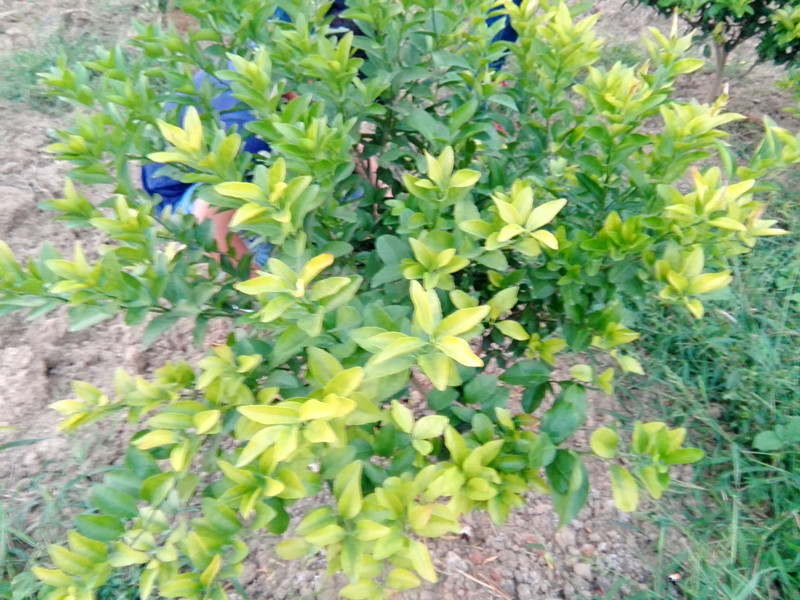
2. Pathogen and Disease Development: Citrus anthracnose is caused by a fungus. The pathogen overwinters in the affected parts of the tree and is transmitted to the tree in spring by wind, rain, and insects, easily invading the tree. When the tree is vigorous, no disease will occur; only when the tree is weak will the disease appear. Therefore, this disease is easily induced when fruit trees are subjected to adverse factors such as frost damage, water and drought damage, nutrient deficiency, or pest damage.
3. Control methods: Under the premise of strengthening cultivation management and enhancing tree vigor, protective spraying should be carried out regularly during the shoot emergence period and young fruit stage. Generally, during the young fruit stage in May-June and the peak disease period in September, spray once every 15 days, for 2-3 consecutive times. Suitable pesticides include Trichoderma harzianum foliar type (300x dilution), 10% polyoxin wettable powder (1000x dilution), or 12% copper rosinate emulsifiable concentrate (800x dilution).
(II) Citrus canker
1. Symptoms: This disease affects the leaves, fruits, and new shoots of citrus. Affected leaves develop evenly raised, nearly circular lesions on both the upper and lower surfaces. The surface of the lesions becomes corky, rough, and grayish-brown. Later, the center of the lesion becomes sunken, forming a crater-like crack, surrounded by a yellow halo. Lesions on the fruit are largely similar to those on the leaves, but lack the surrounding yellow halo. These lesions only affect the peel and not the flesh, and in severe cases, can cause fruit drop. Lesions on twigs are similar to those on the fruit, and in severe cases, can cause leaf drop and twig death.
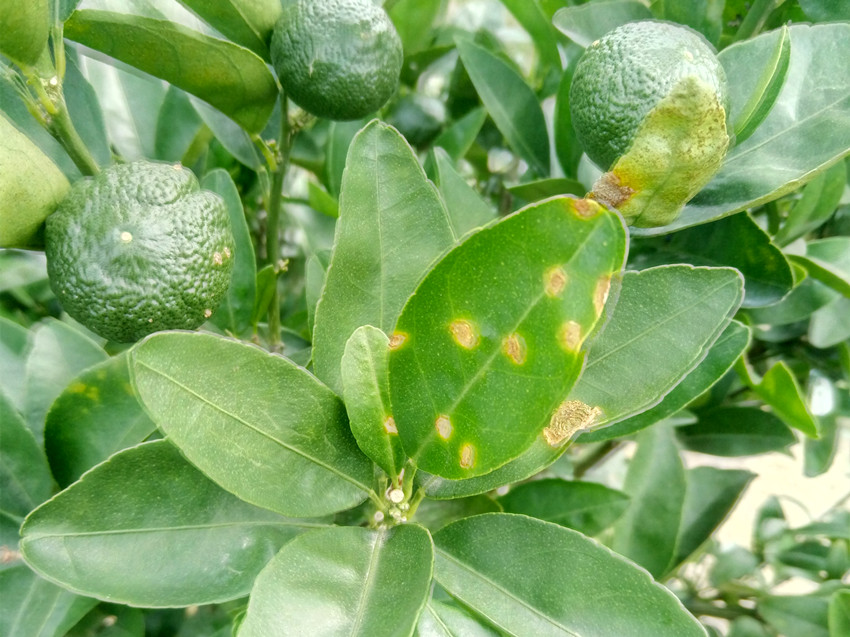 2. Pathogens and Disease Development: *Xanthomonas citrus* and *Xanthomonas tumefaciens*, both belonging to the genus *Xanthomonas*, overwinter in diseased leaves, branches, or fruits. In the following spring, they emerge from the diseased parts upon contact with water and spread through rainwater, insects, seedlings, scions, and fruits, entering the host through stomata, lenticels, or wounds. The pathogens have latent infectivity; some citrus trees may appear healthy but are infected, while others may have autumn shoots infected but show no symptoms in winter, only manifesting in spring. The disease can occur from late March to December, with three peak periods annually. The peak incidence on spring shoots is in early May, on summer shoots in late June, and on autumn shoots in late September, with the most severe damage occurring on summer shoots in June and July, and late summer shoots. The disease is more severe with higher rainfall at temperatures between 25 and 30°C. The disease is more likely to occur after storms and typhoons. Leaf miners, noxious leaf-eating insects, swallowtail butterfly larvae, and typhoons are not only disease vectors, but the wounds they create also facilitate pathogen infection and exacerbate disease occurrence. Improper cultivation management, such as excessive nitrogen fertilizer, mixed planting of varieties, and inadequate control of summer shoots, promotes disease development.
3. Prevention and Control Methods: Quarantine control: Strictly enforce quarantine measures in disease-free areas or newly developed citrus areas, prohibiting the transport of seedlings, scions, or fruits from infected areas. Any such items discovered must be thoroughly destroyed on-site. Agricultural control: Strengthen cultivation management. Avoid excessive nitrogen fertilizer application and increase potassium fertilizer application; control fertilizer and water application in the citrus orchard to ensure uniform summer and autumn shoot growth. In conjunction with winter orchard sanitation, thoroughly remove all remaining branches, fruits, and fallen leaves from the trees and ground, and burn or bury them deeply. Control summer shoots, remove early autumn shoots, and allow new shoots to emerge at the appropriate time. Chemical control: Apply 12% copper rosinate emulsion at 800 times dilution and 95% mineral oil at 200 times dilution before the spring shoots, and then spray once every 10-15 days for a total of 3-4 times. The number of sprays can be adjusted according to local weather conditions and the occurrence pattern of the disease. Do not apply the pesticide during the flowering period. Apply Ruizhen (Bacillus subtilis) at 300 times dilution as a foliar spray, and then spray once every 7-10 days for a total of 3-4 times.
(III) Citrus scab disease
1. Symptoms: Leaf lesions are small, mostly sunken on the upper surface and conical on the lower surface, with corky protrusions and a rough, grayish-brown, scab-like surface. When there are many lesions, the leaves become twisted and deformed. Damage to new shoots is similar to that on leaves, but the conical protrusions are less pronounced, and the shoots become shorter and twisted. Young fruits develop yellowish-brown, conical, corky, tumor-like protrusions and fall off prematurely. Fruits affected later have a rough surface, are small, have thick skin, taste sour, and are deformed.
 2. Pathogen and Disease Development: The pathogen of citrus scab is *Citrus citrinum*, a fungus belonging to the Deuteromycetes. The fungus overwinters in the affected parts of the plant and spreads through wind and rain when spring temperatures exceed 15℃. Newly emerging leaves, shoots, and young fruit after flowering are highly susceptible. The optimal temperature for disease development is around 20-24℃. During this period, continuous rain, heavy fog, and dew promote disease development. Spring shoots are most severely affected, followed by autumn shoots.
3. Prevention and control methods: Prune diseased branches and leaves in winter, remove and burn them; spray with 12% copper rosinate emulsion at 800 times dilution; spray with Ruizhen (Bacillus subtilis) at 300 times dilution once when spring buds are no more than 1cm long and once when 2/3 of the flowers have fallen.
(iv) Citrus foot rot
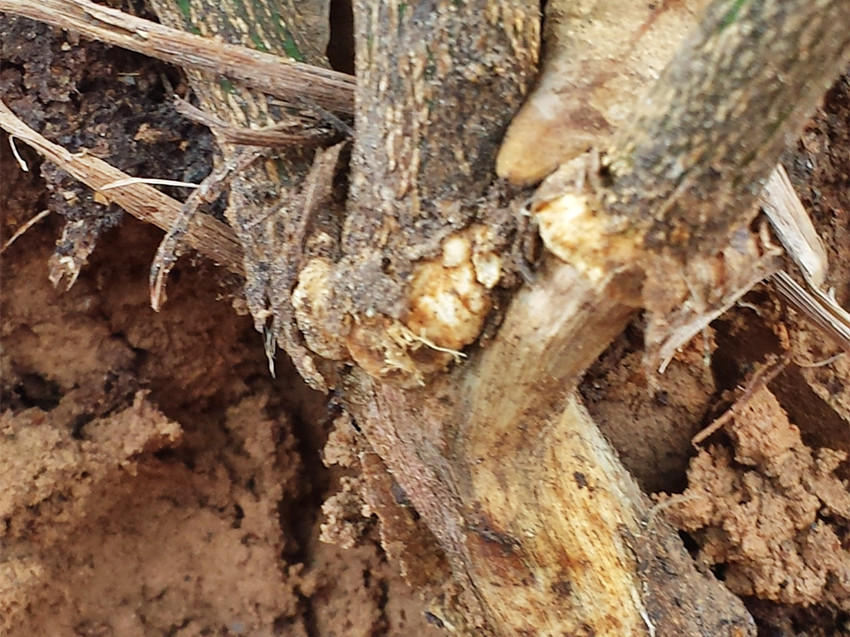
1. Symptoms: Citrus foot rot affects the base of the citrus trunk near the ground (root base). The bark of the affected area rots irregularly, is grayish-brown, water-soaked, and has a fermented smell. Under suitable conditions, the lesions spread rapidly, encircling the trunk and causing the entire tree to die, with leaves turning yellow and falling off.
2. Pathogen and disease development: Citrus foot rot is caused by a fungus. High temperatures and heavy rainfall, heavy clay soil, poor drainage, damage to the bark at the base of the trunk, and planting too deep all contribute to the development of the disease.
3. Prevention and control methods: Prevent waterlogging in the orchard, control pests such as longhorn beetles and jewel beetles in a timely manner, reduce damage to the root and stem base, and ensure that the grafting point is exposed above the ground. For the treatment of diseased trees, dig up the soil at the base of the diseased tree, scrape off the rotten parts, and apply Bordeaux mixture or 12% copper rosinate (Bacillus subtilis) every 7-10 days for 2-3 consecutive times.
II. Pests and Control of Organic Citrus
(a) Citrus aphids
In addition to citrus, the citrus aphid also damages other fruit trees such as peach, pear, and persimmon. Adult and nymph aphids congregate on the surface of tender leaves, stems, and young fruits, sucking sap. Damaged young leaves become wrinkled, and severe infestations can cause fruit drop and affect the following year's yield.
1. Identification features: Wingless female aphids are 0.13 cm long and are brownish-black all over. Nymphs are about 0.05 cm long and are brownish-black.
2. Occurrence pattern: There are more than 10 generations per year, with eggs overwintering on the branches and trunks of citrus trees. The most abundant occurrences are in April-May and September-October of the following year, with egg-laying and overwintering occurring in December. High summer temperatures are unfavorable for citrus aphids, resulting in high mortality and low reproductive rates, leading to fewer occurrences in summer.
3. Control measures: When aphids are found on 1/4 of the new shoots, spray pesticides promptly. Use 95% mineral oil (200 times dilution), 0.5% matrine (600-800 times dilution), or 0.3% azadirachtin (600-800 times dilution) for spraying. When the number of aphids is small, control measures can be taken at any time (i.e., select individual citrus trees or citrus orchards with aphids for spraying).
(ii) Arrowhead Scale
The arrowhead scale infests the branches, leaves, and fruit of citrus trees. Infested branches and leaves turn yellow and lose their green color, affecting the tree's vigor. Infested fruit cannot fully ripen and color properly; the peel around the insect's body turns green, greatly impacting its commercial value. Severe infestations can cause leaf scorch, branch dieback, and even widespread tree death.
1. Identifying features: The female adult scale insect's shell is about 0.2-0.3 cm long, slender and oval, gradually tapering from back to front. The shell is brownish-brown, with a raised longitudinal ridge in the center and a white waxy edge around it. The male scale insect secretes a slender, white, cottony waxy powder, and has two longitudinal ridges on its back.
2. Occurrence Pattern: There are three generations per year. Fertilized female scale insects overwinter on branches and leaves. In mid-to-late May of the following year, each female lays dozens to over a hundred eggs under its shell. The peak infestation period for the first generation of first-instar juveniles is in late May, primarily affecting new leaves. The second generation appears in mid-July, mostly parasitizing fruit surfaces, with some parasitizing leaves and branches. The third generation appears in early September, affecting branches, leaves, and fruit surfaces. First-instar juveniles are about 0.3 mm long, orange-yellow, oval-shaped, with well-developed antennae and legs, which facilitate dispersal and spread. Second-instar juveniles are pale yellow, with lost antennae and legs, and attach to piercing and sucking food.
3. Control methods: Prune infested and dead branches in winter and spring, and burn them to eliminate a large number of overwintering adult female scale insects. During winter and spring orchard cleanup, apply a 100-fold dilution of 95% mineral oil to overwintering adult female scale insects to reduce the number of first-generation larvae. Throughout the year, focus on controlling the first-generation, first-instar larvae. Spray with a drenching method in late May to mid-June, repeating 2-3 times after 10-15 days. A 200-fold dilution of 95% mineral oil provides long-lasting efficacy, good control, and is safe for natural enemies. Avoid use during periods of high temperatures. After mid-July, protect natural enemies and implement biological control measures to maintain control.
(III) Citrus Red Spider Mite
The citrus red spider mite, also known as the citrus golden claw mite, is a pest whose adults, nymphs, and larvae pierce and suck sap from leaves, tender shoots, and fruit peels, with leaves being the most severely affected. Infested leaves develop chlorotic white spots; in severe cases, the entire leaf turns grayish-white, loses its luster, and causes significant leaf drop, impacting tree vigor and yield. It is a common and explosive pest of citrus, considered a top priority.
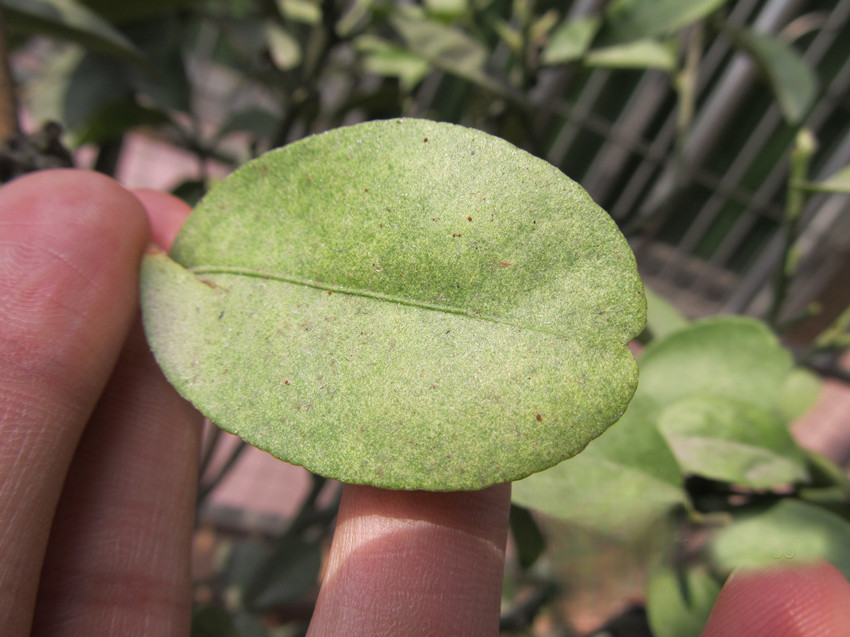
1. Identifying characteristics: Female adult mites are 0.3-0.4 mm long, dark red, oval-shaped, with tubercles on their backs and sides, covered with white hairs, and have 4 pairs of legs. Male adult mites are slightly smaller than females, bright red, narrower at the posterior end, and pear-shaped. Nymphs are similar in shape and color to adults, but smaller, and have 4 pairs of legs. Larvae are 0.2 mm long, paler in color, and have 3 pairs of legs; after their first molt, they become pronymphs, after their second molt, they become late nymphs, and after their third molt, they become adults.
2. Occurrence Pattern: More than 10 generations occur annually, with overlapping generations. Eggs and adults overwinter on the undersides of leaves. The most severe infestations occur in spring and autumn. During the spring shoot growth period in April and May, overwintering adults and larvae/nymphs hatched from overwintering eggs migrate from older leaves to tender shoots and new leaves, causing damage. If not controlled promptly, this can lead to a large-scale infestation. The insect density begins to decline in June, remains low during the high-temperature season of July and August, and then rises again in autumn (September and October), damaging autumn shoots and tender leaves.
3. Control methods: Use 95% mineral oil (200x dilution) and 0.3% azadirachtin (600-800x dilution). Protect and utilize field-feeding mites and ladybugs for predation.
(iv) Citrus leafminer
The citrus leafminer is commonly known as the "ghost scratcher." The larvae bore into the underside of young leaves, feeding on the leaf tissue and creating winding, feeding tunnels. Affected leaves curl up or harden, becoming easily detached, thus impacting growth and development.
Control methods: Manually remove summer shoots to interrupt the food source for early-emerging leafminer larvae and reduce their numbers. Promote early autumn shoot growth by controlling shoot growth and ensuring uniformity. Generally, release autumn shoots uniformly in late August, and spray with 0.3% azadirachtin at a dilution of 600-800 times every 7 days for control.
(V) Citrus fruit fly
The citrus fruit fly is a quarantine pest that damages the fruit of citrus trees. The larvae burrow into the fruit and feed on the fleshy segments, often causing the fruit to turn yellow prematurely and fall off early. Infested fruit is also prone to rotting, severely impacting yield and quality.
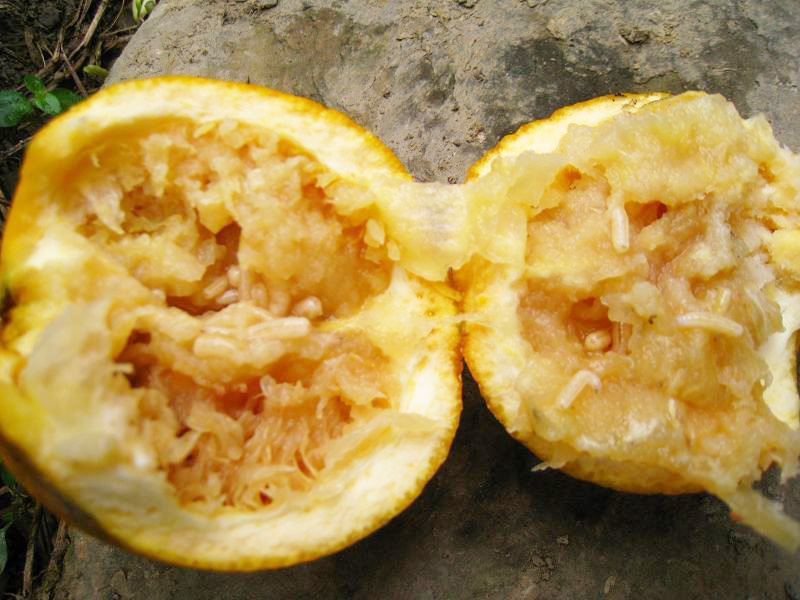
1. Identifying features: Adults are 1-1.3 cm long, yellowish-brown all over. There is a dark brown "V"-shaped marking on the center of the dorsal surface of the thorax. The anterior margin of the second abdominal segment has a broad black transverse stripe that intersects with a black stripe on the center of the dorsal surface of the abdomen, forming a cross shape. The apex of the wings has a distinct misty pattern. Mature larvae are 1.5-1.9 cm long, milky white, legless, with a pointed head and a robust body; pupae are about 0.9 cm long, oval, and golden yellow; initially pale yellow, turning yellowish-brown before hatching.
2. Control methods: Organize joint prevention and control efforts. In affected citrus orchards, fallen fruit should be promptly collected and destroyed during the fruit drop period. At the same time, unripe fruit with insects on the trees should also be removed. Infested fruit should be boiled in water for 2-3 minutes or buried 1 meter deep. Starting in June, during the adult insect hatching and emergence period, hang Green True No. 1 (yellow sticky traps), attractant balls, or insecticidal lamps.
(vi) Citrus rust mite
Citrus rust mite, commonly known as "black-skinned fruit," is a mite that infests fruit by piercing and sucking its flesh. The fruit turns brown to dark brown after being damaged, which seriously affects its commercial value.
1. Identifying characteristics: Adult mites are 0.1-0.2 mm long, orange-yellow, and carrot-shaped. They have four pairs of legs located on the cephalothorax. The abdomen has numerous rings, with the ventral rings being approximately twice as numerous as the dorsal rings. The abdominal legs have one pair of long hairs. Nymphal mites are smaller and have two pairs of legs. The abdominal rings are less distinct, and the body is pale yellow.
2. Control methods: Rust mites are rampant from July to September. Starting in late June, when an average of 2 mites are found per leaf and 5 mites per fruit, spray pesticides until the end of September. (Currently, a layer of grayish-white molted insect remains is observed on the surface of the green fruit.) Spray 2-3 times. Use 45% lime sulfur solution at a dilution of 300-500 times, 95% mineral oil emulsion at a dilution of 200 times, or 0.3% azadirachtin at a dilution of 600-800 times.
(vii) Citrus flower bud maggots
The larvae bore into the citrus flower buds, preventing them from opening and pollinating, thus significantly impacting yield. They are a major pest during the citrus flowering period.
1. Identifying features: Mature larvae are about 0.25 cm long, milky white, legless, and have a brown "Y"-shaped skeletal plate on the ventral surface of the mesothorax. Infested flowers are short and stout, with petals that do not open, and the base of the petals is often bluish-green. The flowers are filled with small maggots.
2. Control methods: Spray with 95% Bio-Oil mineral oil at 300 times dilution and 1.5% pyrethroid at 500 times dilution before flowering.
(8) Citrus tree lice
The citrus psyllid belongs to the order Hemiptera and the family Psyllidaceae. It is a major pest of citrus during the tender shoot stage, mainly damaging citrus fruits, but can also damage Rutaceae plants such as Murraya paniculata and Cimicifuga foetida.
1. Characteristics of Occurrence: Adults and nymphs congregate on tender shoots, young leaves, and new buds to suck sap. Affected tender shoots and young buds wither and dry up, and new leaves become deformed and twisted. The insect's excrement, commonly known as "honeydew," can also induce sooty mold. More importantly, this insect has been proven to be a vector for citrus Huanglongbing (HLB). Therefore, effective control of citrus psyllids is not only necessary to reduce insect damage to citrus, but also a crucial link in the integrated management of citrus HLB and controlling its spread.
2. Morphological characteristics: The adult is a small insect about 3 mm in length. It is bluish-gray all over, with translucent forewings with brown markings, and its body is covered with white wax powder. The head is pointed, and the mesothorax and metathorax are relatively wide. The whole insect is nearly rhomboid. The nymphs are flat and oval, with yellow bodies. There are 5 instars, each with wing buds. The periphery of the abdomen of each instar nymph secretes short white wax filaments.
3. Life Cycle: This insect can have 8-14 generations per year. In citrus orchards in Guangdong, Guangxi, Fujian, and Taiwan, all stages can be observed throughout the year. Adults overwinter densely on the undersides of leaves, and begin laying eggs and reproducing on tender buds of spring shoots from late February of the following year. Generations overlap throughout the year. The population fluctuations of the citrus psyllid coincide with the emergence period of new citrus shoots. In South China, there are three peaks in the insect population throughout the year: mid-March to April, late May to late June, and July to August/September, which are the main periods of spring, summer, and autumn shoot emergence for citrus. Generally, the population is highest and the damage is most severe on autumn shoots, which can cause the autumn buds to wither and die. The number of psyllids varies in different citrus orchards due to differences in nutrition and reproductive conditions. Food, climate, cultivation, pesticide spraying, and the activity of natural enemies are factors that affect the population density of psyllids, among which food has the most significant impact. Without tender buds, psyllids cannot lay eggs. Prolonged periods of overcast and rainy weather are detrimental to the reproductive activities of psyllids, resulting in a significant decrease in their population. Typically, the psyllid population density on weakened trees and trees infected with Huanglongbing (HLB) is much higher than that on healthy trees, with differences ranging from 10 to dozens of times. This is because the canopies of weak and diseased trees are sparse with branches and leaves, and their shoots grow unevenly, which is conducive to the egg-laying and reproduction of psyllids.
4. Control Methods: Citrus psyllids are often found in clustered, core distribution patterns within citrus orchards. Adults are weak fliers and migrate slowly, while nymphs are even less active. Adults are attracted to yellow and red colors. Based on these characteristics, control measures should focus on comprehensive pest surveys. Once a source of infestation is identified, timely spraying of pesticides can effectively control the pest and disease. Agricultural Control: Maintain proper orchard management and avoid planting multiple varieties in combination. Promptly remove trees that have lost their fruiting capacity due to Huanglongbing (HLB) and weakened trees to reduce the source of infestation. Strengthen canopy management to ensure uniform branch growth and create unfavorable breeding grounds for the psyllids. Ecological Control: Primarily, create protective forest belts to create an environment unfavorable to the reproduction and spread of psyllids. In orchards where protective forest belts cannot be created, at least intercropping with tall green manure along the orchard edges and between rows can hinder the migration and spread of psyllids, achieving the effect of pest control and disease prevention. Biological control: Natural enemies of citrus psyllids include flea wasps, ladybugs, lacewings, flower bugs, thrips, mantises, hoverflies, mites, spiders, and ants. Among them, flea wasps, which parasitize nymphs and pupae, can have a parasitism rate as high as 30%–50%, and have a certain inhibitory effect on psyllids; therefore, their protection and utilization should be considered. Chemical control: Based on accurate monitoring of the insect occurrence period and population size, timely spraying should be carried out when each new shoot sprouts about 5 cm in length. Suitable pesticides include 95% mineral oil EC at 300 times dilution, 0.3% azadirachtin EC at 800 times dilution, and 2.5% rotenone EC at 500 times dilution.
Pest and disease control programs for organic citrus at different stages
1. Before or in the early stage of budding
Garden sanitation, primarily controlling: frost damage, moss, spider mites, scale insects, psyllids, aphids, scab, lichen, and promoting healthy flowers and leaves. Use 150x dilution of Bayer mineral oil and 600x dilution of 12% copper rosinate. Biological control: predatory mites.
2. Flower bud stage
Before the flower buds show white (first showing white), spray the ground with 1.5% pyrethrum at 500 times dilution and 95% mineral oil at 200 times dilution in the morning after a night rain to prevent bud maggots.
3. Peak blooming period
Apply pesticides during peak flowering to target gray mold. Spray with a 300-fold dilution of Trichoderma harzianum foliar type and a 300-fold dilution of Bayvo fish protein biostimulant.
4. When 2/3 of the flowers have withered
To prevent and control scab, leafrollers, and moss, and to protect flowers and fruits, spray with 12% copper rosinate at 800 times dilution, 0.0075% brassinolide aqueous solution at 3000 times dilution, and 0.3% azadirachtin at 600 times dilution.
5. Late May (20 days after the flowers have faded)
Prevents black spot disease, spider mites, scale insects, whiteflies, large fruit flies, and yellow spot disease; promotes beautiful fruit, less cracking, and strong leaves. Use 200-300 times diluted Baiwo mineral oil, 800 times diluted 12% copper rosinate, 300 times diluted Baiwo fish protein biostimulant, and 600 times diluted 0.3% azadirachtin. Hang Green True No. 1 (yellow sticky trap), 6-10 tablets per acre.
6. Mid-June (40 days after the flowers have faded)
Prevents black spot disease, spider mites, scale insects, whiteflies, large fruit flies, and yellow spot disease; promotes beautiful fruit, less cracking, and strong leaves. Use: 200-300 times diluted Biovo mineral oil, 800 times diluted 12% copper rosinate, 300 times diluted Biovo fish protein biostimulant, and 600 times diluted 0.3% azadirachtin. Hang Green True No. 1 (yellow sticky traps) at 6-10 tablets per acre. Biological control: predatory mites.
7. Mid-July (60 days after the flowers have faded)
Prevents black spot disease, spider mites, scale insects, whiteflies, large fruit flies, and yellow spot disease; promotes beautiful fruit, less cracking, and strong leaves. Use Woyoumeikang (800-1000x dilution), 12% copper rosinate (800x dilution), Baiwo fish protein biostimulant (300x dilution), and 0.3% azadirachtin (600x dilution). Hang Green True No. 1 (yellow sticky traps) at 6-10 tablets per acre. Biological control: predatory mites.
8. Mid-August to early September (expansion period)
To prevent spider mites, treat second-generation scale insects and small fruit flies; supplement with magnesium to improve leaf lifespan and prevent leaf yellowing before and after harvest. Use Woyoumeikang (800-1000 times dilution), Trichoderma harzianum foliar type (300 times dilution), and Baiwo fish protein biostimulant (300 times dilution), and hang Green True No. 1 (yellow sticky traps) at 6-10 tablets per acre. Biological control: predatory mites.
9. 3-5 days before harvesting
Use 150-200 times diluted Baivo mineral oil to carefully and evenly spray the fruit, achieving a triple effect of washing, waxing, and beautifying the fruit.
October, mid-November
Baiwo mineral oil 150x dilution, 12% copper rosinate 600x dilution. Note: The application plan can be adjusted appropriately according to the main pests and diseases and their occurrence period in different regions.