Diseases and pests of marigolds and their control measures
Marigolds, also known as calendula, are annual herbaceous plants belonging to the genus *Mattina* in the family Asteraceae. What are the common pests and diseases affecting marigolds? What are the main measures for their control?
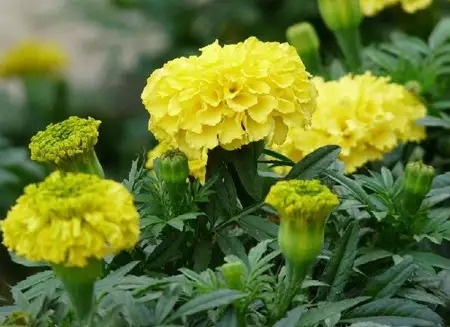
I. Common Diseases and Pests of Marigolds
1. Major diseases of marigolds: The main reason for the low yield of marigolds is disease. According to field surveys, the main diseases of marigolds include wilt, leaf spot, and flower rot.
(1) Wilt: Divided into fungal wilt and bacterial wilt. Fungal wilt causes slow growth, leaves turn yellow and lose their green color from bottom to top, eventually turning the entire plant brown, wilting, and dying. The pathogen of fungal wilt is a species of Fusarium, which can be transmitted through the soil. The disease is more severe in summer when temperatures are high and rainfall is abundant. Bacterial wilt is caused by a bacterium of the genus Erwinia. Symptoms include light gray, water-soaked spots, 1-2 cm long, which gradually turn black. The stem softens and rots after infection, and the tips wither.
(2) Leaf spot: The pathogen of leaf spot is *Syngonium* spp. Symptoms include nearly circular or irregular brown to black spots on the lower leaves of the plant, surrounded by a pale green halo. Later, small black dots, the fruiting bodies of the pathogen, appear. As the disease progresses and the spots enlarge, they gradually spread to the upper parts of the plant, eventually turning all the leaves black and dry, hanging from the plant. The pathogen overwinters as conidiophores on diseased leaf debris. The disease develops rapidly during periods of frequent and heavy rainfall in summer, resulting in increased conidia production and rapid spread. Excessive nitrogen fertilizer application also weakens the plant, leading to more severe disease.
(3) Flower rot: Flower rot is caused by fungi of the genus *Pseudomonas*, also known as blight. The pathogen infects flower buds early, preventing their growth, causing them to turn black and wither. If infection occurs later, it results in deformed flowers that open only on one side, with the flowers turning light brown and withering from base to tip. The pathogen can also damage leaves and stems, causing leaf blight and stem ulcers. The pathogen overwinters on infected plants and spreads via air currents when temperature and humidity are suitable the following year. Cultivated plants with a high incidence of disease are more susceptible to infection if diseased plants and their plant debris are left in the ground.
2. Major pests of marigolds: The main pest of marigolds is the wireworm, which bites the roots and stems of marigold seedlings and can burrow into the roots and stems to cause damage, resulting in the death of seedlings. However, the damage caused by this insect is relatively minor.
II. Main Measures for the Prevention and Control of Diseases and Pests in Marigolds
(1) Disinfection of seedbed soil: Spray 4g of 50% carbendazim with 2kg of water evenly on the seedbed surface to disinfect the seedbed.
(2) Seed treatment: Before sowing, soak the seeds in a 250-fold dilution of 50% carbendazim for 15-25 minutes to disinfect them.
(3) Spraying fungicides during the seedling stage: Marigold seedlings are more susceptible to disease due to the high humidity and temperature in the seedling shed. Therefore, when the seedlings grow to 4-6cm in height, spray fungicide every 7-10 days. You can use 1.5kg/hm2 of 50% carbendazim, 1.5kg/hm2 of 70% thiophanate-methyl, or 150-300g/hm2 of agricultural streptomycin. In addition, before transplanting, you should still spray fungicide with an appropriate amount of foliar fertilizer so that the seedlings are planted with both medicine and fertilizer, thereby achieving the purpose of disease prevention and strong seedlings.
(4) Field disease control: First, after winter, clean up diseased plants and diseased plant debris to reduce the source of infection in the following year; implement crop rotation, and intercrop with short-stalk crops; reduce planting density, and reduce the number of seedlings per hectare from 45,000 to 37,500; pay attention to drainage during periods of heavy summer rainfall. Second, promptly remove diseased plants and plant debris during the disease outbreak period to inhibit the spread of the disease. Third, use chemical control, and spray fungicides such as methyl thiophanate, mancozeb, and Ridomil alternately at the onset of the disease, spraying once every 7-10 days. When the plants enter the reproductive growth stage, i.e., the flowering period, spray fungicide after each harvest or after rainfall. Main pesticide formulations: 70% thiophanate-methyl 1.5 kg/hm2 plus agricultural streptomycin 150-300 g/hm2; 70% thiophanate-methyl plus mancozeb 1.5 kg/hm2; cyprodinil 1.5 kg/hm2 plus agricultural streptomycin 150-300 g/hm2; 75% chlorothalonil 1.5 kg/hm2 plus agricultural streptomycin 150-300 g/hm2.