Back muscle training tutorial
Back training:
Before discussing back training, let's take a look at the anatomy of the back as usual. The back muscles are a very large muscle group.
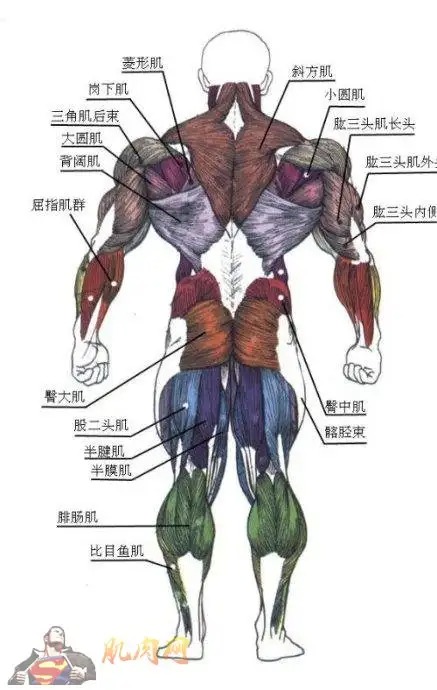
As we can see from the image, the entire back muscle group includes the teres major, teres minor, rhomboids, infraspinatus (which also belongs to the rotator cuff muscles), posterior deltoid, trapezius, and latissimus dorsi. We can't stimulate each muscle individually; we can only stimulate specific areas, generally dividing the back into upper, middle, and lower sections. Since this post focuses on home fitness training and doesn't have the equipment of a gym, we can only explain a few exercises. To learn more exercises, please visit this website: http://www./baodian.html and click on "Back Training".
Okay, let's begin discussing back muscle training. First, I want to talk about the evolution of the back muscles. You can see that the three largest muscles in the back are the trapezius, teres major, and latissimus dorsi. (Of course, the infraspinatus is also large, but it's not part of our discussion. We've mentioned the infraspinatus in the shoulder training post; it's part of the rotator cuff muscles, covering the entire shoulder.) As you can see, the trapezius is very large, hence its strength. It's responsible for lifting heavy objects, but it's generally categorized under shoulder training, so we won't discuss it here. Okay! Now we're left with the teres major and latissimus dorsi. You can see these two muscles resemble wings.
Having studied the history of the latissimus dorsi and teres major muscles, we now know how to train them.
1. Climbing exercises can be simplified into pull-down movements, such as pull-ups. These exercises can increase the size and area of the latissimus dorsi and teres major muscles. However, most people cannot perform a pull-up, so gyms offer lat pulldown exercises with pulleys.
2. Movements that involve the forelimbs moving back and forth can be simplified to rowing motions. These types of movements can make the back thicker and larger. (If you look at the muscles of rowers, you'll find that their backs are very broad and thick, which is the result of years of rowing training.)
Common back training equipment in gyms:
For these two types of exercises, gyms have dedicated equipment. Actually, using a combination machine is better for training your back. I'll post two videos so you can take a look at these two types of exercises. If you can go to the gym, you can try them out. Of course, I'll also talk about how to train your back with dumbbells later.
Seated lat pulldown (for back width):
Comment: This girl's form is pretty good!
Resistance band version:
Seated row (for back thickness)
: Comment: This girl is quite pretty!
Dumbbell back exercises:
Okay~ Now that we've covered the exercises using two gym machines, let me talk about how to train your back with dumbbells. First of all, exercises like seated lat pulldowns and pull-ups can't be simulated with dumbbells (although resistance bands can), so please understand. Now I'm going to talk about a very important exercise:
This exercise is called the deadlift. Why is it important? Because it, along with the bench press and squat, is considered one of the three major strength training exercises. The deadlift is a full-body movement, essentially engaging the entire body. It's also a required movement in powerlifting competitions, and it's the first part of the clean and jerk in weightlifting. From this, you can see how important the deadlift is (of course, the squat is even more important—I'll discuss leg and glute training separately). However, most deadlifts are done with a barbell because it allows for a large lift and is more effective. But we can also use dumbbells. There are many ways to do the deadlift; here we'll only discuss two: the straight-leg deadlift and the bent-leg deadlift. The bent-leg deadlift primarily stimulates the lower back and erector spinae muscles. Of course, the bent-leg deadlift also relies on leg power. Regarding the erector spinae muscles, this muscle corresponds to the lower back and abdominal muscles. It's not shown in the anatomical diagram above, and I haven't mentioned it because this muscle is actually quite complex, but very useful. The straight-leg deadlift effectively stimulates the hamstring muscles. (The hamstring muscles include the biceps femoris, semimembranosus, and semitendinosus – the muscles at the back of your thighs.) Although deadlifting is a full-body exercise, it stimulates the lower back and erector spinae muscles. We'll mention here that you can judge a person's strength by the weight they can deadlift. For example, if an older person can deadlift 160 kg, then that person is stronger than the average person. (Top powerlifters in China typically deadlift over 300 kg.)
Here we'll learn about straight-leg deadlifts~ The key points of bent-leg deadlifts are a bit harder to understand~ I'll post a video later to show you~ Actually, straight-leg deadlifts can also be included in leg and glute tutorials~ Secondly~ if you watch enough training videos, you'll find that most people don't really understand the difference between straight-leg and bent-leg deadlifts... they all do it with straight legs. It's confusing, isn't it?
So let's look at the ones with straight legs directly.
Note: Always keep your back straight when doing deadlifts! A hunched back deadlift is like a tortoise pull! It's extremely harmful to your lower back! Remember! Always keep your back straight! No matter what exercise you do, keep your back straight!
Let's watch a video: (Look at her back, it's very straight. We should straighten our backs like hers.)
Comment: This girl is quite pretty~
We just need to replace the barbell in the video with dumbbells~ Let's watch another video~ This time it's a dumbbell straight-leg deadlift~
Comment: Keep your back straighter~ PS: This girl's movement looks like she hasn't eaten~~
Okay~ Let's see what a bent-leg deadlift looks like. Actually, most people's movements are somewhere between a straight-leg deadlift and a bent-leg deadlift, and some people even do sumo-style deadlifts...
Commentary: Feels similar to straight-leg squats, right? Actually, bent-leg squats just involve squatting as deep as possible when starting. Then exert force. Also, don't imitate the shoulder-shrugging motion of the first woman in the video, like Xu Haixing. She's doing CrossFit, and the shoulder shrugs work her trapezius muscles along the way—we don't need to do that. Let me talk about CrossFit training. The purpose of CrossFit is to develop extreme physical fitness. There are many types of CrossFit training; it includes everything that can improve physical fitness. Track and field, weightlifting, gymnastics—all sorts of random training methods are included. Some training programs are even extremely demanding. Seriously. People who do CrossFit are a bunch of lunatics... The training is so intense, the risk of injury is very high. Of course, the physical fitness achieved through CrossFit is also amazing; some people's strength is completely disproportionate to their physique! Especially women who do CrossFit. Their strength is incredible. Friends in the US might know about CrossFit. It's a sport for lunatics. Here are a few videos to show you what CrossFit is all about. Some women even do it while pregnant.
Ordinary people would be disabled if they practiced this. It's a sport for madmen. Some people call it Crosshit because they hate this kind of insane training. The old man himself likes madness, but he doesn't like this kind of unsafe madness.
Crazy CrossFit: ↓↓↓You've seen how crazy they are, haven't you? Sigh... Let's ignore them... Let's continue our lecture... Damn... We've gone too far off-topic... Let's get back on track...
After introducing the dumbbell deadlift, let's move on to the next exercise: the dumbbell single-arm row. Watch two videos first~
Commentary: The key point is still the same: your back must be straight!!! Your arm should draw an arc, not pull straight up and down. Try to pull towards your side. You can also do this with both arms~ Watch the video below~
Commentary: Okay, that concludes the back exercises. You might ask, why so few? I want to say that back training really relies on pulley machines and barbells; dumbbells are too limiting, or perhaps I'm just ignorant and don't know enough exercises.
Warm-up before back training:
Next, I'll talk about warming up before back training:
Actually, warming up before back training is very simple. Just do deadlifts without weights, then do some arm circles, and then do some arm rows without weights. The number of repetitions is up to you, but you should generally do at least 20 repetitions for your warm-up.
Stretching and relaxation after back training:
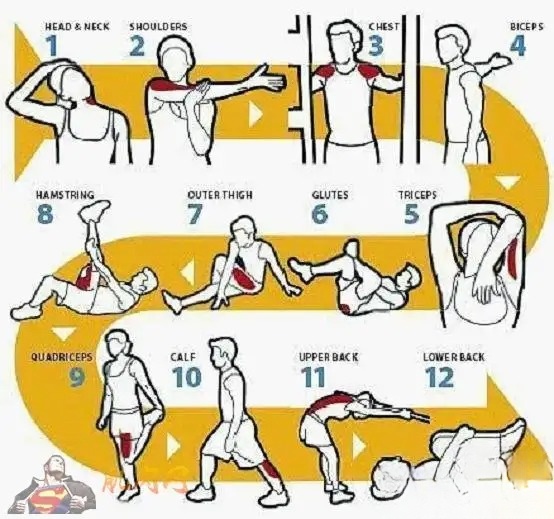
We chose movements 8 and 12 for relaxation.
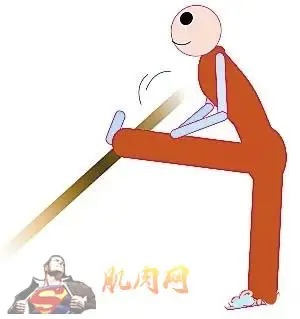
8. Because deadlifts require relaxation of the hamstrings, here's an exercise you can do: stretch your legs or try doing a split. These exercises effectively stretch and relax your hamstrings.
Exercise 12 is designed to relieve the physiological curvature and tension in the lower back, allowing the spine to relax. You can arch your back only during the stretching phase; when carrying weights, you must keep your back straight! PS:
Back training template:
Below I will give you a back training template (excluding warm-up).
Actually, it's better to deadlift heavier weights. Well-trained female coaches with weightlifting belts can typically lift 90 kg+. Some women who do CrossFit can lift 160 kg without protective gear. Of course, some of them do a "turtle pull," which is very damaging to the lower back. So, it's better to deadlift heavier weights; 10 pounds is a bit too light.
Dumbbell deadlifts: 4 sets
First set: 20 reps, 3 pounds
Second set: 15 reps, 5 pounds
Third set: 15 reps, 10 pounds
Set 4: 20-25 reps, 10 pounds
Dumbbell double arm rows: 2 sets
First set: 20 reps, 3 pounds
Second set: 12-15 reps, 5 pounds
Dumbbell single-arm rows: 2 sets (one set consists of completing both arms).
First set: 15 or more reps, 10 pounds
Second set: 12 or more reps, 10 pounds (the last set should ideally be done to failure).
Now that your back workout is complete, you can choose to continue with cardio or rest.