A Brief Discussion on the Diet of the Early U.S. Navy (Part 2)
Bacon and crackers forever
Throughout the first half of the 19th century, the staple food of the US Navy remained unchanged, consisting of hard biscuits and salt pork or corned beef. These foods shared a common characteristic: their hardness and toughness were incredibly challenging, putting a strain on the human bite! For the sailors who needed to feed on them, they were a nightmare, and only dentists would be grateful for their food. This was unavoidable, as food preservation and storage technology was not yet fully developed. Considering that the predecessors of the British Royal Navy had been dominating the oceans with these rations for centuries, there was nothing wrong with the US Navy supplying its own sailors with these rations.

This is the famous hard biscuit
Hard biscuits are a common shipboard food, and their consumption is said to date back to prehistoric times. Due to their lack of moisture after baking, hard biscuits can be stored for a long time without spoiling. If stored properly, they can easily last for over a hundred years, making them a staple for seafarers. It can be said that hard biscuits were originally invented as a more efficient way to transport and store flour.
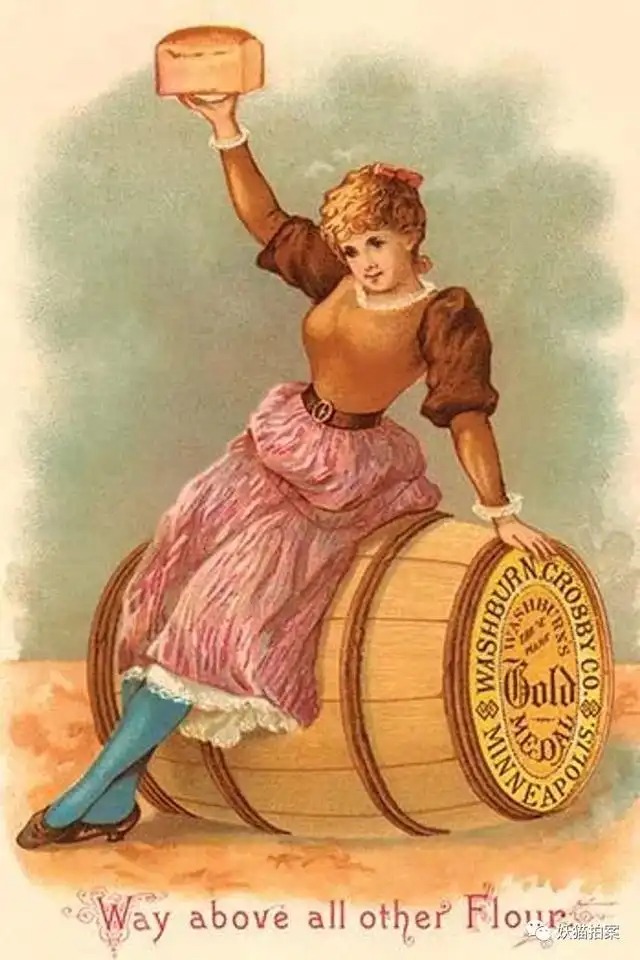
Apparently, hard biscuits in a barrel will stand the test of time better than flour in a barrel.
Sailors at the time often referred to hardtack as "ship biscuits," "sea biscuits," or "sea bread," though there was also the more appealing name, "tin biscuits." The term "hardtack" actually became popular during the American Civil War, though some prior supply contracts simply referred to it as biscuits or bread. Hardtack is made from simple ingredients: typically wheat flour, water, and salt, though salt is often omitted entirely. Hardtack requires no leavening before baking; in other words, it's essentially a baked, unleavened flatbread. While not a delicacy, the baked hardtack is reasonably high in calories and protein, and contains essential vitamins. Many doctors of the time lauded hardtack, believing this simple food to be beneficial for both physical and mental well-being, and would often prescribe a few hardtacks to ward off ill health.
Hard biscuits required no technical skill to make and were inexpensive, making them ideal for mass production. Bakers in many places took orders from the Navy. One such baker was Stephen Harris of Norfolk, Virginia, who owned three brick ovens and could turn 21 barrels of flour into biscuits daily. In 1818, William McKenney, a baker living in Washington, D.C., was fortunate enough to receive a large order from the Navy. The contract required him to deliver 2,000 barrels of hard biscuits, totaling 160,000 pounds. Based on the quantity, he was to deliver a total of 640,000 hard biscuits to the Navy. This business was clearly very lucrative.
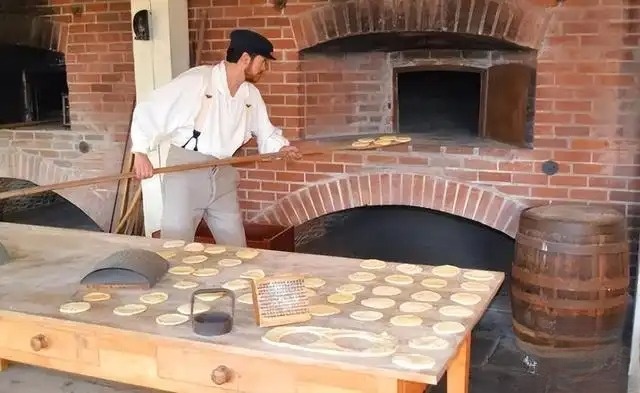
There is absolutely no technical content in the production of hard biscuits
According to an 1816 estimate by the U.S. Navy Department, a 44-gun warship would consume at least 143,550 pounds of hardtack annually. Producing one pound of hardtack cost only
As the Navy's most basic ration, hardtack biscuits were of high quality. The Navy's "Navy Bread Contract" between the Navy and baker William McKenney clearly stipulated that "the bread must not contain rye flour or other impurities other than wheat flour, must be kept thoroughly dry after baking, and must be properly stored during transportation." Researchers have tested and analyzed some surviving hardtack biscuits, and the results confirm that the quality of the biscuits was not bad, and they were indeed made with whole wheat flour.
To ensure that the moisture inside the hard biscuits could evaporate quickly during baking, bakers would punch many small holes in the outside of the hard biscuits. According to some samples left from that time, the hard biscuits commonly found on ships were mostly round, weighing about 4 ounces, with a thickness of about 0.5 inches and a diameter between 4.75 and 5.75 inches, about the size of a sailor's fist.

Hard biscuits baked in 1854, from the collection of the USS Constitution Museum
Hardtack is a food that has stood the test of time. In a dry environment, once dehydrated, it can be stored almost indefinitely, even maintaining minimal change in appearance. Women yearning for eternal youth would surely envy this exceptionally long lifespan. In museums across Europe and the United States, it's common to see hardtack baked over a century ago, some even appearing practically fresh. This exceptional shelf life was both a benefit and a detriment to many soldiers. During the Spanish-American War of 1898, unfortunate American soldiers were savoured of hardtack older than their fathers. Produced over thirty years prior during the American Civil War, it's a true taste of history.
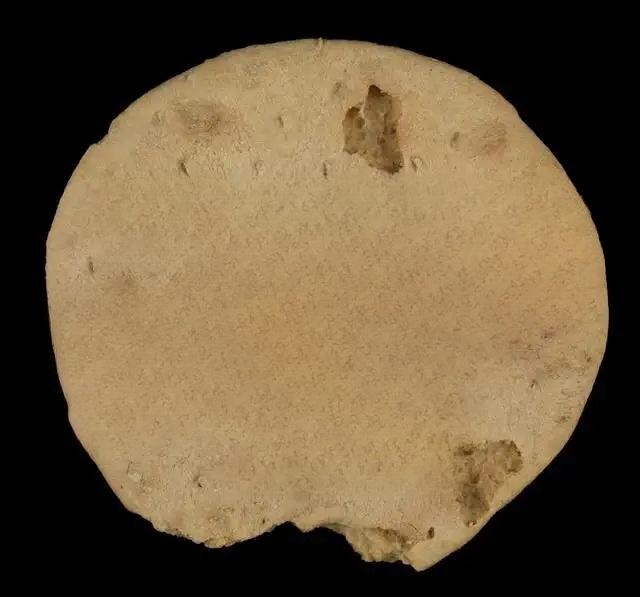
A hard biscuit baked more than 200 years ago, now in the London Maritime Museum in the UK
However, in the humid environment on board, no matter how strong the wooden barrel is, it cannot protect the hard biscuits inside. Moreover, many of the hard biscuits received by the U.S. Navy were packed in canvas bags. It was normal for them to mold and spoil during storage. Weevils and their larvae even made the hard biscuits their home. The sailors had to find ways to drive away these unwelcome guests every day. Wooden barrels have a long history as containers for transporting and storing hard biscuits, but they cannot be said to be a perfect packaging. During the War of 1812, the U.S. Navy tried to use boxes with better sealing to solve this problem. However, at least in Boston Harbor, the hard biscuits received by the Navy were still packed in wooden barrels or sacks.
The inevitable damage caused by a leaky seal was a minor concern for sailors, but the torment to their teeth was unbearable. Hard biscuits typically required a double baking process: baking once, letting them cool, flipping them over, and baking them again. If they weren't satisfied, they could bake them again. To minimize moisture for long-term storage, more rigorous methods would bake them four times, leaving the hard biscuits practically like bricks made from flour. Hard biscuits were often compared to the flintlock used in flintlock guns, earning the name "tin biscuit" well. Unless possessing impenetrable teeth and a powerful jaw, a normal human would be courting disaster. Some people call them "dog biscuits," which is why, however, they wouldn't appreciate being given them to a dog.

Dog: Give me this to eat? This place can’t accept it anymore...
The sailors likely thought so, too. Due to the lack of fresh fruits and vegetables, oral and gum disease was widespread among sailors, and chewing these "tin biscuits" daily was simply worse. They didn't dare subject their teeth to the test of hard biscuits. Through their long battles with hard biscuits, sailors had accumulated extensive experience. A common method was to wrap the hard biscuits in cloth and then pound them with the handle of a knife or any other hard object available. Even after being shattered, the hard biscuits would remain rock-hard, and only soaking them in liquid would provide some relief. Since liquids were necessary, sailors naturally used whatever they had available—broth, beer, rum, drinking water, and, in desperate cases, their own saliva.
Tired of the bitter taste of hard biscuits, sailors devised new ways to entertain themselves. For breakfast, some boiled burnt hard biscuits in water and added sugar or molasses, creating a delicious treat known as "Scottish Coffee." Some with a sweet tooth created a dish called "Honey Cake": crushed hard biscuits mixed with butter and molasses, then toasted in a pan until golden brown. These so-called feasts, as the sailors called them, didn't look particularly appealing, but they were considered excellent, reflecting their lack of experience with proper meals.
In order to perform these tricks, the sailors had to break the hard biscuits into pieces first. In order to save some effort, some clever guys thought of the wooden barrels that contained the hard biscuits - since the barrels were bound to contain residues and crumbs left over from the transportation and storage process, why not make good use of them?
The practice of collecting scraps from barrels gradually became popular among sailors, even among the cooks. Captain David Porter of the Essex, known for his commitment to sailors' rights, was deeply dissatisfied. He believed this practice was detrimental to the health of his crew and would undoubtedly lead to the dreaded disease of scurvy. To avoid the potential risks, Captain David Porter issued a strict ban in 1813, forbidding anyone from using biscuit scraps from barrels for cooking. Any disobedience would likely result in the cat-of-nine-tails.
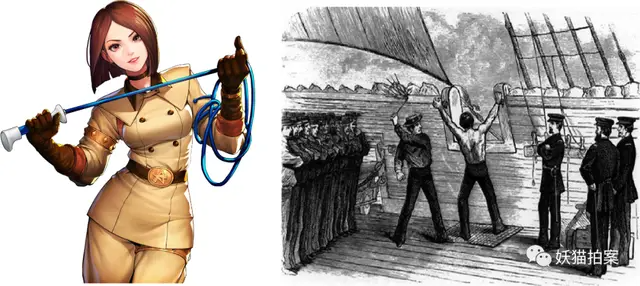
Don't get me wrong, the girl on the left is purely fictional, the one on the right is the real scene
Besides hard biscuits, the sailors' staple food was salted corned beef or pork. Although canned meat had been around since the Napoleonic Wars in the early 19th century, it remained out of reach of sailors. Bacon, stored in large wooden barrels, continued to accompany sailors from various countries on their voyages, as it had always done. Early canned meats were not widely accepted, partly due to technical immaturity. The food sterilization and canning processes during production were inadequate, and the meat products sealed in tin cans often spoiled. More importantly, the price was prohibitive. The high cost of canning meat made it prohibitive for the average person, and the often stingy US Congress was particularly sensitive to price. This situation did not change until the American Civil War. Until then, large barrels of bacon still dominated the US Navy's dining tables.
Typically, bacon stored in wooden barrels was kept in brine. Theoretically, this method allowed the bacon to remain in the barrel for many years. However, because the barrels weighed up to 340 pounds, the brine was often secretly drained to reduce weight. This was most likely to happen during loading, unloading, and transportation. So, when sailors excitedly opened the barrels, they often found the contents stinking.
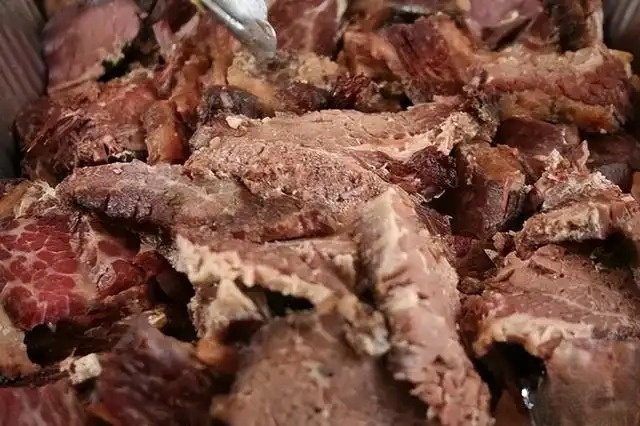
Corned beef back then was much uglier than this
According to regulations at the time, the net weight of beef or pork in a wooden barrel should be 200 pounds. However, there was not much real beef or pork, often just necks, offal, fat, and the like. The taste was even worse. The only seasoning was salt, with the occasional bay leaf. The sailors bluntly called the contents of the barrel "salt garbage" or "salt horse." According to the sailors, the taste of salt pork was acceptable, but the texture of salt beef was unbearable. Because beef has less intramuscular fat and thicker muscle fibers than pork, thoroughly salted salt beef is hard and tough. Even after being cooked in the cook's soup pot, it takes a long time to chew it in your mouth before you can swallow it. The sailors often said, "God created this food, but it's a pity that the devil is the cook!"
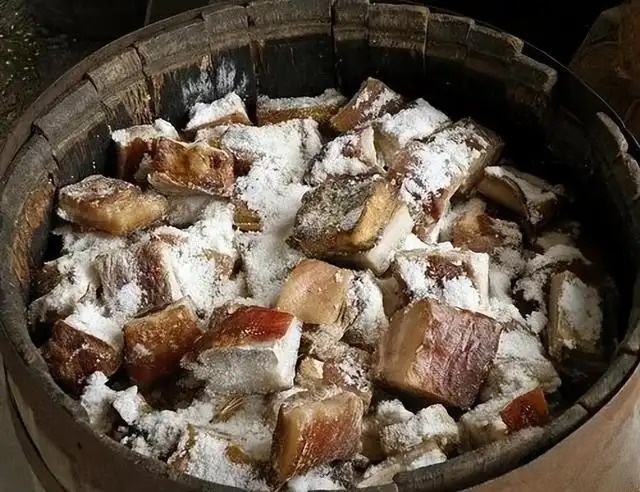
Salt pork is actually more popular than corned beef
Strong liquor - sailors' favorite
For everyone aboard, the most intriguing aspect of the daily rations was the "liquor supply." The US Navy provided two rations of liquor to all crew members daily, a tradition adopted from the British Royal Navy. The Royal Navy also had its own rules for serving liquor: a half-pint of rum was to be mixed with a quart of water and distributed to sailors in two equal portions. This was a Royal Navy tradition dating back to the 1740s. Diluted rum was less potent and harder to preserve, preventing sailors from hoarding rum and drinking it all at once. The practice of diluting rum was originally devised by Admiral Edward Vernon of the British Royal Navy, and naturally copied by the US Navy after its reestablishment. The sailors' right to a half-pint of liquor daily was recognized in the Naval Acts of March 27, 1794, July 1, 1797, and March 3, 1801.

The sailors have Admiral Edward Vernon of the Royal Navy to thank.
At the time, North America needed to import vast quantities of rum for consumption. The West Indies, rich in rum and molasses, the raw material for its production, were controlled by nations like Britain, France, and Spain. These nations all had numerous old and new grievances with the United States, and Americans were well aware of this. Consequently, Robert Smith, the second Secretary of the Navy, who took office in 1801, was deeply concerned about the rum supply. After all, the United States' continued expansion since independence had already embroiled these nations in conflict, and he felt that this external dependence should be minimized to avoid potential risks.
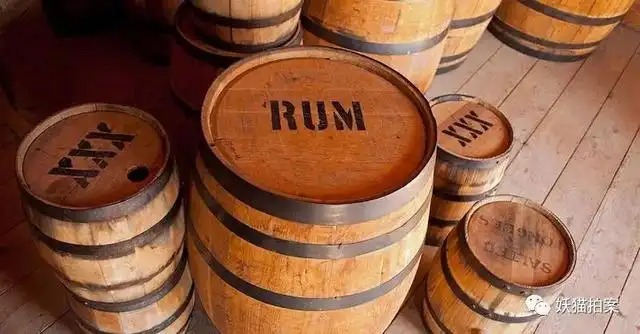
Rum is the sailors' beloved friend
According to Robert Smith, the ideal rum substitute should be American-produced and taste good, otherwise sailors would refuse to buy it and the minister would be embarrassed. Most importantly, the procurement cost should be low. Congress had long been accustomed to the low price of rum, and even a small increase on the bill would cause the officials in Congress to cry foul. After rigorous and in-depth research, only American-produced rye whiskey basically met these requirements. Thanks to the minister's strong promotion, rye whiskey—in other words, American-made rye—became part of the navy's daily rations starting in 1806, gradually replacing the long-standing reliance on imported rum. This was naturally a great success for whiskey suppliers. The minister's maneuvering ultimately succeeded. Whether he had some kind of well-known deal with the whiskey suppliers is difficult to determine, but no one could have predicted the huge popularity of cheap, domestically produced rye whiskey among sailors accustomed to rum. It was a happy ending for everyone.
The ship's rye whiskey was typically distributed twice daily: half after lunch and the other half after dinner. Each time the whiskey was distributed, the ship's purser, acting as the modern-day supply officer, meticulously recorded the distribution with the assistance of his assistant. Each sailor's account would record the day's whiskey ration. During the Second Revolutionary War (1812-1815), it was approximately 4 cents per day. This elaborate distribution process was forced upon them, as attempts to circumvent the rules and secure an extra ration were inevitable. "Rum rats" caught by the purser were severely punished, typically being dragged onto deck the next morning and publicly whipped. This often bloody punishment could also add a touch of entertainment to the otherwise dull life at sea!
With the rise of the American Temperance Movement in the 1820s, this trend gradually spread from land to sea. On May 15, 1831, Secretary of the Navy Levi Woodbury issued an order allowing sailors to forgo their liquor rations in exchange for six cents a day in compensation. In the Naval Act approved and implemented on August 29, 1842, Congress simply reduced the liquor supply to a quarter pint per day and banned the supply of liquor to sailors under the age of 21. Of course, sailors would also receive corresponding compensation. On July 14, 1862, Congress passed a bill officially ending the supply of liquor. The US Navy became the first in the world to abolish liquor rations, and sailors could only say goodbye to liquor.
to be continued……