7 free cleaning tips with amazing results! Insiders have been using them secretly for a long time.
Today I'm going to recommend 7 cleaning tips, all of which are—

Is there really such a good thing?
That's right, some tricky hygiene problems can actually be solved with things that every household has.
Some are cleaning products, but their applications are wider than you might imagine; others have nothing to do with cleaning at all, yet they work surprisingly well.
At first, I didn't believe it either, after all, many popular cleaning tips online can't stand up to scrutiny.
It wasn't until they consulted experts that they discovered these 7 methods not only worked in principle, but were also things they used themselves in their daily lives.
What are you waiting for? Quickly forward this to your family and start today's "Free Cleaning Deals" together .

Dish soap,
Free eyeglass cleaning solution
—
Old friends should know: the cloth in the glasses case should not be used to wipe the lenses.
The best way is not to use the corner of a garment, nor alcohol wipes, but the most ordinary dish soap .
Although the lenses appear thin, their surfaces are coated with numerous layers to protect them and enhance their optical performance. Therefore, when cleaning surface stains, it is crucial to be careful not to damage these coatings or scratch the lenses.
Using a small amount of dish soap, gently massaging in circular motions with your fingers, and rinsing with cold water, it cleans well without leaving scratches—that's wonderful. Specific instructions—
Rinse both sides of the lens with running cold water, then lather a small amount of dish soap in your hands.
Apply to the lens and gently massage in a circular motion with your finger to remove stains. Rinse off the foam from both sides.
Turn the water flow down and rinse the lenses horizontally from left to right. Use a tissue to dab away any excess water droplets.
Image source: Taken by myself
If the water on the lenses neither gathers into droplets nor runs down in streams, it means they are clean.
White vinegar
Free limescale cleaner
—
Over time, glass doors, stainless steel faucets, and showerheads in the bathroom will develop a yellowish, greasy patina.
If you don't have a strong cleaning agent on hand, you might have to work hard and still not get it clean.
You might want to try using white vinegar from your home; it can dissolve calcium carbonate stains, such as limescale.
Specific operation method:
For mild limescale, mix white vinegar, dish soap, and water in a 2:1:1 ratio and pour the mixture into a spray bottle. Spray the mixture onto the limescale and rub it with a cloth. Let it sit for 20 minutes, then wipe it clean with a cloth.
For stubborn limescale (such as from a showerhead that has never been washed), you can soak a cloth in white vinegar, apply it to the limescale, and let it sit for half an hour; for any remaining limescale, apply some dish soap, scrub, and then rinse it clean.
Note that white vinegar should never be mixed with chlorine bleach, as this will cause a violent chemical reaction and produce toxic gases.
Soap,
Free color bleeding reducer
A few dollars' worth of soap can actually save stain-stained clothes? What about those white clothes I threw away before...?
At first, I was skeptical, but then a textile professor said: "You can give it a try."
Its principle is similar to the "soap washing" process in textile dyeing, which removes floating dye by using alkaline surfactants to act on dye molecules and remove floating dye that has not been fixed by encapsulating and dispersing it.
Therefore, when you find that your clothes are fading color after washing, you can do this as soon as possible using soap from your home:
Soak a bar of soap (which can be cut into pieces) in hot water to make a basin of soapy water;
If clothes have been stained with color, soak them in soapy water for 10 minutes. To prevent the original color of the clothes from deteriorating, wait until the water temperature is below 60 degrees Celsius before soaking them.
Finally, rinse the clothes several times with the showerhead, then gently rub and wash them clean.
Of course, this method is more suitable for synthetic fiber clothing that has just been stained with color. If the clothing has been stained for a long time, the effect may be greatly reduced.
Baking soda
Free fruit and vegetable cleaner
—
For most fruits and vegetables, rubbing them in running water for more than 30 seconds can significantly remove surface dirt and pesticide residues.
However, for some fruits and vegetables that are prone to excessive pesticide residues or are difficult to clean, such as broccoli, mulberries, and grapes, you can try soaking and washing them in alkaline water to further break down pesticide residues and remove stains.
For example, most households have baking soda (commonly used for making bread and steamed buns):
Safe ingredients + alkaline properties effectively break down pesticide residues + particle friction removes surface stains.
For specific instructions, it is recommended to add 2g of baking soda per 100ml of water and soak for 5-10 minutes. Do not soak for too long, otherwise pesticides may adhere to and be absorbed into the fruits and vegetables, leading to greater nutrient loss.
For example, with broccoli: Place the broccoli head down and rinse with water for 1 minute, gently separating the florets as you wash to check for cleanliness. Then, cut the broccoli into small florets along the forks, add a small amount of baking soda (2g baking soda/100ml water), and soak for 5-10 minutes.
Sunlight,
Free dyeing bleach
—
We must admit that we have only utilized less than 1% of the sunlight.
I mentioned this when I recommended silicone lunch boxes before: if silicone turns yellow, you can expose it to sunlight to use the high energy of ultraviolet light to decompose the pigment organic molecules.
Prolonged exposure to high temperatures and sunlight can cause silicone to age, but if you really can't stand the look of it, it's okay to try it occasionally. Not only have I tried it, but there are also many successful cases on social media.
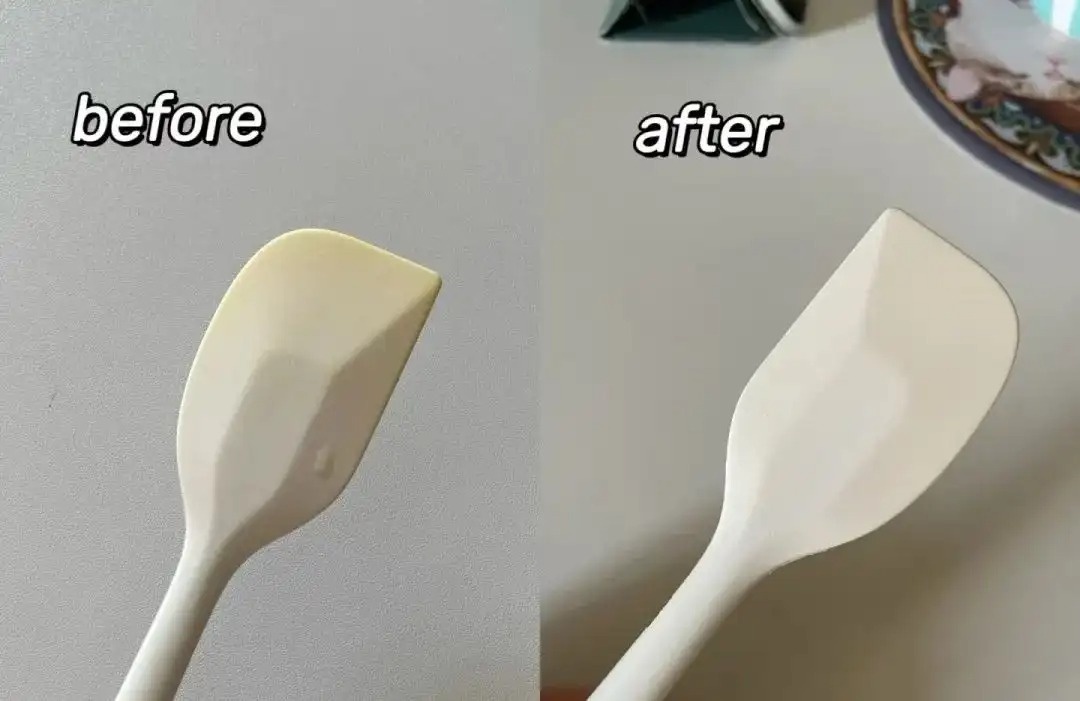
Image source: Social media platforms
Some netizens also shared their amazing experience of "clothes stained with chili oil that disappeared after drying because they weren't washed off properly".
The principle is similar to the one above. The main components of chili oil are capsanthin and oil. Pigments that cannot be washed off can be strongly decomposed under sunlight, and there are studies that support this conclusion.
Got it! Next time you can't get oil stains off your clothes, don't give up. Let them air dry for a while (not in direct sunlight).
Expired lipstick
Free silver jewelry cleaner
—
Lipstick isn't free, but expired lipstick is a different story.
There are always one or two lipsticks on the vanity that have been forgotten because of their strange or unattractive shades, and they sit there for years.
Use them to clean tarnished silver jewelry without feeling guilty.
The method is very simple: apply lipstick to a tissue and rub it on the tarnished silver jewelry, and it will quickly become shiny and bright.
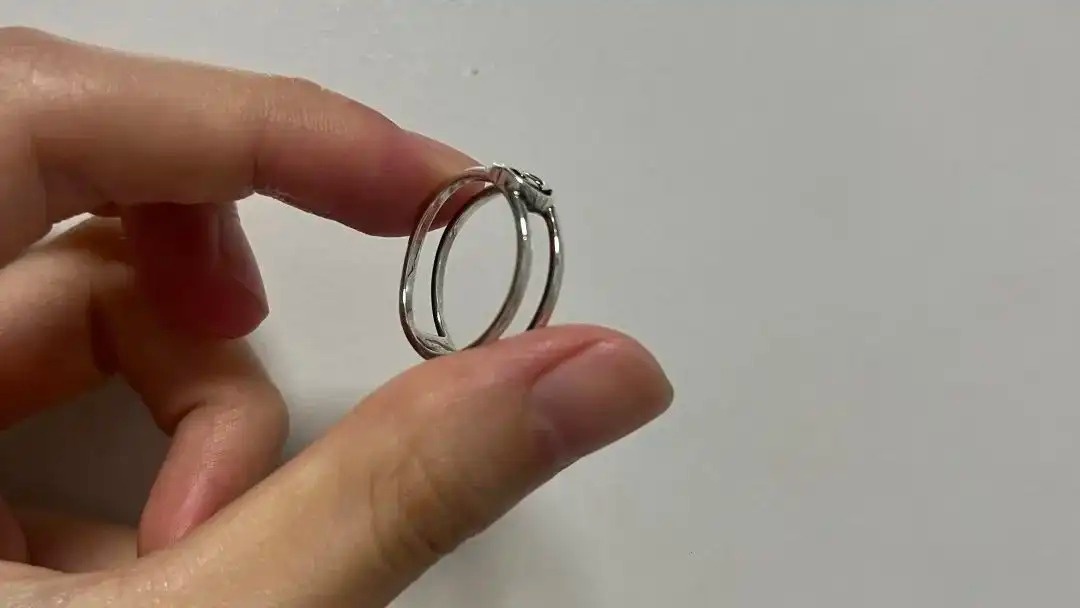
Image source: Taken by myself
This is because, if silver is left for a long time, it will react with hydrogen sulfide, sulfur-containing substances, and oxygen to form silver sulfide, which is the black film we see.
Titanium dioxide (which adds shine) acts as abrasive particles, and with the help of stearic acid (an emulsifier) in lipstick, it can quickly remove black substances from silver jewelry.
If you find lipstick residue after polishing silver jewelry, you can remove it with facial cleanser or makeup remover.
Overall, lipstick is effective at removing black pigment, making it suitable for smooth silver jewelry as the pigment is less likely to get stuck in the crevices. However, for more intricate or expensive silver jewelry, professional cleaning is still recommended.
Unused oral irrigator
Free corner cleaner
—
Don't ask why, some people's water flossers just sit idle after a while (that's me).
As someone with sensitive teeth, I used to think that the water flow from a water flosser was too strong. But by changing my perspective, I discovered that it can be an efficient cleaner for hard-to-reach areas.
At first glance, it might not seem like much, but once you list some examples, you'll slap your thigh and regret not using it sooner. For instance:
The straw of the straw cup, the intricately designed lid of the thermos.
The corner of the water tank of a robot vacuum cleaner and an automatic cat water fountain
Crayfish, lotus root, and other foods with complex appearances
Ventilation holes on the shoe tongue
In summary, even the hard-to-clean nooks and crannies can be reached with the fine water flow and force of a water flosser.
Alright, how many of today's cleaning tips have you decided to try? If you're interested, save them for later and try them out when you get home from get off work (or have your roommate try them out).
If you found today's content helpful, don't forget to share it with your friends and family to spread life wisdom.
We also welcome everyone to leave comments and share their cleaning tips, let's make our lives better together! Yay!