15Minute Core Workout Plan at the Gym
Let's take a look at this 15-minute core muscle training plan at the gym!

The Men's and Women's Club still upholds the spirit of "doing something is better than doing nothing." Today, we've created a set of weight training menus for beginners to refer to. Below are three different core weight training menus, all of which only take you 15 minutes.
However, it's important to note that no matter how much we shorten the training time, the "warm-up" is a crucial and indispensable part. Therefore, each of the following menus will include a low-load, high-repetition warm-up; please be sure to perform it thoroughly.
The main function of the core muscles is to provide stability for various movements of the human body. Whether you are doing intense running, jumping, or quadrupedal movements, you will need the core muscles to provide strength to stabilize your body; even when standing, sitting, or walking, you will need the help of the core muscles, which shows their importance.
However, due to the special arrangement of the core muscles (deeply interwoven) and their relatively small cross-sectional area, he cannot withstand high-weight training loads. Therefore, the following menus are mostly light-load exercises, and you should pay special attention to assessing your own capabilities while performing each menu.
Menu A
Warm-up: 2-minute dynamic exercise. Includes leg raises and lunges combined with upper body rotations, jumping jacks, etc. If you're unsure how to perform the movements, focus on leg raises and then do plenty of dynamic body rotations (note: not stretching).
Exercise 1: Basic Plank. 20 seconds, 5 sets, with 40 seconds rest between sets.
This is a basic plank exercise. Remember to engage your abdominal muscles continuously to support your body and keep your back flat. (See also: The first movement of the ab savior plank exercise.)
Exercise 2: Side Plank. Hold for 15 seconds on each side, 3 sets, with a 1-minute rest between sets.
For the side plank exercise, make sure your body remains perpendicular to the ground and doesn't tilt. See also: The second variation of the ab savior plank (feet together).
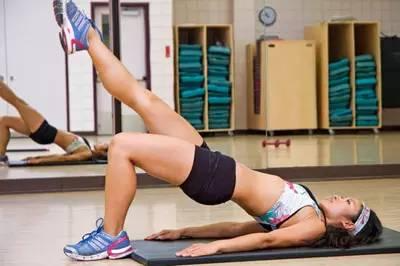
Exercise 3: Bridge. 20 seconds, 3 sets, with a 40-second rest between sets.
Lie on the ground as shown in the picture, arching your back like a bridge, requiring continuous effort from your lower back muscles to support your body. If you find it too difficult, you can put both legs down; conversely, if it's too easy, you can lift your legs and straighten them.
The end!! (Slight stretch)
Menu B
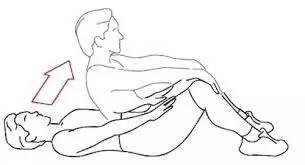
Exercise 1: Sit-ups with knees supported. 15 repetitions, 3 sets, with 1 minute rest between sets.
Similar to a regular sit-up, the only difference is that at the start, your hands are placed on your thighs, and as you lift your upper body, your hands slide down your knees. Once they slide down your knees, you complete one repetition. Reference: Bodyweight Training Exercises—Core.
This method can prevent you from over-straightening your back, instead using the strength of your buttocks and increasing pressure on your lower back.
Exercise 2: Sit-ups over the knees. 15 repetitions, 3 sets, with 1 minute rest between sets.
The movement is the same as the previous one, except that your hands are now placed on top of each other in the middle of your legs (so your thighs need to be slightly apart), and then when you stand up, move your hands parallel past your knees.
Exercise 3: Prone leg raises. 15 repetitions, 3 sets, with 1 minute rest between sets.
Lie face down, keep your upper body still, and lift your legs straight up forcefully. Reference: Bodyweight Training Exercises—The Last Set of Core Exercises.
The end!! (Slight stretch)
The first two menus, A and B, are types that can be done at home, while menu C requires some special equipment and usually requires going to a gym.
Menu C
Warm-up: Jog for 3 minutes.
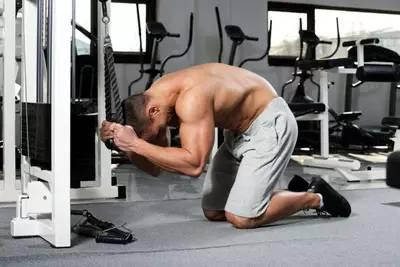
Exercise 1: Cable pulldown. 10 reps, 3 sets, with 1 minute rest between sets.
Replace the rope with a V-shaped hemp rope, grasp it with both hands in a kneeling position, and use the curling force of your body to pull the rope down. Be careful not to use your hands to pull the rope; your hands are just like hooks to hold the rope in place. Focus your attention on your abdomen.
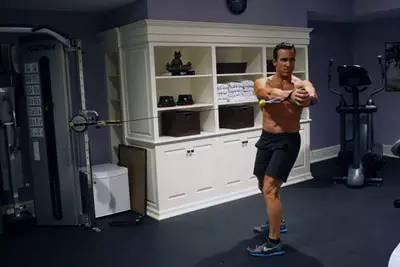
Exercise 2: Rope twists. 10 repetitions to each side, 3 sets, with a 1-minute rest between sets.
Adjust the rope to waist height, bend your knees slightly, lower your center of gravity, keep your feet firmly on the ground and do not move, and use the rotation of your body to pull the rope.
Similarly, do not use excessive force with your hands to pull; focus your awareness on your abdomen.
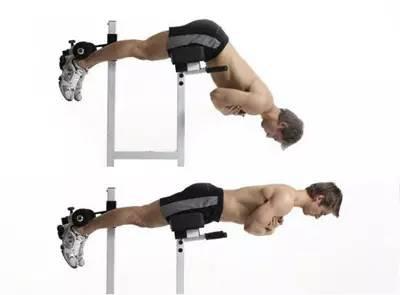
Exercise 3: Roman chair. 10 repetitions, 3 sets, with a 1-minute rest between sets.
With your feet firmly planted on the Roman chair, move your body back and forth from bottom to top. Do not move too fast or too high; just feel the stretch and contraction in your lower back.
The end!! (Slight stretch)