10 basic gym exercises, an essential tutorial for fitness beginners.
This is an era that loves innovation, and bodybuilding training is no exception, with new ideas and methods constantly emerging. However, as a bodybuilding enthusiast, if you become obsessed with the endless stream of novel training methods while neglecting the fundamental bodybuilding exercises, you're putting the cart before the horse. Don't let your barbells and dumbbells gather dust; start reviewing the key points of the following 10 training exercises now and consistently treat them as the core of your training, and you'll be on the road to success.
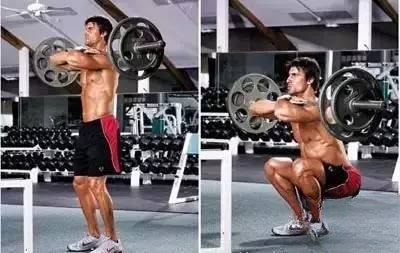
1. Squats
This is a top choice for many athletes' strength training. As squat champion Frederick Field said, " This exercise should be suitable for everyone from housewives to weightlifters. "
Squats primarily work the gluteal muscles, quadriceps, hamstrings, erector spinae, and lower back muscles. They can increase bone density in the spine and legs, increase overall strength, and improve body coordination.
The most basic squat exercise is the standing barbell squat, but it has many variations, such as the sumo squat, single-leg squat, barbell front squat, lunge, free squat, weightlifting squat, dumbbell squat, Smith machine squat, squat machine squat, hacker squat, jump squat, and exercise ball squat.
Correct approach:
Use a barbell lock to prevent the weight plates from slipping off ;
Place the barbell on your trapezius muscles, not on your neck or too low .
Stand with your feet shoulder-width apart or slightly wider, toes pointing outwards at a 35- degree angle ;
Your knees and toes should point in the same direction, and make sure your knees don't go past your toes when you squat .
Stand tall and straighten your back ;
Tighten your abdomen ;
Maintain the natural physiological curvature of the lower back ; under heavy loads, never bend the spine or overextend it .
Knees straight, but not locked ;
Squat down until your thighs and calves form a 120-90 degree angle.
Inhale when you squat down and exhale when you stand up; do not breathe too deeply .
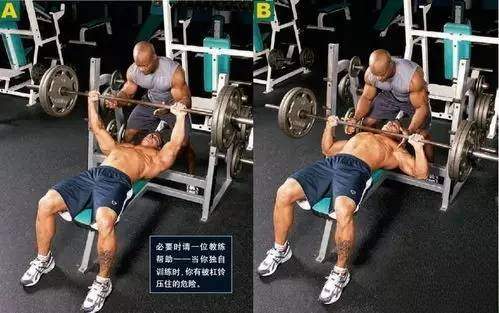
2. Bench Press
" How high can you bench press? " is a common question asked when two fitness enthusiasts meet for the first time. This exercise is particularly popular in the West, so many gyms have 6-10 bench press racks, and even then, they are still full on Monday nights with waiting lists.
This exercise primarily works the pectoralis major, triceps brachii, and anterior deltoid, improving pushing, hitting, and throwing power, and enhancing upper body posture.
The most popular bench press exercise is the flat barbell bench press. Other bench press exercises include incline and decline barbell bench presses, incline, decline, flat dumbbell bench presses, and Smith machine bench presses. Similar exercises include machine chest presses and push-ups. The narrow-grip bench press focuses on working the triceps.
Correct approach:
Use a barbell lock to prevent the weight plates from falling off ;
Head position: When the club is not lowered, the eyes should be directly below the club .
Grip the barbell with both hands, slightly wider than shoulder-width apart ( when the elbows are at 90 degrees, the chest, both forearms, and the barbell should form a rectangle ) ;
Maintain stability at six points: both feet, hips, both shoulder blades, and head ;
Maintain the natural curvature of the spine ; avoid raising your hips .
During the press , the elbow should always be directly below the bar .
The barbell should move vertically up and down above the chest .
The barbell should be lowered to lightly touch the chest .
Exhale as you push upwards, and inhale as you lower down ;
Do n't let the barbell bounce back from your chest muscles ;
Do not lock your elbow joint when pushing to the highest point ;
Do not lift your feet, head, or hips . If the weight is too heavy, you should reduce the weight or find someone to spot you.
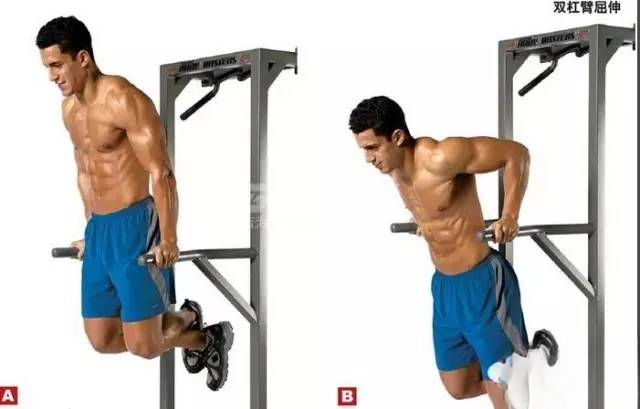
3. Parallel bar dips
To do this exercise, you only need two parallel bars. The classic parallel bar dip has two variations: elbows pointing outwards work the lower pectoralis major more ; elbows closer to the body engage the triceps more.
Correct action:
Grip the club with both hands, keeping your wrists straight and your arms perpendicular to the club above it ;
Slowly bend your elbow to approximately 90 degrees ;
Keep your shooting face outwards, chest slightly tilted downwards, and knees bent ;
Do not lock your elbows at the top of the movement ;
If you can do more than 15 reps, you can use a strap to tie the barbell plates around your waist, or hook the dumbbells with your feet to increase the load.
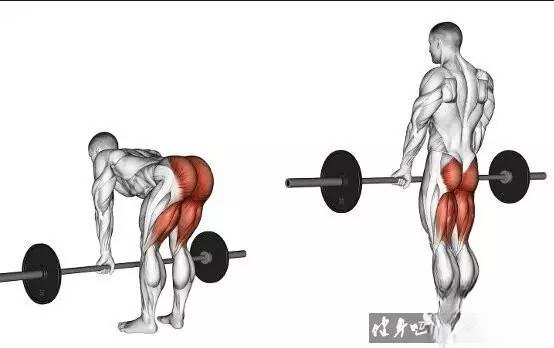
4. Deadlift
Even though the English name of this exercise sounds scary, it should still be part of a serious training regimen.
This exercise primarily works the erector spinae, quadratus lumborum, quadriceps femoris, gluteus maximus, trapezius, and forearm flexors ; the straight-leg deadlift and Romanian deadlift primarily work the hamstrings.
Correct approach:
Use a combination of overhand and underhand grips to prevent the barbell from slipping ;
Stand with your feet shoulder-width apart or slightly wider . If you adopt a very wide stance, it's called a sumo deadlift .
Stand tall and straighten your back ;
Maintain the normal physiological curvature of the spine and avoid slouching .
Tighten your abdominal muscles using 30% of their strength beforehand ;
Lift the barbell close to your body ;
At the peak of the movement, do not lean your upper body back excessively ;
If you lack grip strength, you can use a support belt.
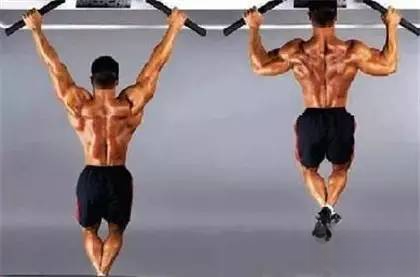
5. Pull-ups
This exercise primarily targets the latissimus dorsi, lower trapezius, biceps brachii, posterior deltoid, and forearm flexors, improving upward pulling strength and upper spinal stability.
The most popular method is the pull-up with a slightly wider than shoulder-width overhand grip. Other methods include a neutral grip, a wide underhand grip ( pre- or post-pre- ) , a narrow underhand grip, and a barbell grip, the differences being the degree of involvement of each muscle group. The lat pulldown machine is very similar to the pull-up, except that it uses lat pulldown weight plates instead of pulling up the torso.
Correct action:
You can grip it fully or loosely, but make sure your grip is strong enough to prevent your hand from slipping .
Stand tall and straighten your back ;
Tighten your abdominal muscles beforehand using 30%-40% of their strength ;
Pull your body up until your hands and collarbone are in the same horizontal line ;
Lower your body in a controlled manner until your elbows are extended to 170-175 degrees ;
Do not sway your body to gain momentum. If you cannot complete 3-4 standard repetitions, use pulleys or lever machines to do back pulls first . If you can easily do 15 correct repetitions, you can use straps to tie weight plates around your waist or hook dumbbells with your feet to increase the load.
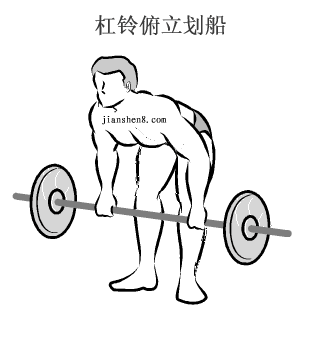
6. Bent-over rowing
This exercise trains almost all the muscles in the back, including the biceps, brachialis, brachioradialis, and forearm flexors. If there is no cushion in front of the chest, the quadratus lumborum, erector spinae, gluteus maximus, and quadriceps femoris need to maintain isometric contraction to stabilize the body.
There are many variations of this exercise: bent-over barbell row ( reverse grip /pronounce grip ) , dumbbell bent-over row, dumbbell prone row, T -bar row, T -bar chest row, pulley row, machine row, Smith machine row, barbell row with added weight on one end, etc.
Correct action:
Preserve the spine 's natural physiological curvature ;
Pull the barbell down to your lower abdomen or navel ;
When lowering the weight, straighten your elbows, but keep your back muscles engaged ( do not rely solely on your grip strength ) .
Stand tall with your chest out ;
Primarily move the arms, not the spine ;
Tighten your abdomen beforehand using 30-40% of your abdominal muscles .
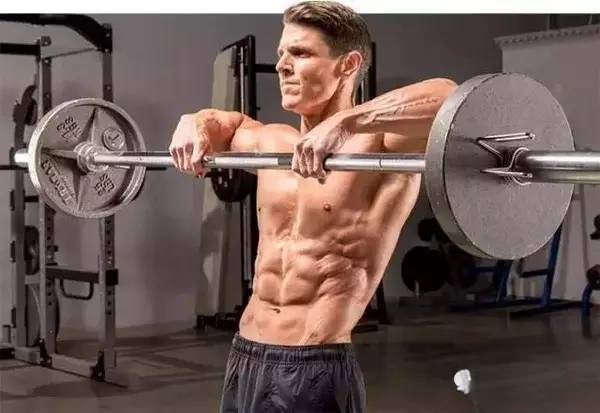
7. Upright rowing
This exercise primarily trains the deltoids ( anterior and medial ) , trapezius, and also engages the biceps and forearm flexors. To stabilize the upper body, the abdominal and spinal muscles need to maintain isometric contraction.
Common types of exercises include: barbell upright row, dumbbell upright row, cable upright row, and Smith machine upright row.
Correct action:
You can choose a narrow grip ( hands 10-20 cm apart ) or a grip shoulder-width apart ;
Slightly bend your knees and lean your upper body forward 5-10 degrees ;
Throughout the workout , keep the barbell close to your body, even close enough to touch your T- shirt ;
Pull the barbell up to your collarbone, raising your elbows as high as possible ;
Inhale as you pull upwards, and exhale as the weight lowers .
Do not relax or slump your shoulders when lowering the weight—keep your elbows extended to 170-175 degrees .
Tighten your abdomen in advance using 30%-40% of your abdominal muscles .
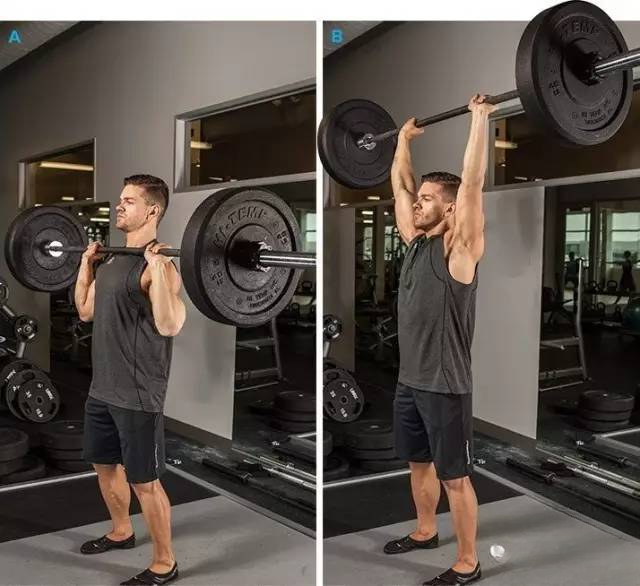
8. Shoulder Press
This exercise primarily trains the shoulders ( anterior and medial deltoids ) , upper chest, and trapezius muscles. During the standing exercise, the muscles of the glutes, abdomen, and spine need to contract isometrically to maintain upper body stability. The basic movement is the standing barbell front shoulder press.
Similar exercises include barbell behind-the-neck shoulder press, dumbbell shoulder press, Smith machine shoulder press, machine shoulder press, and Arnold press.
Correct approach:
Maintain the natural physiological curvature of the spine ;
Do not let your abdomen protrude forward ;
You can choose to grip it fully or with an open grip ;
Keep your wrist straight and your weight on your forearm ;
Let the weight decrease slowly .
Keep your elbows below the bar ;
Push the weight onto your head instead of the front of your body ;
Do not lock your elbow at the top of the movement ;
If you choose to train in a seated position, adjust the backrest angle to approximately 100 degrees instead of 90 degrees.
9. Bicep curl
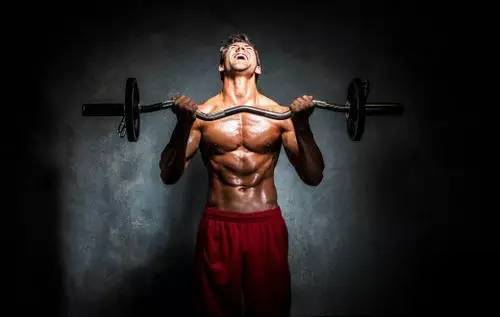
This movement involves the biceps brachii, coracobrachialis, brachioradialis, and forearm flexors. When standing, the muscles of the hips, abdomen, waist, and spine will contract isometrically.
In addition to the classic standing barbell curl ( straight or curved bar ) , there are also standing dumbbell curls, standing barbell reverse grip curls ( which work the brachioradialis muscles more ) , standing dumbbell hammer curls, standing barbell hammer curls, dumbbell cross curls, dumbbell hanging curls, incline curls, and machine curls.
Correct action:
Tighten your abdominal muscles beforehand using 30%-40% of their strength ;
Stand tall and straighten your back ;
Keep your elbows close to your sides ;
Slightly bend your knees and lean your upper body slightly forward ;
Lower the weight smoothly and in a controlled manner, without swaying your body back and forth.
10. Abdominal muscle training
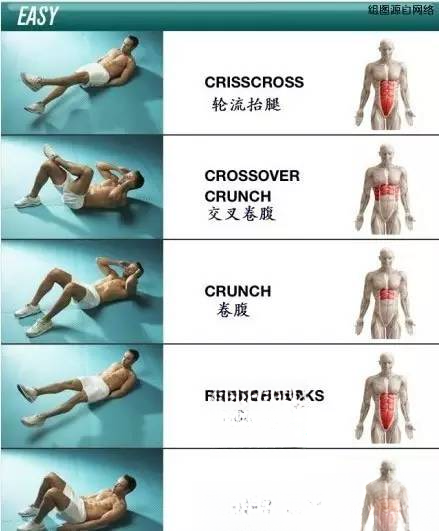
The main goals of abdominal training are to increase lower back stability during exercise, prevent lower back pain, and create the visual effect of six- pack abs. Abdominal training is not directly related to reducing belly fat.
Correct action:
The crunch exercise should shorten the distance between the sternum and pelvis; this shortening indicates that the abdominal muscles are contracting .
Keep your waist on the ground ;
Lift your chest ;
Keep the front part straight and avoid excessive bending.
Fitness beginners should learn the above 10 exercises well . They can basically work all the muscles in your body. As long as you exercise step by step for a year or two, you will definitely achieve the body shape you want.